Same-sex couples will be allowed to marry in Iowa by month’s end, after a ruling on Friday by the Iowa Supreme Court that found unconstitutional a state law limiting marriage to a man and a woman.
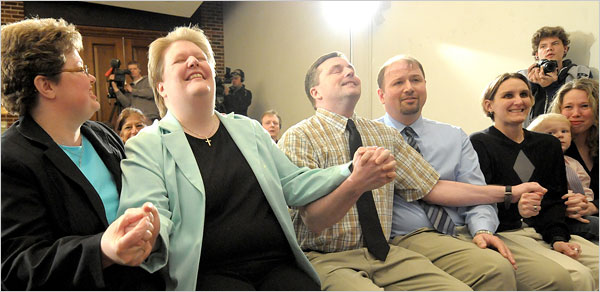 |
| In Des Moines, plaintiffs in the lawsuit that challenged the ban on same-sex marriage reacted Friday after hearing the Iowa Supreme Court’s ruling. Steve Pope/AP |
The unanimous decision moved the heated battle over same-sex marriage beyond the East and West Coasts to the nation’s middle. Only Massachusetts and Connecticut now allow same-sex marriages, while California permitted them for about six months before voters approved a ban in November.
“We are firmly convinced the exclusion of gay and lesbian people from the institution of civil marriage does not substantially further any important governmental objective,” Justice Mark S. Cady wrote for the seven-member court, adding later, “We have a constitutional duty to ensure equal protection of the law.”
Opponents of same-sex marriage pledged to fight the outcome, but acknowledged that there appeared to be no immediate way to undo it. The only avenue would be a constitutional amendment, but under Iowa law that process would take at least two years.
Members of the Iowa Family Policy Center, a group opposed to same-sex marriage, spoke with state lawmakers after the ruling in hopes of jump-starting the amendment process.
“A court decision doesn’t change what’s right and what’s wrong,” said Bryan English, a spokesman for the group.
But there was no indication that the Legislature, controlled by Democrats, would take up the matter.
Meanwhile, the ruling set off celebrations among same-sex couples, many of whom had gathered at a hotel here to await word. They wept, embraced, laughed, and wept some more.
“I think there’s been a perception that it couldn’t happen here,” David Twombley, 67, said, moments after he learned that he and his partner could marry. The couple was among six Iowa couples to start the legal fight four years ago that culminated in Friday’s decision.
“But yes, it happened, right here in Iowa,” Mr. Twombley said. “There’s something about that, about it happening in the heartland, that has got to accelerate this process for the whole country.”
Same-sex marriages could take place in counties here starting in three weeks, when the ruling becomes final, lawyers said. There is no requirement that people seeking marriage licenses prove they live in Iowa, so the doors will be open to same-sex couples from other states.
“Go get married!” Dennis W. Johnson, a lawyer from Des Moines who had helped represent the gay and lesbian couples in the case, told the gathering at the hotel. “Live happily ever after,” Mr. Johnson called out, adding, “Live the American dream.”
Opponents of the decision said they believed it would awaken enormous backlash here and throughout the Midwest once people understood what had happened.
Along the streets of this city in the hours after the ruling, people expressed mixed views of the matter, though nearly all said they were surprised — happily so, in some cases, but less so for others — at what the court had concluded.
On at least one talk-radio show, residents were enraged.
“I’m almost ready to up and leave Iowa and move back to Minnesota,” one woman said angrily.
Within hours of the decision, the representatives of the Iowa Family Policy Center left the Supreme Court building here, and sought out state lawmakers in the State Capitol building just down the street.
Unlike some states that have barred the marriages with voter-led ballot measures, voters here cannot directly initiate constitutional amendments. Instead, an amendment would require approval by state lawmakers during two legislative sessions, and then approval by voters at the ballot box. That means the earliest a prospective ban could take effect would be 2012.
Opponents of same-sex marriages want state lawmakers, who are a few weeks from finishing their annual legislative session, to begin the process now. But the idea seemed to have no backing among legislative leaders; both chambers here are controlled by Democrats.
“We’re just going to say no to amending our Constitution and putting discrimination into our Constitution,” said Michael E. Gronstal, a Democrat and State Senate majority leader, who noted that such an amendment had failed in the Senate several years ago, even before the suit that led to Friday’s ruling, and would, he said, most likely fail again.
Gov. Chet Culver, also a Democrat, was more muted in his response to the ruling.
“The next responsible step is to thoroughly review this decision, which I am doing with my legal counsel and the attorney general, before reacting to what it means for Iowa,” Mr. Culver said in a written statement.
Whether or not state lawmakers take up the constitutional amendment in the coming weeks, the ruling ensures the state will become a battleground over same-sex marriage.
National advocacy groups, which have been focused on a case before the California Supreme Court that seeks to overturn the ban in that state, and on Vermont, where a bill legalizing same-sex marriage is pending, have already turned their eyes to Des Moines.
“The gay marriage movement has once again used the power of the courts to push an untruth on unwilling Iowans,” said Brian S. Brown, the executive director of the National Organization for Marriage, a group formed in 2007 to preserve traditional marriage. “Same-sex unions are not marriages, and Iowans should not be forced by law to treat them as such.”
Leaders of Lambda Legal, which is based in New York and led — along with state and local lawyers here — the legal case before the Supreme Court, said Iowans had a long history of openmindedness, or as State Senator Matt McCoy, a Democrat who is openly gay, described it, “a live and let live attitude.”
Camilla Taylor, a senior staff lawyer for Lambda, said the Supreme Court ruling in a way was merely “vindicating quintessential Iowa values,” namely, a commitment to families. That this battle was being waged in Iowa, Ms. Taylor said, would have a “transformative effect” not just on the Midwest, but elsewhere.
“The fact that it’s here in some way highlights the inevitability of this all,” she said.
The legal case here began in 2005, when the six same-sex couples filed suit against the county recorder here in Polk County because he would not accept their marriage license applications.
Two years later, a local judge, Robert B. Hanson, ruled in that case that a 1998 state law defining marriage as only between a man and woman was unconstitutional. The ruling, in 2007, set off a flurry of same-sex couples from all over the state, racing for the courthouse in Polk County.
The rush lasted less than a day in August 2007. Although Judge Hanson had ruled against the state law, he quickly decided to delay any additional granting of licenses, saying that the Iowa Supreme Court should have an opportunity to weigh in first.
“If gay and lesbian people must submit to different treatment without an exceedingly persuasive justification, they are deprived of the benefits of the principle of equal protection upon which the rule of law is founded,” the Supreme Court said in agreeing that the 1998 law was unconstitutional.
Text of Ruling
Liz Robbins contributed reporting from New York.
New York Times





 Print This
  Print This