U.S.: Vermont recognizes equal marriage rights
 Print This Print This
By Amanda Calder
Socialist Worker
Friday, Apr 10, 2009
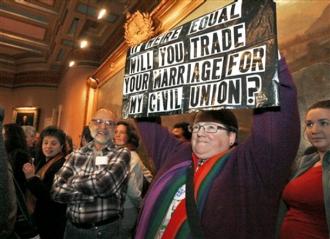 |
| People standing up for gay and lesbian rights in Vermont. |
After weeks of mobilizing supporters putting intense pressure on state politicians, equal-marriage activists celebrated in Vermont on April 7, after legislators overrode Republican Gov. Jim Douglas' veto of a bill legalizing same-sex marriage. This makes Vermont the fourth state to recognize same-sex marriage.
Mark Leach, a member of the University of Vermont's Universal Marriage Equality (UnME), expressed his pride Tuesday night. "We're the first state legislature saying civil unions aren't enough," he said. "It opens the way for other states."
House members voted 100-49--one vote more than they needed to override the governor's veto--after the state Senate's resounding 23-5 vote earlier in the day.
The importance of this legislative victory was underscored by UnME member Alex Zuckuss. "It's amazing that it was won legislatively rather than through a judicial review," Zuckuss said. "Legislation involves getting the support of a lot more people, so this is even more significant than a court case."
Civil unions have been legal in Vermont for nine years, but over and over again in letters to the editor, in speeches at rallies, and in testimony at the Statehouse, proponents of gay marriage articulated the many ways in which "separate is not equal."
As Rep. David Zuckerman, a member of the Progressive Party and sponsor of the bill, put it, "As states around the country are looking to create 'equality,' some looked to civil unions as the 'safe' out. By moving from civil unions to marriage, we show that separate is not quite equal."
Massive public pressure was mobilized to pass this legislation: thousands came out for public hearings at the Statehouse and rallies around the state; thousands of calls, e-mails, and letters were sent to legislators; and hundreds of volunteers canvassed and phone-banked in the weeks leading up to the vote.
Opposition to the bill was much weaker than during the civil union debate in 2000, which was historic at the time since no other states had legalized same-sex unions. Since then, public opinion has shifted decidedly in favor of marriage equality. In January, 58 percent of Vermonters said they supported or leaned in favor of gay marriage, and only 39% opposed or leaned against it, according to a poll by the independent polling agency Macro International, Inc.
The opposition this time around was much reduced in numbers and intensity. Their largest showing was a rally of just 200 people.
One of the strengths of the Vermont fight for gay marriage was the way it put a human face to the issue and framed it as one of civil rights. Vermont Freedom to Marry regularly featured same-sex couples in their messaging and TV ads, showing gay couples talking about their relationships and lives together.
In a recent interview on Democracy Now!, Beth Robinson, the board chair of Vermont Freedom to Marry, explained the significance of this victory in light of Proposition 8 in California:
"[It] was a real wake-up call to us here in Vermont...to see for the first time, certainly in my lifetime, civil rights moving backwards, people having rights and losing them. And I think it really shook us out of the temptation to complacency and, I think, led to a greater sense of urgency to our work here in Vermont, because we felt, and I still feel, that the path to undoing Prop 8 really ran right through Vermont.
And we're hopeful that in addition to providing equal rights for gay, lesbian, bisexual and transgender Vermonters right here at home, we're hopeful that we've done our part to try to shift the tide back in the right direction on a national basis."
The celebratory feel and sense of forward momentum was expressed by UnME activist Hannah Doherty. "This is a really huge step, overcoming this, when 100 years ago people could be imprisoned for their sexuality. I hope that, in 100 years, we've gone this much farther," she said.
"I hope we move forward to address issues like workplace discrimination, transgender rights, DOMA [Defense of Marriage Act, the federal legislation banning gay marriage] and all other oppressions."
Socialist Worker
 Print This Print This

|