By Karla Jacobs. Axis of Logic
April 17th 2009
On April 5th (Palm Sunday) Nicaragua's centrist corporate daily, El Nuevo Diario, published what has since become an infamous and highly controversial interview with Abelardo Mata, Bishop of Estelí and Vice President of the Nicaraguan Catholic Bishops Conference. The front-page headline read "Mata fears civil war." The contents of the interview are based on the Bishop's inflammatory claim that there are armed groups in the mountains of the northern departments of Nueva Segovia and Madriz who are preparing themselves to engage in armed violence against the government in response to what he describes as President Daniel Ortega's authoritarian actions.
|
|
| Abelardo Mata, Bishop of Estelí and VP of Nicaraguan Catholic Bishops Conference |
" We are certain of the existence of armed groups in San Juan de Río Coco," said Mata, "it is sad that in order to defend our rights we have to look to arms. ... What triggered these groups to take to arms was the [supposedly fraudulent] Municipal Elections, that is what people say in the countryside. Now we have to wait for the campesinos to start shooting each other, they are always the first ones to give their blood, and then the Army will start shooting people in an attempt to solve the problem. ... It hurts me to see this coming."
In El Nuevo Diario's April 6th edition these claims were backed up by Archbishop of Managua and President of the Nicaraguan Bishops Conference, Monsignor Leopoldo Brenes, who went on to allege that the Church has knowledge of the existence of anti government armed groups in the mountains of two other northern departments (Matagalpa and Jinotega).
Despite the fact that the Catholic Church hierarchy's claims have been categorically denied by both First Commissioner of the National Police, Aminta Granera, and Head of the Nicaraguan Army, Omar Halleslevens, the corporate media outlets, which are passionately opposed to the FSLN government, have made it their business to pimp the "story" and surrounding controversy for all it is worth. Something which has not proved difficult given the course of events that followed.
|
|
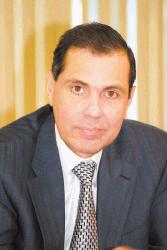
| Hernán Estrada, Attorney General |
At around 7.45 am on April 6th (Holy Monday) two armed individuals riding a motorbike attacked the Attorney General of the Republic, Hernan Estrada, while he was out on his routine morning run near his home in Managua as part of an apparent assassination attempt. According to statements given by Estrada at a press conference later the same day one of the individuals took four shots at him "all aimed at my head," of which only one penetrated his body causing a flesh wound in his neck. As a result of the impact Estrada fell to the ground bleeding, at which point "the criminals assumed they had achieved their objective" and drove off. The police are carrying out a criminal investigation into the incident of which few details have yet been made public.
At the same press conference, during which Estrada was visibly shaken up, he said the attack was the result of the "calls made by certain religious leaders and media outlets who are apologists of violence. They have been encouraging people to carry out criminal acts such as this one."
Immediately Estrada's comments were taken up and interpreted by the opposition media as a direct accusation against the Catholic Church hierarchy of involvement in the planning of the assassination attempt. Journalists rushed to request statements from Bishops Brenes and Mata in response to Estrada's "accusation." Among the headlines derived from this second round of interviews were; "the Church is the first to want peace," (the same phrase famously used by Pope John Paul II on his visit to Nicaragua in 1983); and, the Attorney General is "rude and irrational" ... "but [his] comments do not worry us because, thank god, the population knows who [to believe]."
During an appearance on Channel 4's morning TV show "Live with Alberto Mora" on April 15th Roberto Larios, President of the Nicaraguan Union of Journalists, described the corporate media's treatment of the series of events as a farrago: "They take a rumour about a non existence issue and, baselessly, project it in the media [in order to] generate a distorted opinion surrounding the supposed course of events." According to Larios in doing so the corporate media are "rehearsing an old technique they used in the 1980s as part of their campaign against the Popular Sandinista Revolution."
The continuation of the media's manipulation of this particular series of events was greatly facilitated on April 9th when a civil society group called Movement for Nicaragua (founded and funded by the US Embassy and USAID) issued a statement condemning Estrada's comments about the Bishops. These comments, reads the statement, "aim to keep the Bishops quiet, when [the Bishops] are the very ones who transmit the sentiments of the population."
The statement then goes on to imply that the assassination attempt against Attorney General Estrada was actually a set up devised by Estrada and his government colleagues as part of a plan to justify future "arbitrary actions." Ortega and his colleagues "are experts in the production of counter propaganda," reads the statement, "in the past they have invented martyrs, assaults and physical attacks in an attempt to counteract adverse situations and justify whatever arbitrary actions they decide to take. So [the attack on Estrada] would be no exception."
As can be expected this insinuation was taken up and embellished by different anti FSLN commentators and political figures permitting a situation whereby both daily newspapers along with other anti FSLN media outlets felt able to come to the conclusion earlier this week that, not only is the presence of politically motivated armed groups in the northern mountains of the country almost certainly a reality (despite such a notion being denied by the highest representatives of the public security forces), it is practically beyond reasonable doubt to assume that the Attorney General shot himself in the neck in an attempt to justify future arbitrary government actions of an unknown but sinister nature.
This onslaught of misinformation makes it hard for one to focus on the implications both the Mata interview and the Estrada assassination attempt have for the country in terms of the strategies being put into practise as part of the ongoing destabilization campaign. There is a sense in which one is obliged to acknowledge and attempt to counteract the slanderous claims made by representatives of the forces working to undermine the government. More often than not one's intellectual energy is exhausted in the process. An analysis of the implications of the Holy Week events in Nicaragua is necessary, however, in order to permit rational anticipation of future opposition strategies.
As independent Italian journalist Giorgio Trucchi states in a short article about the two incidents, the Bishops' claims of the presence of politically motivated armed groups should be understood as forming part "of a destabilization plan orchestrated by an opposition that until now, has not shown itself capable of presenting an alternative political or economic plan (let alone a national plan) to the one the Ortega government has been implementing for the last two years."
In Nicaragua, as in other Latin American countries like Venezuela and Ecuador, when the political opposition fails to undermine the government via conventional political processes (debate and campaigning for example), the corporate media, a number of influential "civil society" organizations, the Catholic Church and underground grupos de choque step in to do the job for them via dishonest and often illegal processes (misinformation, provocation and violence).
|
|
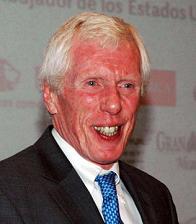
| Robert Callahan, US Ambassador to Nicaragua and former spokesman for John Negroponte |
It is not possible to define to what extent the details like timing of and reactions to provocative events as part of this campaign is coordinated between the different participants. It would be naïve, though, not to suspect US ambassador Robert Callahan's involvement in whatever coordination does take place. [Callahan worked for many years as John Negroponte's sidekick; as a spokesman for Ambassador Negroponte in Tegucigalpa (from where the Contra War was coordinated) and more recently in Baghdad.]
Since Callahan began his diplomatic mission in Nicaragua in 2007 the general tone of the opposition forces' anti government rhetoric has risen to unacceptably provocative levels. Meanwhile a number of atypical violent political attacks have taken place the most disturbing of which was the attack on Radio Ya (pro FSLN) journalist Nicolás Berríos Santana. Berríos was attacked by a group of around eight people travelling in two pick up trucks. Berríos received multiple stab wounds before his attackers set fire to his vehicle and attempted to through him inside it. His attackers were forced to flee, however, due to the passing of another vehicle.
Understood within this context the attack on Attorney General Estrada is the logical continuation of a worrying trend of politically motivated violent attacks against individuals. Director of Radio La Primerisima, an independent left wing radio station, William Grigsby considers the attempted assassination a "very grave case. ... It is the first attack [against a government representative] in Nicaragua for many years."
As for the inflammatory statements made by Bishops Mata and Brenes, Grigsby condemns what he believes to be a call for violence but is not of the opinion that the premonitions the Bishops appear to be making are relevant to the current socio political situation in Nicaragua. "These diatribes being lanced from the pulpit provoke a tense environment in the country that has no reason to exist. It would appear the Bishops are keen for things to heat up, even for armed violence to take place. ... Of course it is dangerous to propitiate violence, but [armed conflict] is not what the people want, nor would the political situation allow ... for such a thing to take place."
|
|
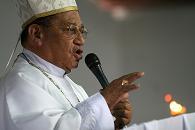
| Cardinal Miguel Obando y Bravo openly supports the Ortega Administration while the bishops oppose the government. |
Almost as a afterthought it would seem relevant to the context of recent events to mention the ongoing split in the Catholic Church hierarchy. While former Cardinal Miguel Obando y Bravo (one of the most fervent critics of the first FSLN government) openly supports the Ortega Administration and even presides the government Commission of Reconciliation, Verification, Peace and Justice, the most influential members of the Nicaraguan Bishops Conference, as demonstrated in this article, are fiercely opposed to the FSLN.
It may well be the case that this apparent ideological division of the hierarchs is representative of the dilemma in which the Nicaraguan Church finds itself faced with steadily diminishing congregations and the ongoing rise of different evangelical churches and other more populist forms of religion.
It would not be unreasonable to assume that there are a number of wealthy conservative parishioners (whose generous donations help fund the different dioceses' activities and the comfortable lifestyles of church representatives) putting pressure on the Bishops Conference to use their influence to undermine the government. Perhaps Bishops Mata and Brenes' anti government stance is partly motivated by the need to protect the various short term interests at stake. It is worth mentioning at this point that among the list of recipients of USAID funding in Nicaragua features the Nicaraguan Association for Human Rights (ANPDH), an organization presided by Bishop Mata.
Cardinal Obando y Bravo's strategy may be the product of a longer term vision based on the concern of whether or not the Catholic Church in Nicaragua will survive at all in its current form. Catholicism's decline in Nicaragua was undeniably hastened along during the previous neo liberal governments as a result of the plummeting living standards and cultural denaturalization provoked by those governments' economic and social policies. Perhaps Obando's break with the Nicaraguan right is part of an attempt to slow that ongoing decline.
Karla writes for www.tortillaconsal.com
Karla Jacobs first visited Nicaragua in 2001. Her work with a local women's group in a severely impoverished barrio of Managua changed her life and inspired two further visits prior to moving to Nicaragua in 2003. Karla has since collaborated as a teacher, education promoter, project administrator, translator and writer with diverse Nicaraguan and international grass roots organizations. Currently she lives and works in a rural community in northern Nicaragua with her family.





 Print This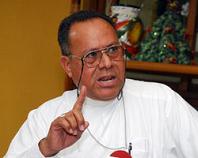
 Print This