As the world follows the escapades of the country's pirates, civilians are fleeing the anarchy on land, creating the world's biggest refugee camp.
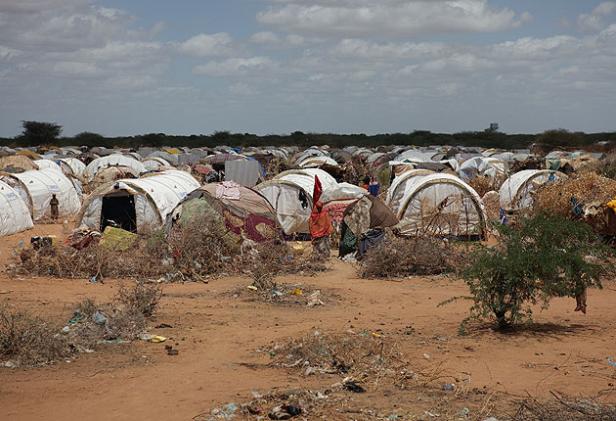
The lucky ones come with their families, others appear out of the thorn bushes, walking alone. Five hundred Somalis are now arriving at this bleak Kenyan outpost every day. They join a population of 267,000 and counting, in a facility built to shelter just 45,000. While the world has been captivated by the high seas drama of Somalia's pirates, this human tide has swollen the ranks of Dadaab, turning it into the world's largest refugee camp.
 |
The new arrivals sit in their hundreds under a makeshift tarpaulin, trying to keep perfectly still in temperatures that reach 40C in the shade. It speaks volumes for the horrors unfolding in Somalia that people will abandon their homes, risk arbitrary arrest, death or starvation to reach the desolate welcome on offer in this corner of northern Kenya.
These people are proof of the human cost of the accelerating collapse of Somalia, yet their fate attracts nothing like the global interest that surrounds Somali piracy and its threat to commerce. The UN refugee agency (UNHCR) that runs Dadaab urgently needs new money from international donors and new land from the Kenyan government. Neither has been forthcoming. The annual budget for this camp is $19m (£13m) – roughly half the annual operational cost of a single warship patrolling the Indian Ocean in search of modern-day Blackbeards.
The story of Dadaab is in some senses the story of modern Somalia. Its three camps, Hagadera, Ifo and Dagahaley, were built to house those who fled when the last functioning central government – that of socialist dictator Siad Barre – collapsed in 1991. The camps soon reached their initial capacity and as the mother country just 50 miles to the north has sunk deeper and deeper, so the number of refugees has risen and risen. An entire generation of children has grown up knowing Dadaab as their only home. There have been 14 failed governments since then, Somalia is in a state of anarchy and Dadaab is facing an extraordinary influx. Last August the land ran out and the UN had to declare the camps full. It has not stopped the desperate masses arriving.
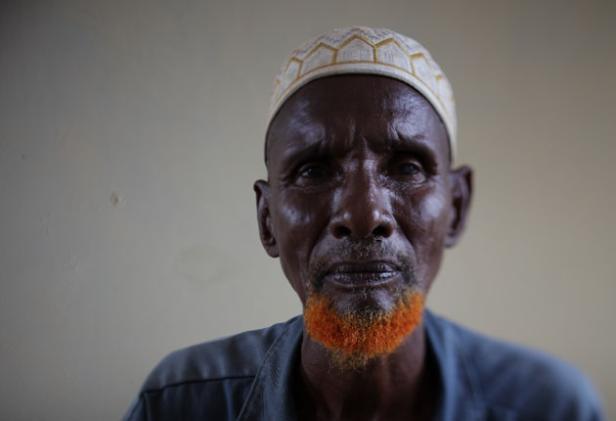
Somalia is a country surrounded by political walls. Its land borders with Ethiopia and Kenya have been closed to protect their countries from the Islamic militias on the other side. In reality the only effect of the closures has been to make it even harder for people like Osman Hussein Bare to flee. With his family seated in a tired circle around him, the middle-aged man stands to tell his story with some dignity. "There is war in Somalia," he explains. "A lot of bullets; day and night they are fighting in the place."
 |
A farmer from a village close to the coastal city of Kismayo, Mr Bare found his life taken over by the emergence of the powerful Al-Shabaab militia. The breaking point, which sent him trekking for two nights across a sealed border to another country, came when the militants began to dig up the remains of religious leaders from Islamic sects they considered their rivals. "The way they rule I cannot live under them," he said.
Amina, 22, was not one of the lucky ones. She was separated from her family and has arrived alone from Kismayo. During her fortnight's journey to reach Dadaab she was badly beaten twice, once by militiamen and once by Ethiopian soldiers. She says: "I'm a woman, I'm vulnerable and there's no government to protect me."
By midday at the UNHCR's registration office at Dagahaley camp, a state of organised chaos prevails. Lines of worn and exhausted people queue in all directions; young children howl as they are given basic vaccinations. The prize on offer is a ration card. Outside the high fence faces and fingers push against the wire, some desperate, some curious. "Some people will have to come back tomorrow," Andy Needham from UNHCR explains. Registration means access to basic food and a rudimentary kit to build a shelter. There is no more land to give so people must find relatives or friends already inside the swollen camps to accommodate them.
After a week in which the first attempted hijack of a US ship off the coast of Somalia propelled the troubled nation to the top of the news agenda, it is the image of a shoeless young Somali, armed with a rocket launcher and shielded by a foreign hostage, that has remained with much of the world. In fact, the hundreds of thousands of Somalis in Dadaab are as much victims of those pirate gangs as the foreign sailors captured in the Gulf of Aden. Food supplies to the camps were delayed by this week's surge of hijackings and the refugees' rations have been cut by one third. A recent report on Dadaab by Oxfam described conditions as "conducive to a public health emergency".
The outlines of that are clearest at the N-0 encampment which lies on the fringe of the Ifo facility. It is known to regular visitors as the "end of the world". There are no buildings here, just white UNHCR tents and balloon-shaped shelters that refugees have built from sticks and bits of plastic. Everything has been blasted by red dust and nothing grows here but the ragged, thorned acacia trees. The shelters are packed so tightly together there is barely room to walk between them. A fire here would have no natural barriers and the consequences would be devastating. Yet each night hundreds of families cook on open hearths, there is no other choice.
 |
This is just one of the nightmares that is haunting David Kangethe, a programme manager for Care International, the agency struggling to deliver basic services like water, sanitation and rubbish collection.
"Refugees are building everywhere. This place is a matchbox, if you lit it up it would just burn," Mr Kangethe sighs. There are chronic water shortages, sanitation facilities are overwhelmed and diseases like cholera are rife. The need for new land is acute but so far the Kenyan government has dragged its feet, citing complaints from the local community that they are being overwhelmed by the number of refugees. Some 70,000 people live in the surrounding area, mainly animal herders who fear the loss of grazing land and scrub forest.
What is needed, according to aid workers, are three to four new camps but negotiations with Nairobi have remained deadlocked. UNHCR has looked at what it would cost to give people the basic minimum living standard. The answer is $92m and an urgent appeal has been issued. The response has been a near-deafening silence. The UK offered £2m in new money last week. Similar small pledges are trickling in but observers believe donors are waiting for a major crisis to break out before taking real action. That may happen very soon.
"If the numbers continue to increase we're headed for a crisis," says Mr Kangethe of Care. In the meantime anti-piracy efforts will continue to dominate thinking in regard to the Somalia situation. Gerry Simpson from the New York-based Human Rights Watch says the equation is simple: "When commercial interests are at stake there's money. When it's women and children there is not."
Survivors' stories
Ahmad Abdullahi Hussein
I was part of a militia that was fighting against al-Shabaab. We had to fight them. At night I was attacked in my home. I managed to go from the window. Later I found my wife was killed and only my two children Anisa and Abdulmalik were alive. The others were dead. I couldn't do anything. No-one can do anything against them.
I brought my children here to find my mother. She is in Hagadera camp, I want to be reunited with her. The children have no mother, they need mine.
Habib Waleda
In Mogadishu bombs were coming down from the sky and hitting houses. When the mortar hit my house we all just ran away. We were separated. I had nine children. Now I don't know where my husband is or where eight of my children are. I looked for them in Mogadishu but they don't have a telephone. It's impossible to find them. I found a taxi and I offered to give him the small money I had. I gave him $150 and I told him I didn't have any more money. He brought me near to the border. I don't know where they are. All I have is to hope they are coming.
Mohamed Ali
I am 70 years old. I fled from a town called Barra. I have lost my wife and my two children. I think they have gone to Bosasso, but I have not seen them for a year. I had to walk for 15 days through the desert. It was hard for me to walk because I am blind.
I had to stop and ask people for a little food along the way. Even if I go out and walk on the streets now a member of my family could walk by me and I would not see them. I have to hope that they will see me.
The Independent
Photos by Andreas Lascaris, taken from forthcoming documentary 'Stolen Seas: The untold story of Somali pirates'. More info at Thymayapayne.com





 Print This
  Print This