|

|
Cross-border diamond deals sidestep Kimberley Process
 Print This Print This
By News Bulletin
IRIN Africa
Tuesday, Jun 30, 2009
Signatories to the Kimberley Process Certification Scheme (KPCS) - an international initiative to stem the flow of conflict diamonds - restated their commitment to the scheme at the close of a three-day meeting in Namibia on 26 June, but campaigners warned that more action, not talk, was needed now.
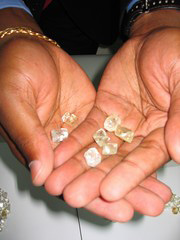 |
| In many African countries the illicit diamond trade has been used to finance wars. IRIN |
|
"There were some useful discussions ... [but] it is not possible to be more positive unless governments take concrete action," said Amy Barry, spokesperson for Global Witness (GW), a UK-based NGO that seeks to prevent the use of natural resources to fuel conflict, and a prime mover in setting up the KPCS.
The cooperative effort by government, industry and civil society imposes extensive requirements on its members before allowing them to certify shipments of rough diamonds as "conflict-free".
But discontent in civil society organizations has grown steadily since the scheme was launched in January 2003, that not enough was being done to stampout the illicit stones, also called 'blood diamonds'.
"In theory there are structures in place; it is now a question of political will in implementing them," commented Elly Harrowell, assistant campaigner at GW.
Loopholes
A statement by a coalition of civil society organizations, including GW, Partnership Africa Canada, and Green Advocates, called on governments to "translate the positive discussions ... into strong commitments and concrete actions to close the loopholes that continue to compromise the effectiveness of the Kimberley Process."
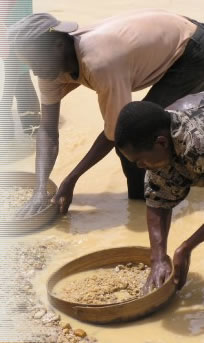 |
| Global Witness |
|
In particular, they emphasized the need for KPCS signatory governments and working groups to investigate statistical anomalies and illicit cross-border trade between participants more promptly.
"We urge participant governments to strengthen internal controls and improve monitoring systems in producing countries, but also in trading and cutting and polishing centres," said Susanne Emond of Partnership Africa Canada.
According to GW's Harrowell, information on the flow of stones into and out of major cutting and polishing centres, like Surat in India and Antwerp in Belgium, was still very limited, creating a possible entry point for conflict diamonds into the legitimate multimillion-dollar market. "Once just one side of a diamond is polished it is no longer covered by the KPCS," she pointed out.
First test
A significant concern ahead of the meeting was the need for KPCS participant governments "to address cases of serious non-compliance by some members; in particular, campaigners sounded the alarm about the human rights abuses, militarization of mining and diamond smuggling taking place in Zimbabwe's diamond sector."
Human Rights Watch, an international watchdog, published a report on 26 June that claimed massive human rights violations were taking place in Zimbabwe's Marange diamond fields.
The report documented how the police and army used force "to control access to the diamond fields, and to take over unlicensed diamond mining and trading". President Robert Mugabe's ZANU-PF party was accused of profiting from the alleged abuses. A KPCS team is visiting the country to probe the alleged illegal diamond trade.
GW's Annie Dunnebacke said, "We sincerely hope that the upcoming Kimberley Process review mission to Zimbabwe is given unfettered access to the sites and people it needs to see. We urge the government ... to fulfil its pledge to guarantee the safety of all individuals and groups."
IRIN News
For more information, please visit Global Witness.
About The Kimberly Process
The
Kimberley Process (KP) is a joint governments, industry and civil
society initiative to stem the flow of conflict diamonds – rough
diamonds used by rebel movements to finance wars against legitimate
governments. The trade in these illicit stones has fuelled decades of
devastating conflicts in countries such as Angola, Cote d'Ivoire, the
Democratic Republic of the Congo and Sierra Leone.
The Kimberley
Process Certification Scheme (KPCS) imposes extensive requirements on
its members to enable them to certify shipments of rough diamonds as
‘conflict-free’. As of November 2008, the KP has 49 members,
representing 75 countries, with the European Community and its Member
States counting as an individual participant.
Read more... |
 Print This Print This
|
If you appreciated this article, please consider making a donation to Axis of Logic.
We do not use commercial advertising or corporate funding. We depend solely upon you,
the reader, to continue providing quality news and opinion on world affairs. Donate here
|
|
World News

|