“We're
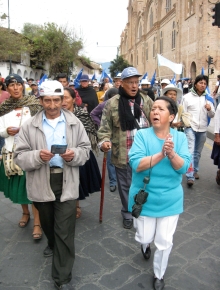
crazy for water,” chanted about a thousand campesinos as they marched
through the streets of downtown Cuenca in southern Ecuador on Monday.
The march, called for by the Confederation of Indigenous Nationalities of Ecuador (CONAIE), was part
of a nation-wide mobilization against a new water law. It included
intermittent road blockades throughout the highlands over the course of
the day that by all acounts were peaceful.
The
protests took place amidst a heavy onslaught of insults and efforts to
delegitimize their concerns, largely by President Rafael Correa. Correa
told EFE news service that the popular movements are being used by the
right to destabilize his government. He also interrupted national
television programming over the weekend to urge Ecuadorians “not to let
themselves be deceived by the same old manipulators...who benefit from
chaos.”
However,
despite Correa's insistence that he would not be forced to dialogue, by
day's end the CONAIE had suspended protests to enter into talks with
him. Campesino organizations in Cuenca also agreed to dialogue, while
the Amazonian branch of the CONAIE reported that it remains mobilized,
asking for its own talks with the government in order to address issues
specific to the region.
The
protests come exactly one year since Ecuador's 2008 political
constitution was passed, which recognizes the right to water, rights
for nature and which declared the country a plurinational state.
However, indigenous and campesino organizations involved in the
protests criticize the government for having digressed from the highly
lauded constitution. The constitution passed in a national referendum
on September 28, 2008 with 64 percent of the vote.
Criticisms
concerning the new water law, which was initially scheduled for first
debate in the National Assembly last Saturday, apply to the
privatization of water, limits on community participation in water
management, prioritization of water access for industrial users and
lack of sanctions for water contamination, and more. In anticipation of
this week's protests, the debate was postponed for several weeks.
In
Cuenca, representatives of rural water systems from across the
south-central province focused on aspects of the water bill pertaining
to water use for mining projects that are deemed a national priority.
Some of the most advanced metal mining projects in the country are
being developed within the páramo outlying the city. Páramo are fragile
high altitude wetlands, or essentially a deep sponge composed of soil
and vegetation that regulates the water supply for the city and rural
populations involved in dairy farming and other agricultural activities.
Campesino
groups, led by Rural Water Systems President Carlos Pérez, proposed
that mining should be prohibited in the páramo, which should also be
off limits to other intensive activities such as farming and motorized
sports. Communities within the vicinity of Cuenca have for years been
opposing large scale gold mining projects belonging to
Canadian-financed companies such as Iamgold and International Minerals
Corporation.
These
groups were also concerned about reduced participation for rural water
boards in water management under the draft law, which Pérez says, “are
organizations that have been created at the community level over many
years of hard work,” questioning the state's interest to now step in
and overtake control.
Pérez
is hopeful that they will have time now before the water law is debated
for a national dialogue. However, he says, such dialogue will only be
meaningful “if there is a serious commitment on the part of Assembly
Members and the President, given our current lack of confidence in this
government.” Pérez's organization previously got involved in talks over
a new mining law passed in January, which did not substantially
incorporate their proposals. They hope the mining law will be declared
unconstitutional by Ecuador's Constitutional Court based upon an appeal
they filed earlier this year.
Before
yesterday the potential for dialogue did not seem promising. President
Correa had repeatedly insulted indigenous organizations and their
leaders, insisting that they “are lying” when they say the water law
allows for privatization. He has cited both Article 3 of the law and
the constitution which oppose commodification of the precious resource.
He also accused leaders of the CONAIE and the highland indigenous
organization ECUARUNARI of being part of a privileged class. Both
groups rejected his insults and cite them as part of their rationale
for Monday's protests.
Assembly
Member Lourdes Tibán from the indigenous Pachakutik movement also wrote
an open letter to Correa on Monday, saying, “Enough of your insults Mr.
President.” She criticized him for using the term “golden ponchos”
against indigenous movement leaders, which she says was coined by the
right-wing oligarchy more than 10 years ago, around the time that the
indigenous movement was growing in political influence and participated
in the overthrow of two governments.
She
further observed that Correa has not made such accusations against
indigenous members who are supportive of his political movement,
despite personal achievements that have brought them a long way out of
poverty and marginalization, including past employment with the
Interamerican Development Bank in one case. The difference, she says,
is political:
“You
are
very mistaken to think that the indigenous person who is servile is
good, while the indigenous person who is critical of your government is
part of the elite and a golden poncho," said Tibán. "If this is what
you think, it is a very poor definition and an unacceptable
perspective.”
She
also did not hesitate to recall a recent scandal over President
Correa's brother who was revealed to have obtained tens of millions of
dollars in public contracts over the last couple of years, and says his
insults deserve to be tried in court.
Finally,
Pérez publicly denied that his organization has any interest “in
causing upheaval in the country” or in “overthrowing any government.”
However, he indicated that they are serious about their demands and
calls Monday's march “just a warm up” for further actions which could
escalate depending on how talks progress.
“If
[the President] continues with his high-handed attitude and insults,”
he concludes, “we know that he who sows wind, reaps tempests.”
Upside Down World





 Print This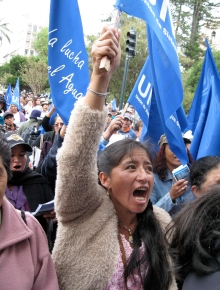
 Print This