 |
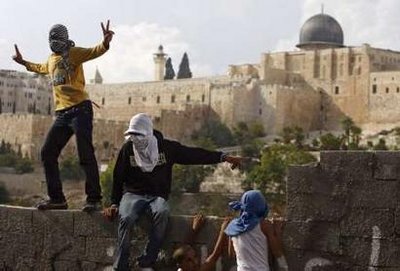
| The al-Aqsa mosque is seen in the background as a Palestinian youth gestures in the East Jerusalem neighbourhood of Ras al-Amud October 7, 2009. (Ammar Awad) |
|
The week five-day siege on Al Aqsa Mosque Compound was finally lifted
on October 9 after pressure from Jordan and reportedly, from the United
States, was placed on Israel, although tensions remain high. Since
October 4, when a group of Jewish extremists tried to break into Al
Aqsa and were warded off by Palestinian protestors, Israeli police and
border guards have cordoned off the Old City in its entirety,
especially around the compound. Men over 50 were not allowed to pray in
the mosque and police were constantly questioning people going in and
out of the Old City, including children on their way to school.
An estimated 100 men holed themselves up inside the Aqsa Mosque to
protect it from any intruders. After failing to force them to leave,
Israeli police first threatened to arrest them and then cut off all
food supplies to inside the compound. Clashes broke out on October 4
between Palestinian protesters and Israeli police and soldiers in which
several Palestinians were injured and arrested. A number of Israeli
police were also said to have been injured by stones.
On October 6, Israeli police arrested Islamic Movement head, Sheikh
Raed Salah for "incitement". While he was later released, Salah has
been banned from Jerusalem for 30 days.
After days of clashes and protests in the Palestinian territories and
Arab countries – Jordan in particular – Israeli authorities decided to
lift the siege rather than further strain tensions with the neighbor
kingdom. Still, on October 10, a group of extremist Jews tried to break
in again, but were stopped by Israeli police and Palestinian
protestors.
In an interview in the Israeli daily Haaretz on October 9,
Jordanian King Abdullah II warned that with the current situation,
Israelis and Palestinians were "sliding back into the darkness."
He also said Jerusalem was a "tinderbox" warning that the ongoing clashes would only escalate if not ended.
The king was apparently concerned, not only with Jerusalem but with the
situation on his home turf. On Friday, thousands of Jordanians in Amman
and Zarqa demonstrated against Israeli measures at Al Aqsa. In the
capital, the protestors marched to the Prime Minister's office,
chanting slogans urging their government to sever diplomatic ties with
Israel and expel its ambassador.
In the afternoon, the police barricades were removed and the
doors to Al Aqsa were opened although a large Israeli military presence
remained in the city given that the Jewish holiday of Sukkot has one
more day before ending. Over 100 men remained inside the Aqsa Mosque as
a precaution until Sukkot ends.
The clash over Al Aqsa is perfect testimony to the difficult
task of achieving peace US President Barack Obama says he wants to
accomplish and one that the Nobel Prize officials believe he is capable
of. On October 9, Obama was awarded the Nobel Peace Prize, much to his
own surprise he says and something which has "humbled" him.
In a speech from the White House, Obama said he remained committed to resolving the Israeli-Palestinian conflict.
"We must all do our part to resolve those conflicts that have caused so
much pain and hardship over so many years," he said. "And that effort
must include an unwavering commitment that finally realizes the rights
of all Israelis and Palestinians to live in peace and security in
nations of their own."
Palestinians and Israelis have mixed feelings towards Obama's Nobel
honor. "We hope that he will be able to achieve peace in the Middle
East and achieve Israeli withdrawal to the 1967 border and establish an
independent state on 1967 borders with Jerusalem as its capital," said
chief Palestinian negotiator Saeb Erekat.
Israeli officials also expressed mixed emotions. Prime Minister
Benjamin Netanyahu lauded Obama in his message. "You have already
inspired so many people around the world, and I know that this award
also expresses the hope that your Presidency will usher in a new era of
peace and reconciliation." Others, however were not as enthusiastic.
"I'm a little surprised at the choice,' said former Israeli UN
Ambassador Dan Gillerman. "I think that at this time he has done very
little, at least from the point of view of results," he said, calling
the choice "somewhat premature."
He is probably right, given the indications on the ground. US
Middle East envoy George Mitchell wrapped up yet another visit to the
region on October 10, again with no tangible results. On October 9,
Mitchell met with both Netanyahu and President Mahmoud Abbas in
Ramallah at which point he said peace efforts would continue but "at a
much lower level." Mitchell also said he had extended an invitation to
the two sides to come to Washington to continue discussions.
Hopefully, by that time, Palestinians would have gotten their own house
in order. It is still not clear whether they will finally put their
differences aside for the sake of national unity, but that is the goal
Egypt is hoping for before the end of this month.
On October 9, Palestinian government sources announced that President
Abbas had official received an invitation to sign a conciliation
agreement with Hamas in Cairo on October 25. Hamas, while it initially
said it would travel to Cairo, is still mulling over the decision
whether to go or not.
The latest bump in the road towards unity is the PA's recent
involvement in the deferral of the Goldstone Report discussion in the
UN Human Rights Council. Hamas has called for Abbas to step down in
light the fiasco, which it called "shameful."
Hamas is not the only party angry with the presidency. Hundreds of
Palestinians took to the streets in protest of the PA's deferral of the
report, which was scheduled to be discussed earlier this month in the
HRC. A coalition of 40 Palestinian institutions and NGOs dealing with
Palestinian affairs in Europe also demanded that President Abbas resign
in light of the fiasco. On October 9, the PFLP called for stripping
Abbas of his diplomatic immunity so as to question him about his
involvement, saying those responsible should be held accountable. The
PLO, under Abbas, has formed an "investigation committee" into why the
decision was made in Geneva and who was responsible, although most are
pointing fingers at the president himself.
On October 7, the Security Council rejected a Libyan request to discuss
the report there, saying it would not hold an emergency session. Now,
the PLO is pushing for a date earlier than its March session to discuss
the Goldstone report, saying Israel's actions in Jerusalem have made it
more urgent.
Meanwhile, Israeli authorities began with the second phase of
construction of a settlement in Jabbal Al Mukkaber in Jerusalem.
According to the Israeli movement, Peace Now, settlement construction
is now underway for 800 new housing units in the West Bank.
In the Ramallah-area village of Deir Ammar, Jewish settlers uprooted
250 olive trees according to Palestinian media sources on October 6.
Finally, 70 Palestinian laborers were arrested by Israeli police in the
Wadi Ara region on October 4 after trying to be smuggled into Israel to
find work. The 70 men were packed into a refrigerator truck and
arrested after the truck was stopped at a checkpoint.
MIFTA





 Print This
  Print This