|

|
U.S.: Latino Youth Adopt Health Care Reform Priorities at the 2009 LULAC Washington Youth Leadership Seminar
 Print This Print This
By Press Release
LULAC
Wednesday, Oct 14, 2009
56 outstanding high school students met to discuss what Congress should do to provide better health care for all Americans.
The League of United Latin American
Citizens, the largest and oldest Hispanic civil rights organization,
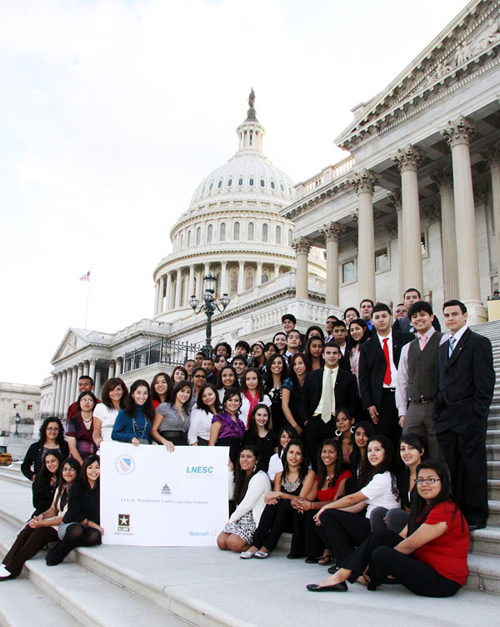
through the LULAC National Educational Service Centers, brought 56
students from around the country to the nation’s capitol to adopt and
share their Health Care Reform agenda with White House officials and
Members of Congress.
“The Washington Youth Seminar is one of
the nation’s longest running and most respected Hispanic youth
leadership programs. The students come to the nation’s capitol to
expand their leadership skills and knowledge on key issues,” said LNESC
Executive Director Richard Roybal. “We want to thank the U.S. Army and
WalMart for their generous sponsorship.”
The four-day annual event brings fifty-six emerging student leaders in
grades 11 and 12 from across the U.S. and Puerto Rico to Washington,
DC.
While in the nation’s Capitol, students discussed issues impacting the
Latino community with national leaders from Congress, corporate America
and other public and private institutions.
“Going to Washington, DC was a once in a life time experience,” said
Elizabeth Roque a Milwaukee junior sponsored by LULAC Council 326. “I
was able to meet people from all over the United States and learned
more than I expected about Health Care Reform. This reform will cover
more citizens than it does now. The importance is that a high
percentage of Americans will be insured. This is a wonderful experience
that I will forever cherish.”
On Wednesday, September 30th the students adopted the following positions:
-
Comprehensive Health Care Reform: We urge
Congress to pass comprehensive health care reform that will guarantee
quality, affordable health care for all. We support a mandate to ensure
all Americans are covered and legislation that would prevent insurers
from denying coverage to customers with pre-existing conditions. We
also support an increase in taxes on the wealthiest Americans and sin
taxes on unhealthy foods to help pay for the cost of the increased
coverage. We support a public option to encourage competition and lower
costs.
-
School-based Health Care: We urge
Congress to expand school-based health care clinics because students
perform better when they show up for class, healthy and ready to learn.
We believe it is a common sense cost effective approach to offer care
for the health of the student in the same building where we care for
their mind. We know if our schools offered health care services, more
students would get the care they need and would be able to concentrate
on their studies, lowering disciplinary problems and increasing
academic success.
-
Increase Access: Congress should
increase funding for community health centers which provide easier
access for many families around the country at a lower price point. An
increase in the capacity of health centers would provide a culturally
competent outreach method for preventative and essential care. Congress
should also expand access to care by phone and internet services for
routine health care needs to reduce unnecessary office visits.
-
Focus on Preventative Care:
Congress should invest heavily in preventative health care, which, if
implemented properly, is more cost effective than fee-for-service
plans. We believe that a major emphasis on preventative care through
media campaigns, workplaces and schools, could save billions of dollars
in higher cost chronic care down the line.
-
Coverage of Immigrants: We
believe children, regardless of immigration status, should be covered
by health insurance as long as they are enrolled in school. We also
believe legal immigrants should have the same access to health care as
other American citizens without special restrictions based upon their
time within the United States.
-
Lowering the Cost of Prescription Drugs:
Congress should regulate the price of patented prescription drugs.
Individuals who are in need of essential prescription medication should
not go without because of the cost. Congress should set two pricing
tiers; one that sets a maximum price manufacturers may charge for a
prescription drug and another that provides a discounted pricing
structure for low income families, the elderly, handicapped and
chronically ill.
-
Nutritional Instruction: Congress
should create a public awareness campaign to inform Americans about
healthier eating habits. We believe that all restaurants and school
cafeterias should display mandatory calorie and nutrition facts that
are visible and accessible to the consumer. Schools should offer a year
long course on nutrition and health. We know that a healthy and
knowledgeable brain leads to a healthy body.
-
Increase Physical Activity:Congress
should provide incentives to schools to expand physical education
classes and keep school gyms open longer. Because obesity increases
with the amount of hours spent watching TV and playing video games; TV
shows and game manufactures should receive a seal of approval from the
government if they alter their content to encourage physical activity.
Likewise, businesses could receive a seal of approval if they provided
exercise options for their staff. Congress should consider subsidizing
gym membership for low income Americans.
-
Healthier Options in our Lunchrooms:
Congress should pass legislation that ensures that all schools provide
healthy, affordable and high quality options in their cafeterias. With
a limited time to eat and easy access to unhealthy products, we often
fall victim to eating the most readily available option which is often
the least healthy. Schools should be incentivized to promote healthier
choices instead of junk food.
-
Peer-to-Peer Programs: Congress
should create a pilot to develop peer-to-peer health care programs that
are taught by fellow students with the goal of harnessing peer pressure
to encourage healthy lifestyles. Several studies have shown that
peer-to-peer instruction is an effective method to counter drug use,
poor nutrition and lack of exercise. Peer-to-peer programs would have
the buy-in from youth who are inspired to lead healthy and positive
lives while being able to speak to the language of their peers to join
them.
Participants are recommended and
sponsored by LULAC Councils to serve as representatives of their home
states. Once in Washington, D.C., students work with LNESC and LULAC
staff as well as LULAC leaders from across the country to develop a
platform of initiatives which are of interest to the Hispanic youth.
The students meet with policymakers to discuss, collaborate on a
position paper, which is then sent to their congressional
representatives. In past years, students have focused on issues such as
gun control, education and immigration.
The League of United
Latin American Citizens, the largest and oldest Hispanic membership
organization in the country, advances the economic conditions,
educational attainment, political influence, health, housing and civil
rights of Hispanic Americans through community-based programs operating
at more than 700 LULAC councils nationwide.
League of United Latin American Citizens
 Print This Print This
|
If you appreciated this article, please consider making a donation to Axis of Logic.
We do not use commercial advertising or corporate funding. We depend solely upon you,
the reader, to continue providing quality news and opinion on world affairs. Donate here
|
|
World News

|