By W. T. Whitney Jr.
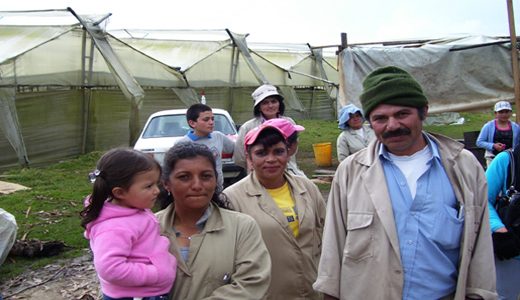 |
| Aidé Silva, left, and her family. (W.T. Whitney) |
|
Accompanied by her children and 25 fellow workers, strike leader
Aidé Silva escorted our small U.S. labor delegation through an
industrialized floriculture operation near Madrid, Colombia. Some 400
workers organized by the National Union of Flower Workers (Untraflores)
began their strike on September 9. Only 35 strikers were on hand for
the visit October 18, because, said Silva, it was Sunday.
Strikers were occupying the 100 - acre, plastic- enclosed Benilda
Farm owned by the wealthy Mejia brothers of Cauca. Multinational
corporations, notably Dole Food Company, own most of the 400 flower
plantations near Bogota. Colombia exports 85 percent of its cut-flower
production to the United States, which acquires 65 - 75 percent of all
its flower imports from Colombia.
Colombian flower exporters, helped along by government subsidies and
U.S. tariff exemptions, take in $1 billion annually. Colombia's export
total to the United States came to $13.1 billion in 2008.
Three fourths of the Benilda strikers are women who have averaged 20
years of work there. In all, 200,000 Colombians work directly or
indirectly in the flower industry. The lives of many are precarious
because of poverty and displacement by paramilitaries and the army from
land and homes elsewhere.
Aidé Silva and a handful of other women formed the Untraflores union
in 2001 as an alternative to a company union - "the best thing we ever
did," she said. Some 3000 of them work at Benilda and six nearby flower
plantations. The Bendilda strikers complained of months with no wages
and failure by the company to make mandated payments toward pensions,
family subsidies, and health plans. The company also absconded with
$800,000 in a worker savings plan, say the workers.
Extraordinary amounts of plastic piping and discarded spray
equipment seen along long rows of roses and chrysanthemums betoken,
said Silva, vanishing water reserves in the Bogota tableland and
workers' toxic exposure to herbicides, fungicides, and fertilizers.
The U.S. delegation heard later from Aura Rodriguez, head of Cactus
Corporation, source of legal advice and advocacy for flower workers.
She reported on rampant sexual exploitation, including advances from
male bosses, employment denial because of pregnancy, and sterilization
forced upon nine workers in 2007.
Aidé Silva said that media
portrayal of workers as "loose women" and worker anxieties about
providing for needy children exert intimidating effects on organizing."
Wages of unionized flower workers approach $200 monthly.
The strike came about when the Mejia brothers closed down Benilda,
dismissing some workers and transferring others elsewhere. Aidé Silva
views that action as a ploy for facilitating industry-wide
reorganization into other business entities. Owners dodge legal
protections for workers' rights by forming dummy corporations
specializing in recruitment of contract and temporary workers ripe for
exploitation.
Downsizing served as pretext for the re-shuffle. The flower industry
has contracted due to the world economic crisis, monetary fluctuations,
inflation, and rising fuel and, allegedly, labor costs. Over 20,000
flower workers have lost jobs recently.
Under Colombian law, Benilda Company must use money derived from
property sales to pay off obligations toward worker pensions and health
benefits. The strikers are occupying Benilda to maintain facilities and
preserve resale value so that pensions and health care can be funded.
The courage of workers, who have gone months without pay, in retrieving
a thin lifeline, seemed palpable what with powerful forces impinging on
their lives and an immense, but abandoned, plasticized work world at
hand.
Colombian labor unions have provided support along with the local
Catholic Diocese. Community residents, most of them flower workers and
displaced people, have responded to pleas from strikers at their doors.
Aidé Silva cherishes a donation from Cauca sugar cane cutters whom
Untraflores assisted last year during their successful strike.
Aidé Silva views the Colombian cut flower industry as a case study
demonstrating potential beneficiaries and victims should Colombia and
the United States institute a trade regimen beholden to trans-national
corporations. She urged her visitors to join the international campaign
against flower industry abuses. They should, for example, honor
International Flower Workers' Day on Valentine's Day, a prime occasion
for demonstrations, boycotts, and education programs,
Bidding farewell, Silva said that unity between North American and
Latin American workers was essential for an end to imperialism. More
information is available at Untra Flores.
Peoples Weekly World





 Print This
  Print This