RAMALLAH, West Bank -
Palestinians gathered Wednesday to mark five years since the death of
their iconic leader Yasser Arafat, with Mahmud Abbas due to address the
West Bank rally.
The anniversary of Arafat's
death finds Palestinians more divided than ever and his successor Abbas
pondering resignation because of stalled US-led peace efforts that have
failed to bring about an independent Palestinian state.
Crowds began gathering in
the West Bank's political capital of Ramallah, with thousands expected
to attend the rally to honour the man who catapulted the Palestinians'
struggle onto the world stage and led them through nearly four decades
of armed struggle and sputtering peace negotiations.
Abbas was to address the
crowd amid grim predictions by his aides that he may resign as
president, perhaps leading to the collapse of the Palestinian Authority
established by Arafat during the Oslo peace process in the 1990s.
"The moment of truth has
come and we have to be frank with the Palestinian people that we have
not been able to reach a two-state solution through 18 years of
negotiation," chief Palestinian negotiator Saeb Erakat said.
"We have become convinced
that Israel does not want a Palestinian state on lands it occupied in
1967," he said, referring to the Gaza Strip and the West Bank including
East Jerusalem, which Israel captured illegally via war.
Abbas resigning would throw the divided Palestinians into new legal and political limbo.
According to Palestinian
Basic Law, to become effective Abbas's resignation has to be approved
by two thirds of the Palestinian parliament. But the chamber has not
convened since 2006 (as Israel illegally holds many Hams MPs in prison)
and it is unclear whether it would do so if he quits.
If the resignation is
approved, the speaker of parliament, Aziz Dweik of the rival
democratically elected Hamas movement, would assume the presidency
until new elections are held within 60 days.
But aides have indicated in
recent days that if Abbas steps down the entire Palestinian Authority
could collapse, which would spell the end of the already defunct Oslo
process.
The Palestinians have said
they will not resume peace talks with Israel without a complete freeze
of illegal Jewish settlements in the occupied West Bank and East
Jerusalem, a demand initially backed by Washington.
But Israel's hardline Prime
Minister Benjamin Netanyahu has refused to freeze settlements, and in
recent weeks Washington has backed down, calling on both sides to
return to the negotiating table without preconditions.
Erakat said the two-state
solution would only be possible at this point if there were
"unprecedented international movement" towards pressuring Israel
because "the situation has reached the point of no return."
All Jewish settlements are
illegal under international law because they are built on Arab land
(mainly Palestinian), illegally occupied by Israel since 1967.
Around illegal 200,000
Jewish settlers are estimated to have moved into the dozen or so
Israeli settlements in Palestinian East Jerusalem.
There are about 300,000 more illegal Jewish settlers currently living in settlements the Palestinian West Bank.
The settlers adhere to radical ideologies and are extremely violent to almost-defenceless Palestinians.
Middle East Online





 Print This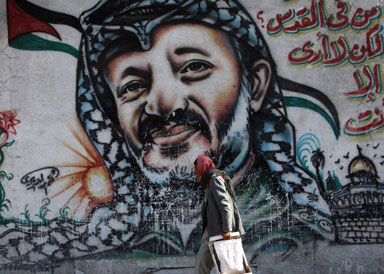
 Print This