By Shahid R. Siddiqi
|
|
|
U.S. Secretary of State Hillary Clinton in a group photograph
at the Badshahi Mosque in Lahore, Pakistan (APP) |
Pakistanis
make their anger with the American policies very clear
After three days of America-bashing that Secretary of State, Hilary Clinton,
endured during her recent visit she must have carried back interesting baggage
- some realistic and troubling assessments about how Pakistanis look upon the
war on terror that America has imposed on them and the region. If she is
honest, she will report to President Obama the disdain that exists in Pakistani
streets for America’s
thoughtless policies and heartless actions that have brought death, destruction
and suffering.
She experienced this firsthand when a tribesman from FATA, where the Pakistan
Army is fighting to dislodge TTP militants who engage in terrorist activities
in Pakistan and where American drones kill hundreds of innocent men, women and
children, when he said to her point blank:
"Your presence in the
region is not good for peace."
Clinton was here for first hand
assessments of ground realities important for Obama’s future Afghan war
strategy now under review. She wanted to know the mood of the people, prospects
of survival of their man in the presidency amid public uproar against him on a
variety of issues and reading the mind of Pakistan’s
military, which remains the key player in matters related to defence and the Afghan
war, much to America’s
chagrin.
Washington has, in the past, turned a deaf
ear to sensitivities and opinions from Pakistan’s
civil society and the media about its heavy-handed, counter-productive,
insensitive policies that generated public distrust and anger which eventually turned
into hatred for America.
Obama administration, like others before it, relies for decision-making on
Washington-based neoconservatives, military hawks, war mongering intellectuals,
short sighted diplomats and the so called `experts’ who are either unaware of ground
realties, or hide unpleasant facts and tell the administrations only what they want
to hear or perpetuate their own distorted visions.
This failure to understand the world outside their
own frontiers and driven by their ‘super power arrogance’, successive
administrations after the Eisenhower era, arbitrarily imposed their will on
others, which earned them ill will and created enemies. The US began to lose the hearts and minds of the people
of Pakistan
after 1965 Indo-Pakistan war. People, who at one time looked upon the US as a symbol
of hope began to distrust it as an unreliable ‘ally’.
Today, as polls indicate, the US is hated in
Pakistan for a consistently high level of unreliability, unfriendly policies,
patronage of dictators and corrupt and inefficient rulers, interference in
Pakistan’s internal affairs, its readiness to take advantage of Pakistan even at
the cost of Pakistan’s security and disregard of Pakistan’s interests while
allying itself with its arch enemy India. In this backdrop, Hilary’s visit comes
as a breath of fresh air. One does not expect a policy change but she can at
least give a correct input to her administration in relation to Pakistan.
Clinton later
told CNN that she anticipated the "pretty negative situation" in Pakistan, but
she said "I wanted to have these interactions. ... I don't think the way
you deal with negative feelings is to pretend they're not there ..."
She did well to broaden the
scope of her visit by meeting a cross section of civil society. Even though she was sheltered
from adverse public opinion, with participants carefully screened, yet they challenged
her on sensitive issues such as drone attacks, mammoth new embassy, suspicious
activities of Blackwater now believed by many to be behind devastating bomb
attacks, violations of local law by American marines, American plans of denuclearizing
Pakistan, its support to anti Pakistan elements in Afghanistan and FATA, its collusion
with India, etc. While she did give forthright answers to some, to many an
awkward and probing question Clinton
had no answers. “… [T]his issue is between the
leadership of two sides. So let’s not to discuss this here,” was her typical evasive
line.
When Clinton
sought support for the Afghan war, in no uncertain terms was she toldby a woman journalist: "We are fighting a war that is imposed on us. It's not our war. It
is your war. You had one 9-11. We are having daily 9-11s in Pakistan."
And when her contention that the U.S. and Pakistan
face a common enemy in ‘terrorism’ was publicly rejected, Clinton admitted that "we're not getting
through.”
In a country where 90% people oppose
this war, where the Afghan Taliban (not TTP) are regarded as national
resistance to American occupation and where the fallout of the war turns their
lives upside down, this answer is perfectly legitimate. Polls indicate there is
no support for religious extremism and Al Qaeda is not believed to cause
bloodshed. On the contrary the belief is that American sponsored militants from
FATA (TTP) commit these heinous crimes which are then pinned on Al Qaeda. “Winning
public support is critical for Al Qaeda to succeed. Why then would it shed
blood and alienate people”, asked a tribesman.
The critical media coverage about
American policies caused a frustrated Clinton to
retort that the US would respond “aggressively” to
the misreporting by Pakistani media. When this drew an immediate response from
the media’s spokesperson who said: “We should understand the actual message
behind her statement…..”, the US
embassy in Islamabad rushed to quickly issue a
statement that Clinton
was not making any threats. “It has been taken wrong. The word aggressive doesn’t
mean that US will take any action…”
Clinton’s
meeting with General Kayani, Pakistan’s
Army chief was significant. The general’s influence on the presidency is well understood.
Also Pakistan Army is the custodian of nuclear assets, seizing which is widely
believed to be America’s
key objective. The meeting was aimed to figure out General Kayani’s response to
upcoming war strategy, in which Obama would most likely want Pakistan Army to
play a role, and the security environment. She must have also tried to make
sense of President Zardari’s position in view of the increasing confrontation
that he faces from the Army on security issues.
Zardari and his team, who touted
the insensitive Kerry-Lugar Bill which drew scorn within the country, were
openly rebuffed by the Army when it publicly asked for a review of unacceptable
clauses, after behind-the-scene messages were ignored by Zardari’s men. Washington’s demand for indirect veto power over promotions
and appointments to senior ranks set off alarm bells in the armed forces, and rightly so.
A
female MNA, Marvi Memon, who refused to meet Clinton,
said in an open letter: “…. there are patriotic Pakistanis who will defend the
soil before accepting your policies of creating a US
fiefdom in Pakistan. As
a young parliamentarian, I would only welcome you to Pakistan
once we have evidence of your shift in policy so that Pakistan is
dealt with as a sovereign country.”
In her meeting with prominent
tribesmen in the NWFP, which bears the brunt of the Afghan war, she heard the
same hostile message: Pakistanis do not want American friendship due to its
policies, despite offer of a multi-billion-dollar aid package.
Clinton’s
earlier criticism of Pakistan’s
failure to get Al Qaeda leadership had generated negative headlines. Softening
her tone, she told a group of women: "…… the U.S. would very much like to see
the end of the Al Qaeda leadership. And our best information is that they are
somewhere in Pakistan, and
we think it's in Pakistan's
interests, as well as our own, that we try to capture or kill the leadership of
Al Qaeda,"
But Clinton’s
call to locate and eliminate Al Qaeda leadership was rejected for lack of
evidence. On the contrary it raised questions: Why after seven years of
disinterest in eliminating Al Qaeda leadership by Bush, has Obama
administration taken up the cudgel now? Is he seeking in Al Qaeda an objective
for the war, which he has been accused of not having. Why is America with its technology and intelligence
incapable of pinpointing the location of Al-Qaeda leadership to Pakistan for
eight years? Is Al Qaeda being used as a pretext to launch attacks in
Balochistan like FATA and Afghanistan?
Pakistan has
consistently denied Al Qaeda’s presence on its soil and has challenged the
Americans to point it out if they believe it is here.
Recent call for air attacks on Al Qaeda leaders in Quetta by Anne Patterson,
the intemperate US Ambassador in Islamabad in
‘her imperial hubris’ (to borrow a phrase from Eric Margolis) lends credibility
to the belief that America
intends to destabilize Balochistan after having done that to FATA and NWFP. Active
Indian support to Balochistan Liberation Army, a rogue insurgent outfit
headquartered in Tel Aviv, with fundraising address in Washington, is well known. American drone
attacks would only supplement Indian effort.
If Clinton kept an open mind
and made some sense of the criticism she heard, she should have drawn some
important conclusions.
One, there is
enormous pent up anger against decades of manipulative American policies to
exploit Pakistan.
Two, Pakistanis intensely dislike American intervention in their internal
affairs, including manipulations of removing and installing governments. Three,
no government in Islamabad
can survive for long that serves as a door mat for the Americans. Four,
Pakistanis would aggressively reject policies that serve American geopolitical
interests in this region that threaten Pakistan’s stability and
security.
Foreign Policy Journal





 Print This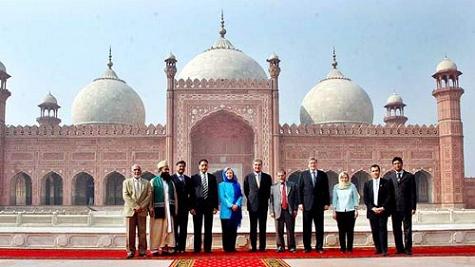
 Print This