British writer and photographer Stuart Littlewood talks to Angie
Tibbs about his experience of Israel’s occupation in Gaza and the West
Bank, and comments on how British and American collusion, under the
auspices of the Jewish lobby, is helping to sustain the world’s most
lawless, brutal and unjust occupation regime.
"Lawlessness must have painful consequences for the lawless, not their victims." (Stuart Littlewood)
Stuart
Littlewood is one of the most consistent and passionate writers on the
continuing Israeli occupation of Palestine. His book, Radio Free Palestine,
and his frequent articles, focus readers on the plight of the
Palestinian people, on the occupiers who are responsible, and on the
governments who support Israel's slow-motion genocide and theft of an
indigenous people's homeland, culture and history. I spoke with him
recently.
[Angie Tibbs] Has your active
support for the Palestinian people always been a part of who you are or
was there a defining moment which caused you to speak out?
[Stuart Littlewood]
I'm new to this game. The Palestinians' struggle for justice isn’t
taught in school here and our politicians are afraid to discuss it, so
the British people are kept in ignorance.
I knew next to
nothing until I had to research the subject for a newspaper column. The
more I delved into it the angrier I became. The sheer evil! A short
time later, in 2005, somebody who had read my column invited me to
visit the West Bank and shoot pictures for a book.
First impressions of Palestine under occupation
[Question] What towns and villages did you visit in occupied Palestine and what were your impressions?
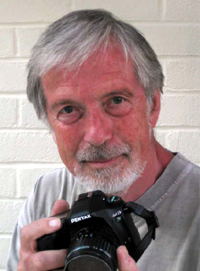 |
| Stuart Littlewood: consistent and passionate writer on the Israeli occupation of Palestine. (Angie Tibbs) |
|
[Answer] Much
of the time was spent with Palestinian priests in their parishes. These
are the Church's front-line troops. They are abused and sometimes shot
at by the Israelis, yet they remain focused and good-humoured.
The first trip took us to Jericho, Bethlehem and East Jerusalem,
including the Old City, as well as smaller towns in the West Bank. We
also visited Jenin, which was considered dangerous so we didn't stay
long. The town was a rubble-strewn mess after the onslaught and war
crimes three years earlier (Israel denied accusations of massacre). The
devastation was massive and brought back childhood memories of London
after the Nazi blitz, which my family lived through.
All
over the West Bank what struck me most was the resilience of ordinary
people under brutal occupation and having to cope with endless
restrictions. For them life was a cruel obstacle course, just like the
Nazi occupation of Europe... There is no legal protection against the
thuggish military. Every Palestinian we met urged us to tell their
story when we got home because they felt sure the British people didn't
know the truth ... otherwise how could we stand idly by?
These
are kind, hospitable and sophisticated people who have done nothing to
deserve the misery inflicted on them by the Israeli regime and its
supporters in the West.
I was also shocked by the way the
Israelis have systematically trashed the Holy Land and many of its
antiquities. Once-beautiful landscapes, many with biblical connections,
are now crowned with hideous hill-top settlements or military
installations. Town and country planning principles are unheard-of.
Israel’s vandalism, visible everywhere, has ruined a gentle Arab
civilization and its heritage, and that's something else they'll never
be forgiven for.
[Q] Your initial trip to the West Bank was shortly after the death of Yasser Arafat. Were people talking about him? Remembering him?
[A]
No, but his image was everywhere ... in village squares, on buildings,
inside shops and offices. I noticed in the assembly hall of a Catholic
school an enormous portrait of the Pope, and on the adjacent wall an
equally large portrait of Arafat. As a symbol of resistance he's as big
as they come.
On the second trip, I visited Arafat's mausoleum
in Ramallah. The family I was staying with were delighted I wanted me
to go there and they accompanied me. It was only half-built, so I asked
the soldiers who stood guard: "Is he really buried here?" "Yes," they
said, visibly swelling with pride, "he's under that slab." For all his
faults, it seems the old rascal is greatly missed.
The book project
[Q] Your visits to Palestine resulted in your book, Radio Free Palestine. Tell us about that. First of all, what is the significance of the title?
[A]
We were going to call it "This Land is Our Land", but that title is
already used by others. Eventually we settled on “Radio Free Palestine”
because that's what Palestinians need: a broadcasting service that can
be heard all over the world.
Proceeds from the sale of the book go to humanitarian projects in the West Bank, by the way.
The original idea was a poems-and-pictures book with me shooting the
photos. But it soon became clear that to do the situation justice we
needed to report in greater detail how the Israelis had effectively
turned the occupied territories into a prison and were creating “facts
on the ground” to make their occupation permanent. The least we could
do was tell the truth and provide readers with enough information to
challenge the propaganda lies.
So I made a second visit at
Easter 2006, just after Hamas's surprise election victory. The place
was in turmoil, tension was running high and plans to meet Palestinian
Authority officials in Ramallah had to be scrapped. Contacts also
advised that it was much too risky to visit the Gaza Strip.
All the same, I gathered a lot of material, and it was a great
privilege when Jeff Halper agreed to write the Foreword. I had visited
his organization ICAHD
(Israeli Committee Against House Demolitions) in Jerusalem and learned
a great deal from his team. Jeff is a truly courageous man and a beacon
of hope.
Christians and Muslims under Hamas “all Palestinians first”
[Q]
You had to leave Gaza out of your book, but nevertheless you provided
readers with an in-depth look at 2007 Gaza in your widely published
article “See Gaza and weep",
in which you described how Gaza’s people were struggling to survive
under the appalling conditions created by Israeli sanctions. What
stands out most vividly in your mind today, some two years on, not only
about Gaza itself, but about Palestinian Prime Minister Ismail Haniyeh
and his party, Hamas?
[A] On the third
trip, a small group of us went into Gaza and met Mr Haniyeh, but, as
you say, that was after the book came out. The Gaza Strip had been
under sanctions and siege for about 18 months, so there was already a
chronic shortage of food, fuel and essentials. The sick were dying from
lack of medicines and hospital equipment spares. Power cuts were a
daily fact of life – another Israeli weapon of collective punishment.
Some 3,500 licensed fishermen couldn't put to sea without being shelled
by marauding Israeli gunboats.
Mr Haniyeh and his colleagues
were courteous and attentive. He gave us a generous slice of his time,
considering the problems he faced and the continual emergencies. I was
pleased to see a strong sense of unity, with Muslims and Christians
standing together against a common enemy. They are all "Palestinians
first".
I think it would be a mistake to underestimate
Hamas. These are men who have pulled themselves up by their own
bootstraps. Most were raised in refugee camps, and have done time in
Israeli jails or been exiled for putting up resistance. But they made
sure they got themselves a good education at the Islamic University.
Some went to universities in Britain and the US. They are as
well-equipped as we are to govern, and they have been tested almost
beyond human endurance.
When I got home the Health Ministry in
Gaza sent me a list of hospital spares they desperately needed. I
forwarded it to our own Health Ministry and to my MP. It was ignored,
and the disgust I felt – and still feel – towards our political class
is beyond words.
In the meantime I was receiving
heart-breaking messages from Gazan doctors telling about the
difficulties at work and at home, where their shivering children
struggled to study by candle-light. What could I say to them? Here we
are, two years later, and we are still letting those decent and
desperate people down. How despicable is that? I cringe with shame.
[Q] What were your contacts telling you about the conditions in Gaza?
[A] One message in particular still haunts me. Father Manuel Mussallam, the elderly priest in Gaza, emailed to say:
If
you wish to really understand what is taking place in the Gaza Strip,
please open your Bible and read the Lamentations of Jeremiah. This is
what we are living. People are crying, hungry, thirsty, desperate. They
need food. Even if there is food for sale, people have no money to buy
it. They have no income, no opportunities to bring food from outside
and no opportunities to secure money inside Gaza. No work, no
livelihood, no future... They have no hope and many very poor people
are aimlessly wandering around trying to beg for something from others
who also have nothing. It is heartbreaking to see.
He
ended: "I beg you, we do not need pity, we need only justice. If you
don't give justice, there will be no peace. Peace is the farthest thing
away from the mind of anyone, Christian or Muslim, in Gaza at this
time."
The Hamas “terror”
[Q] Israel
has branded Hamas a "terrorist organization" and convinced a few of its
friends to do likewise. Is this a valid designation, and what role, if
any, has it played vis-à-vis lasting peace?
[A] I
suppose it depends where you stand on the fascist spectrum. The Nazis
called the French Resistance terrorists; we called them heroes. When a
vicious occupier has his jackboot on your throat you have no choice but
to fight with any weapon or any method that's available. Pinning labels
like "terrorist" and "militant" on people who are defending their homes
and families is ridiculous. Always the little guy with the little gun
is the terrorist, never the big guy with big guns, bunker-busting bombs
and nukes. This warped mentality is the greatest obstacle to peace.
I call Palestinian fighters guerrillas or freedom fighters. The
Palestinians would love to hit back with F-16 jets, tanks, helicopter
gunships, armed drones and naval gunboats. That would be nice and
conventional and acceptable, yes? But all they have are AK47s, RPGs and
rockets made in the garden shed, and they ride into battle in a pick-up
truck.
The US administration defines terrorism as "an
activity that (i) involves a violent act or an act dangerous to human
life, property, or infrastructure; and (ii) appears to be intended to
intimidate or coerce a civilian population, influence the policy of a
government by intimidation or coercion, or affect the conduct of a
government by mass destruction, assassination, kidnapping, or
hostage-taking". And they use the definition to hurt people they don't
like. The laugh is that it fits the US itself, and its special friend
Israel, like a glove.
The big guys are going to have to talk
to Hamas eventually and when they do, they'll discover that Hamas is
not at all the way it is painted. Britain should lead the way since we
caused this mess in the first place, 92 years ago.
The evil wall
[Q] What
was your reaction to seeing the illegal wall and the hundreds of
checkpoints that are scattered throughout occupied Palestine? What
effect is this curtailment of free movement having on the area and its
people?
[A] I love Banksy's graffiti art on
this monstrosity. The fact that the wall is still standing – and still
being built – five years after the International Court of Justice
ordered it to be pulled down tells us all we need to know about our
contemptible Western leaders.
Most tourists are waved through
crossings in the wall without leaving their bus seats. The last time I
stayed in Bethlehem, I caught the ordinary service bus back from
Jerusalem and walked with Palestinian workers (those who were lucky
enough to have permits) through the sinister maze of steel and concrete
barriers and holding pens. It was a thoroughly dehumanizing experience.
They often have to queue for hours to get to work and queue again to
get home – all part of Israel's humiliation policy.
The wall
is also an insult to Christianity – the way it seals off and imprisons
towns like Bethlehem and important holy places like the Church of the
Nativity. It shreds and divides communities and prevents access to
Jerusalem. It disrupts the life of the Church as well as the
livelihoods of ordinary people.
Its other purpose, and the
real reason it bites deep into Palestinian territory, is to steal large
areas of prime agricultural land and the water resources beneath. If it
was purely for security, as the Israelis claim, they should have built
it on the internationally-recognized 1967 border.
We have
just seen the world’s high-ranking hypocrites celebrating the fall of
the Berlin Wall but saying nothing about Israel’s apartheid wall.
Lack of respect for non-Jewish faiths
[Q] Let's talk about the religious dimension in all of this. How important is it?
[A] The
three faiths are all in one place, and Jerusalem is vitally important
to all of them. What's lacking is proper respect. How many people in
the West realize that Israel doesn’t allow Muslims and Arab Christians
living outside Jerusalem to visit the holy places in the Old City?
When Palestine was under British mandate, Christians accounted for 20
per cent of the population. Now, after 61 years of hostilities,
dispossession and economic strangulation the numbers have been whittled
down to 1 or 2 per cent. At this rate there will soon be no Christians
left in the land where Christianity was born. The Israelis are waging a
religious war that's designed to disrupt and paralyse Christianity in
the Holy Land. It's part of their attempt to Judaize everything.
Western Christendom doesn't seem bothered and keeps quiet. Few
churchmen, I believe, have any real clue what's going on there. Shame
on them.
[Q] Are Western church leaders playing a sufficient role in protecting the Holy Land, its religious history and its people?
[A]
The Catholic Church, which has a significant presence in the Holy Land
and runs a number of schools, appears to be fighting the battle alone.
Anglican Church ministers I have spoken to are largely disinterested.
Yes, their faith is focused on the Holy Land, they teach the Holy Land
texts and they deliver sermons on the Holy Land, but what do they
really care about it? One morning they'll wake up and discover that the
Holy Land – the central plank to their existence – has been stolen from
under their noses.
The Latin Patriarchate of Jerusalem – the
Catholic Church in the Holy Land – does its best, but I don’t think it
gets the support it deserves from the Vatican. As for the rest, they
could unite and surely do much more. While Israel was planning its blitzkrieg
against Gaza's Muslims and Christians – after blockading and starving
them with the British government’s connivance – the Archbishop of
Canterbury went swanning off with the Chief Rabbi on a visit to
Auschwitz, preaching their joint solidarity against extreme hostility
and genocide! The archbishop talked about the collective corruption and
moral sickness that made the Holocaust possible. But where was his
concern for the shattered Christian remnants in Gaza? Or for the
murdered, maimed and homeless Muslims who, many claim, are being
subjected to a “slow genocide”? Let's remember that the Israelis’
killing spree left nearly 60,000 homeless and 400,000 without running
water, and they still won't allow cement and other reconstruction
materials to be brought in.
Did the Pope visit Gaza to show solidarity with his frightened and impoverished flock there?
Pious wafflers in their palaces make me sick, when genuine men of God –
those in the front line, the priests, the nuns and the imams – risk
their lives as they work round the clock to bring comfort to the
victims of political greed and aggression.
Inhuman bid to starve a population and wreck their fragile economy
[Q]
You visited occupied Palestine in 2006 after the landslide victory by
Hamas, and again in 2007. Did you get a sense of optimism from the
population? Hope for a better future? Or had "the West" and Israel
already begun their campaign to ensure that the Palestinian democratic
election results would never become a reality?
[A]
We were there just after the election in 2006, and the situation was
turning nasty. Fatah’s defeat at the polls seemed broadly welcomed, but
hopes of a brighter future were scuppered by the West’s childish
rejection of the people’s democratic choice, Hamas.
The US
and Israel were plotting to bring down Hamas by "starving" the
Palestinian Authority and hence all the people it employed and served.
It began by axing US-EU aid while Israel stepped up its military
attacks on Gaza, killing and maiming, and destroying infrastructure,
including the only power station – which was built with UK taxpayers'
money, I understand. Israel also kidnapped eight Hamas cabinet
ministers and a quarter of the elected members of the legislative
council. On top of that, Fatah collaborators joined the plotting
against Hamas and organized strikes and protests.
What
spurred me to finish the book as quickly as possible was an email from
a girl who worked for the Palestinian Authority in Ramallah. Daily life
was getting worse and she hadn't been paid for over two months because
the West had cut the flow of money and Israel was stealing the
Palestinians’ own tax revenues.
Some of my
colleagues can't come to work anymore because simply they don't have
money for the transport. On Thursday we made a protest in front of the
entrance of our ministry demanding the international community to end
this isolation and asking for our salaries. The mothers are bringing
their babies and kids to work everyday because they can't pay for the
kinder yards or the babysitters...
Eventually her
emails stopped. Presumably she could no longer get to work and access
the internet. Her distress was the final straw.
Hamas
misjudged the lengths to which pro-Zionist Western leaders would go to
undermine democratic processes that didn't suit their purpose or
Israel’s interests. These same leaders endlessly praise Israel for
being "the only democracy in the Middle East" ... Everyone must be made
to understand that's because they deliberately snuffed out Palestine's
democracy as soon as it was born.
[Q] How has this ongoing siege affected the lives of the women of occupied Palestine and how are they coping?
[A]
The wrecking of the Palestinian economy has made it impossible for the
men to work or do business effectively, and this puts a great strain on
their women. They are amazingly resourceful, like the women of London
during the German blitz. As a child I remember the courage of my mother
and our neighbours as they overcame the hardships of being bombed every
night. But Palestinian women face the added danger of enemy troops,
tanks and armoured bulldozers.
In Palestinian society women
hold many important positions. Even Hamas has a woman minister. Nuns
too play a big part among the Christian communities. Not only are they
very brave and enterprising, they are also great fun to meet.
Visit Bethlehem and Birzeit universities and you'll see many stunningly
beautiful but very determined young women – Christian and Muslim –
working hard for a first-class education and running the gauntlet of
Israeli checkpoints and other unpleasant obstacles. On every trip I
manage to spend some time at Bethlehem University and am always
impressed by the sharp minds and outgoing nature of the women students.
I salute them.
Palestinians’ voice abroad silenced
[Q] Does Palestine have an official voice in the UK and, if so, how effective is it?
[A]
You’d think Palestinians were tormented enough without the added
misfortune of being represented in London by the most invisible and
silent embassy it is possible to imagine. Little is done to set the
news agenda or ensure that the Palestinian case is clearly heard.
In contrast the Israelis are businesslike and proactive. They pump out
endless disinformation which is lapped up by the media unchallenged.
Their version of events and their definition of the situation is
accepted. So it's a propaganda massacre. Many of us are convinced that
the Palestinian leadership in Ramallah has instructed embassies and
delegations abroad not to embarrass Israel, and denies them the
necessary resources to do an effective job. It's like a fixed football
match. Palestinian “strikers” mustn't even shoot at an open goal.
Washington-London-Tel Aviv “axis of evil”
[Q] What role, if any, does Britain play in Palestine today?
[A]
None that I can see. The country that betrayed the Holy Land and its
people does nothing. Our navy used to guarantee the freedom of the
seas, but now it won't even protect mercy ships from attack by Israeli
pirates. The MV Dignity, for example, was deliberately rammed and
nearly sunk in international waters with 16 civilians aboard, including
British citizens. Nor will Britain intervene when Gazan fishermen,
lawfully trying to feed a hungry population, are fired on.
[Q] And the UN?
[A]
Please don't talk to me about the UN, Angie... To quote Major Rufus
Cobb in that classic Jesse James film: "If we are ever going to have
law and order the first thing we gotta do is take 'em all out and shoot
'em down like dogs!"
[Q] The UN and most
world leaders continue to turn a blind eye to Israel's crimes against
humanity and its occupation of Palestine. What can be done to end what
many feel is the slow-motion genocide of the Palestinian people?
[A]
This is how my good friend Dr David Halpin, a tireless campaigner for
justice, describes the situation, and I couldn’t put it any better
myself:
There is an axis of evil with Tel Aviv at
one pole and Washington at the other. In the centre is London where
barbarity and treachery is clothed in plummy speech and fine spectacle.
Power shuttles backwards and forwards along this axis as busily as the
jets carrying the psychopaths to these command centres which bring hell
to earth.
I call it the axis of greed, but either will do.
Israel is an aggressive military power bristling with nuclear and
state-of-the-art weaponry, funded and equipped by the US and run by
what British MP Sir Gerald Kaufman – himself a Jew – calls "a gang of
amoral thugs". That is simply terrifying. Those thugs are already
threatening another bloodbath in Gaza, as if their atrocities 11 months
ago weren’t despicable enough. If the international community doesn't
get a grip and force Israel to observe acceptable standards of
behaviour and conform to international law, we can say goodbye to hopes
of building a civilized world.
Lawlessness must have painful consequences for the lawless, not their victims.
As for the Palestinians, their internal squabbles play straight into
the enemy’s hands. Other nations would find it easier to intervene
positively if Hamas were to carry out a convincing “rebranding”
exercise and issue a new charter that's more appropriate in tone to the
21st century and their diplomatic ambitions. They now have democratic
credentials and a certain amount of sympathy and goodwill among Western
citizens. I hope they’ll build on it, not throw it away.
Citizens of the world must take on the Israel lobby
[Q]
What would be a good starting point for us, the citizens of the world,
in our efforts to help the Palestinian people in a real and productive
manner?
[A] At citizen level we must
continue to expose Israel’s propaganda lies and evil intent. The other
side uses every dirty trick under the sun and has produced an instruction manual to teach its embassy staff and its army of cyber-activists how to brainwash Western citizens and their politicians. It'll be a long haul but the truth will eventually break through.
Citizens also need to tackle Zionist infiltration and rid us of its
stranglehold on our political and government institutions. Israel has
the British government eating out of its hand. Here’s an example. The
other day the minister for foreign affairs, in reply to a question in
the House of Commons, said:
Israel is a close ally
of the UK and we have regular productive exchanges at all levels, going
far beyond relations between governments. Our political relations allow
us to address openly issues both of common concern and where we
disagree. Most recently, on 27 October, I met the Israeli deputy
foreign minister, Danny Ayalon. We will continue to foster this
relationship and use it to further the interests of both countries and
the wider region.
No prizes for guessing the British minister’s ethnicity.
Israel's agents of influence
are so embedded at the heart of government that signing up to the
Zionist cause is a necessary stepping stone to high office. These
stooges are fatal to our foreign policy and security, and have cost us
dear in terms of world respect and dead and injured. At election time
activists need to identify and expose parliamentary candidates who are
involved with the Israel lobby.
We are supposed to be governed
in accordance with the Seven Principles of Public Life. Principle No.2
is about "integrity" – holders of public office should not place
themselves under any financial or other obligation to outside
individuals or organizations that might seek to influence them in the
performance of their official duties. The Israel lobby has been
powerful enough to ensure this is ignored. Activists need to find ways
to reimpose it.
In a sane world...
[Q] What happens next, and where do you fit into the scheme of things?
[A]
In a sane world the UN would have guaranteed to keep Gaza’s sea border
open and provide a naval escort for ships wishing to trade. And it
would have declared Jerusalem an international city as stipulated in
the partition plan. I hope the UN might still find the backbone to do
these things.
The way America is now trying to rewrite
international law to legitimize Israel's continuing land-grab and
settlement expansion, and the way the US House of Representatives voted
344 to 36 to reject the UN-Goldstone report exposing Israel's war
crimes – in which America is deeply implicated – shows more clearly
than ever how US politics is corrupted by the power and influence of
the Israel lobby.
As for me, I’m not really an activist. I’m
more a commentator. I am, however, involved with a campaign group that
is part of a rapidly growing global network. There are many, many
others and we are linking up. The Zionists know they have a fight on
their hands in the battle for hearts and minds.
[Q] Finally, what is your most fervent wish?
[A]
That you and I and anybody else can visit friends in Palestine without
being molested by Israel’s bad-mannered security officials. We should
be able to fly or sail direct, without setting foot in Israel. Citizens
of the world must make this crystal clear to the UN: if we want to
wander through Old Jerusalem’s souk, holiday on Gaza’s beach, go
fishing with Gaza’s fishermen or talk football with Mr Haniyeh over
coffee, it should be none of Israel’s damn business.
[Angie Tibbs] Thank you, Stuart.
Redress





 Print This
  Print This