 |
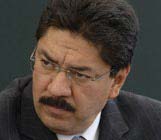
| The Mexican Supreme Court decided
that Ulises Ruiz Ortiz is culpable
for human rights violations. |
|
After two days
of deliberations, on Oct. 14 the Mexican Supreme Court made public its
decision that Ulises Ruiz Ortiz (governor of the state of Oaxaca) is
culpable for the human rights violations that occurred in Oaxaca as a
result of teacher protests and political and social unrest in May
2006-January 2007 and July of 2008.
The decision
came after a year and a half investigation into the events—ordered by
the lower house of the Mexican Congress in 2006—resulting in a vote of
six to four. Among the violations cited by the court were the lack of
access to justice, violations of personal integrity, the right to life
and liberties such as the right to transportation and work, in addition
to violations of the freedoms of expression, education, property, and
peace, as well as access to information. Minister Juan N. Silva Meza of
the Supreme Court stated during the vote that the events of Oaxaca "will become one of the black pages in the book of our country's history."
The decision
cites Ruiz as responsible for serious violations of individual
guarantees and for not complying with his duty to maintain order during
the period of unrest spanning from 2006-2008. The decision names
several other individuals as responsible for "generalized disorder" and
human rights violations: state police officials; the director of Public
Security, José Manuel Vera Salinas; the director of the Ministerial
Police, José Moreno Rivas; and the director of the Auxiliary Police,
Joaquín Darío Berges. Some local and federal police were also cited as
responsible for use of excessive force.
The decision
cites state-level officials and deliberations led to a debate among the
judges as to whether or not federal officials should be blamed as well.
A proposal brought before the court by Ministers Silva Meza, José de
Jesús Gudiño Pelayo, and José Ramón Cossío to name former President
Vicente Fox and the ex-Secretary of Public Security Eduardo Medina
Mora, among others, as responsible for the lack of governability in
Oaxaca resulting in human rights violations, was voted down eight to
three. Silva Meza's proposal for naming current President Felipe
Calderon found no support from his fellow ministers.
The Supreme
Court decision is simply a resolution and does not include any
prosecution or sentencing measures. It is now up to the president, the
Congress, the federal attorney general, the Oaxacan Congress and other
authorities to move forward on the resolution. Oaxacan opposition
leaders from the APPO (Popular Assembly of the People of Oaxaca) and
Section 22 of the National Union of Education Workers (SNTE, by its
Spanish initials) have called on Governor Ulises Ruiz to take
responsibility for the deaths of 28 individuals and the detention of
250 political prisoners that resulted from the events in Oaxaca. During
a meeting with the APPO and Section 22, congressmen from the PRD
(Democratic Revolution Party) declared
that they would push for political prosecution of Ruiz. "We are going
for the political prosecution and fall of Ulises Ruiz," stated Leticia
Quesada of the PRD.
Meanwhile, Ruiz has denounced
the court decision, stating that it is a political game being played by
the opposition. He declared that he will not resign, despite calls for
his resignation by members of several political parties in Oaxaca and
at the federal level.
Despite Ruiz's
dismissal of the decision as a political maneuver, several grassroots
organizations at both the state and federal level have stated that they
will continue to fight for justice. Alba Cruz of Section 22 stated that
her organization will insist that Ruiz be prosecuted. Cruz pointed out
that in 2007 a petition was filed before Congress to strip Ruiz of his
political immunity, however it was denied by then-president of the
congressional Government Commission, Diódoro Carrasco of the PAN
(National Action Party).
Gabriel López Chiña, also of Section 22, affirmed
that there will be massive civil society mobilizations in favor of the
APPO to "apply the necessary pressure" to bring Ruiz to trial for
political crimes. He stated, "There are 72,000 education workers who
have not forgotten the offense, the damage done, by Ulises Ruiz Ortiz
against the people of Oaxaca. The political cost was 28 deaths that as
of yet have not been vindicated by the imprisonment of those
responsible."
The APPO
mobilization is already in the works. On Oct. 29 hundreds of teachers
from Section 22 and followers of the APPO marched to mark the
three-year anniversary of the government crackdown on social protest in
the city of Oaxaca. They marched from the western edge of the city to
its heart at the tree-shaded zocalo. As they traversed the city streets, cries of "Jail Ulises Ruiz!" could be heard echoing through the colonial corridors.
The secretary
general of Section 22, Azael Santiago Chepi, told the crowds that the
Oaxacan people will always remember the repression that took place
there in 2006 and added,
"… we have not lost sight of the bloodshed by our heroic people in
defense of their dreams for liberty, justice, and democracy."
The current
situation in Oaxaca has not significantly improved since 2007. The
state government again resorted to violent repression against social
movements during the traditional festival of the Guelaguetza in July of
2008. Local and national human rights organizations recently revealed
that the state government had threatened human rights defenders.
The same day
that the Supreme Court decision was made public, several organizations,
including Peace Watch Switzerland, Limeddh (Mexican League for the
Defense of Human Rights), and Centro Prodh, among others, held a press conference in which they made public a report
on the latest threats. Among the complaints were intimidation,
persecution, physical aggression, and the defamation of organizations
and their work. The organizations highlighted the increased
criminalization of social protest as a result of the social movement of
2006.
Though the
Supreme Court decision does not mention the death of U.S. independent
journalist Brad Will, the case surrounding his murder that occurred
during the unrest of 2006 had been a point of contention for the U.S.
government. Several of the appropriations bills to fund Felipe
Calderon's drug war through the Merida Initiative mention the need for
progress on finding and prosecuting Will's murderers, although they
fall short of making this a condition for full funding.
It is important to note that Will was not the only person murdered on that fateful day of Oct. 27, 2006. Three Oaxacans were also killed
in the battle for the city, Emilio Alonso Fabián, Esteban Ruiz, and
Eudocia Olivera Díaz, as well as 23 others who were wounded. These
individuals were never given the national and international attention
that Will's death was afforded.
This past
summer, the U.S. State Department ignored ample evidence provided by
Mexican and U.S. human rights organizations that the Mexican government
has committed numerous human rights violations in Oaxaca and in the
drug war, and authorized the release of remaining funds to the same
security forces accused of perpetrating the violations. In addition,
the impact that the drug war is having on social movements has also
been largely ignored as more and more members of social movements are
targeted with false claims of organized criminal activity that has the
insidious result of criminalizing social protest throughout Mexico. The
decision of the Mexican Supreme Court is yet another confirmation of
the U.S. government's deliberate refusal to recognize the reality of
the human rights situation in Mexico.
Americas CIP





 Print This
  Print This