Dear Investor,
Yesterday S. and I walked through an office building in a park location near the airport in Baltimore which we had been told was facing foreclosure. The building was unremarkable, but we thought it could be a potential purchase for us if the price was right. What we found out surprised us considerably.
The Landlord/Owner had not made a mortgage payment for over a year, yet the Lender had not defaulted him on his loan. In searching out the title to the property, we found that the first mortgage holder was followed by four more secondary mortgage holders who collectively doubled the amount of the loans outstanding on the property. No one was being paid, but the Landlord was collecting rent and the building was reasonably well maintained. In trying to find the Primary Lien Holder (in Texas!), the loan had gone into syndication and was somewhere in a “traunch” of other loans. Even if it could be traded out under a “credit swap”, to find a person who could exercise some authority over the loan was impossible.
You might believe that this was some strange situation where the loan servicer [the company who collects payments and administers the loan for the loan owner(s)] could not collect the mortgage payments and could not default the borrower, but it is actually very common since Wall Street started trading mortgage instruments. The actual owners of this debt are investors and banks who did not originate these loans and do not even know in general where or what they are.
In most mortgage notes, the person entitled to act for the lender usually has to get an approval before he acts or otherwise he faces a lawsuit from his investors and owners, especially if he discounts the loan to “market” values. If, for example, the owners are an Asian Investment Pool invested in a large “traunch” of loans in a pool of other loans, how does the administrator get permission from the owners to act? Further complicating things, no Wall Street investment house will take any responsibility for the operation of these loans because they do not want the liability either. So the Landlord/Owner keeps the rent and makes no effort to pay his lenders back.
On top of this issue, S. and I determined that, under the best possible scenario, the building mortgage was twice the value in place of the asset, i.e. an aggregate loan amount of $7,500,000 on a building worth less than $4,000,000 if we used the 2007 capitalization rates. Just for the record, S. and I have no idea what would be a realistic capitalization rate at the end of 2009. Last spring our Government changed the rules under which Banks and other lending institutions account for their assets. Until that time, if the “market” value of a property went down, the bank was forced to mark its asset to realistically reflect the new value. Now the banks are only required to mark their assets to what the bank determines is a fair value, regardless of the actual value, and they do not need any backup authority (say, an appraisal) to validate the price they decide the asset is worth.
One of the issues Development Group has faced this year in acquiring new buildings for our portfolio is the determination of what we can expect to get for rent over the coming years. It is our opinion that a building is only worth the capitalization of the net lease cash flow. Even if the building is a showpiece property with large glass windows overlooking the Chesapeake Bay, when it cannot be rented at a market rate which reflects its acquisition cost, it is worth less than a secondary property in a dirty industrial park which has a high demand and a realistic lease rate.
As we go into 2010, anyone who knows the correct lease rate for the coming five years will become very rich. We hope we will get an understanding of that value before many others do. Meanwhile, since we have always been prudent investors, none of our buildings are operating like the property we described above. But over the years, I have found that when a lot of people do risky and greedy things, they get a “pass” from the Government. The people who have done the “right” thing get nothing, and often the same people who created the problems are put in charge of straitening it out (remember the RTC?).
I am therefore recommending to S. that he holds in as much cash this year as he can reasonably set aside. If there are opportunities which arise out of the chaos I expect to occur as we unwind the mortgage mess, we want to be winners and take advantage of our position. Therefore, S. will probably be distributing the minimum marginal tax rate on earnings for 2009 even in properties which are doing well because none of us has any idea where this is going to turn out and we do not want to be caught short in a time filled with enormous prospects.
Development Group (no known URL)
Received via e-mail from Don Stacey, a retired investment banker in Boston and long time friend of Axis of Logic. Don received this from one of his acquaintances, "Steven".





 Print This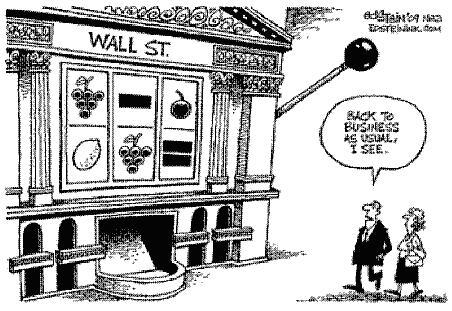
 Print This