 |
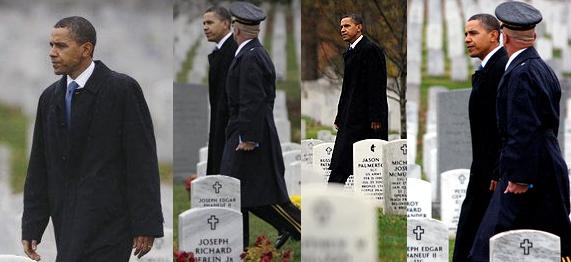
| Obama manages to look very solemn for the Veterans Day photo-ops. |
|
Mine might not be a headline the New York Times would choose, but that’s the story they tell under their flatly descriptive: “How Obama Came to Plan for ‘Surge’ in Afghanistan.”
The narrative reads like a script for NBC’s “West Wing” as it dramatises Obama’s deliberative process and that
seems to have been the object of the exercise for this stellar team of
reporters: paint a picture of presidential solemnity that will inspire
confidence in how Obama makes decisions and thereby drum up a bit of good old-fashioned blind-faith in the presidency.
If there is no inescapable logic to the idea that a faster surge will enable a swifter withdrawal, then — the Times
would have its readers believe — we shouldn’t worry our little heads
about that because our fabulously diligent president has performed an
operation of executive intelligence that renders all further
consideration superfluous.
In a similar vein I’ll spare readers here the tedium of wading through a 4,660-word article and pick out some of the highlights. Actually, to my eye there is really only one point of substance:
Mr. Obama and his advisers … considered options for
stepping up the pursuit of extremists in Pakistan’s border areas. He
eventually approved a C.I.A. request to expand the areas where remotely
piloted aircraft could strike, and other covert action. The trick would
be getting Pakistani consent, which still has not been granted.
For “expand the areas” read: Baluchistan.
If getting Pakistani consent to open a new front in the war simply
comes down to diplomatic finesse, then yes, you could call it a “trick”
managing to get those instransigent Pakistanis to do the right thing.
In reality, it is merely the imperatives of fluent story-telling that compels the Times
to glide over this important detail in the much larger and grimmer
story of the war. Understanding why Baluchistan represents a red line
that Pakistan refuses to abandon is something that Washington might
grasp only when it’s too late.
The matter of most importance both for this administration and for the New York Times has less to do with people, places, history and geography, than it does with high-value words. Words like “surge”.
Obama wants to push in hard so he can pull out fast.
A three-month strategic review thus produced a choreographic solution:
The plan, called Option 2A, was presented to the
president on Nov. 11. Mr. Obama complained that the bell curve would
take 18 months to get all the troops in place.
He turned to General Petraeus and asked him how long it took to get
the so-called surge troops he commanded in Iraq in 2007. That was six
months.
“What I’m looking for is a surge,” Mr. Obama said. “This has to be a surge.”
That represented a contrast from when Mr. Obama, as a presidential
candidate, staunchly opposed President Bush’s buildup in Iraq. But
unlike Mr. Bush, Mr. Obama wanted from the start to speed up a
withdrawal as well. The military was told to come up with a plan to
send troops quickly and then begin bringing them home quickly.
On November 29, after winning the approval of all his immediate advisers, the president moved into action:
Mr. Obama then went to the Situation Room to call
General McChrystal and Ambassador Eikenberry. The president made it
clear that in the next assessment in December 2010 he would not
contemplate more troops. “It will only be about the flexibility in how
we draw down, not if we draw down,” he said.
Two days later, Mr. Obama flew to West Point to give his speech.
After three months of agonizing review, he seemed surprisingly serene.
“He was,” said one adviser, “totally at peace.”
Obama wanted a surge, he’s getting a surge, and it feels good — at least for now.
War in Context





 Print This
  Print This