The Interview Ha’aretz Doesn’t Want You To See
Rehaviya Berman conducted an interview with Ali Abunimah, for Ha’aretz, a few weeks ago. The Interview was never published. Berman decided to publish it on his blog [Hebrew] and I decided to translate it, for your reading pleasure.
Tali Shapiro
-----------------------------------
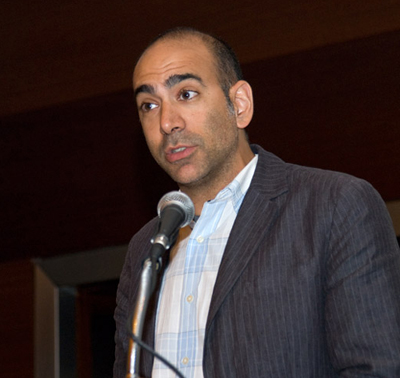 |
| Ali Abunimah of Electronic Intifada. |
|
Meet Ali Abunimah, the son of a Jordanian diplomat, a Palestinian
activist, and the man who brings the hottest news of the struggle to
thousands of people. His message: Forget two states, one will be tough
enough to get it right.
“First of all, it’s important for me to clarify that I’m not a leader, and I’m not interested in being a leader.” That’s
how Ali Abunimah, 38, opens our two and a half hour interview. A
Washington D.C. Born Palestinian, son of Palestinian parents of
different villages in the Jeruusalem area, his mother a native of
Lifta, a 1948 refugee, and his father, a native of of Battir, a 1967
refugee. Abunimah (@avinunu on Twitter) may renounce the label of a
leader, but in the history that will one day be written, it’s probable
that he’ll be described as the “harbinger of electronic revolution”, as
the Electronic Intifada- the name of the website that Abunimah is of
his founders and active members. There are Twitter users with many more
“followers”, but there are very few who seriously deal with the
Isreli-Palestinian issue, feeds voraciously on the web and doesn’t
follow “@avinunu” and “E-Intifada”. He’s also a sought after and
articulate interviewee on news networks such as CNN and MSNBC, for his
consistent representation of the Palestinian position.
Abunimah is one of the most active people on the web in Palestinian
Hasbara, and this without being identified with any of the political
factions. His father, Hasan, served as a senior diplomat of Jordan,
among other things its ambassador to the United Nations. But Ali
doesn’t hesitate to criticize the kingdom where most his relatives live
today, when he finds it’s time to do so. A portrait of a leader in the
internet age- Unidentified, not representative, and doesn’t owe any one.
Recently, Abunimah surfaced into consciousness, after ruining [Ehud]
Olmert’s little apearance-for-profit at Chicago University, when he
abruptly cut his speech with the piercing question about the
dissatisfyingly discriminatory killing that the IDF executed in Gaza, a
year ago. Abunimah was joined by more protestors and Olmert couldn’t go
through his speech as planned.
A few days later, Olmert tried to give a speech in San Francisco,
and as in Chicago pro-Palestinian students got up and drowned his voice
in shouts and protest. Ali Abunimah, in Chicago, wasn’t there for the
second silencing of Olmert, that included an attempt of a “citizen’s
arrest”, but he was there with immediate reports, updates and links to
videos and Twitter, before anyone else, at the front lines of the
unfolding events, as is the case, in the past few years. Nothing of
importance happens in the field or in the virtual space that has to do
with Palestine (but not only) without Abunimah’s keyboard being there
to distribute, sharply comment, connect the incriminating dots, point
fingers and supply background and context to each event.
Inviting Olmert? A “Miserable Decision”
The man himself, as I mentioned, is humble, on the conversation I
had with him on the computer program, Skype. “I organized nothing that
had to do with San Francisco, and I don’t want to talk second hand
about how and what other people are planning.” He also doesn’t want to
talk about other internet activists such as himself, for the
possibility that he may forget to mention someone and that’ll open a
possibility for offense. When I persist,he obliges in mentioning the
International BDS committee, the Palestinian action organization for
boycotting Israel, students and many activists across the USA and the
BDS movement- acronym for Boycott, Divestment, Sanction.
In addition to the clear protest against Olmert’s actions and
against Israel, Abunimah and others wanted to protest the actual
decision to invite Olmert to speak.
“I think it was a miserable decision by The Harris School of Public
Policy Studies, in my university, the University of Chicago, to invite
a man who is- forget the war crimes- suspect of serious corruption
offenses, by his own state, and to pay him tens of thousands of dollars
for a speech. It just inappropriate.”
Be honest, it may have been inappropriate, but it created a great opportunity to get your struggle some headlines.
“It helped, but at the same time, the school could have invited
judge Richard Goldstone to speak about the findings of his report, that
way we would have gotten a debate about the subject and the school
wouldn’t have put itself in a the compromising position of paying an
enormous sum to a corrupt person”.
Similar to the Struggle Against South Africa
I try to stir the conversation to the methods of organization that
have been bringing Abunimah and his colleagues success, lately. But it
seems he’s pleased- in an impeccably polite manner- to disappoint me.
“Not only did I not organize anything, I don’t think there’s such a
quick organizers the likes of which you’re describing,” He says. “These
are very spontaneous actions. Information is very decentralized today
on the web. It reaches many people simultaneously. I feed on the flow
of information more than I contribute to it. I almost want to say that
I’m sorry we’re not more organized, but this is the reality and I think
that in the grander scheme of things, it doesn’t matter.”
It’s a bit strange to hear from a man that grew up in the house of a
professional diplomat that organizing doesn’t matter for the public
struggle, but Abunimah persists: “It’s a fact that the Zionists are
much more organized than we are, in the campuses and an the US in
general, and they have a huge budget, nevertheless, they haven’t
achieved similar success in spreading their message. It’s not that I’m
more skilled at using Twitter than anyone else. It’s because they’re
trying to sell a 19th century message in the 21st century, and
apparently even with 21st century technology, you can’t sell that
merchandise.”
“It’s very similar to the struggle against apartheid in South
Africa, on campuses,” he continues. “The struggle was very
decentralized there, too, and succeeded because of the undeniable
justness of the cause.” This is where Abunimah doesn’t forget to
mention that one of the lone states to keep tight relations with the
apartheid regime in South Africa was Israel.
Beyond the massive volume of his online dealings with the issue, his
education and what he had absorbed in his father’s home, one of the
reasons that people turn to him in order to understand the Middle East
conflict is his considerably rational stance that he vigilantly keeps:
“We don’t boycott Israelis just because they are Israelis or work for
an Israeli institution. If Chicago University would have invited some
Israeli professor, then cutting him off in protest would have been
silencing of freedom of speech. But Ehud Olmert isn’t a private citizen
and it’s obvious he’s a legitimate target for this purpose.”
If You Give Up Territory, You’ll Take it Out on Your Arab Citizens
That said, those of you hoping to find a partner for a rational
debate about coexistence within the two-state framework will be highly
disappointed. Abunimah believes in a single-state solution,
bi-national, completely democratic, in which there’s no state
expression of Jewish/Israeli nationality. He also wrote a book about
it: One Country: A Bold Proposal to End the Israeli-Palestinian Impasse.
”It’s not that I oppose the two-state solution. I don’t think this
solution exists. Those who try to repeat the mistakes of 1948 will find
out that it won’t end less tragically, this time around,” he claims.
And still, let’s say that tomorrow we’re informed that
Netanyahu and Abu-Mazen have signed an agreement that includes the
pulling out of all that’s east of the separation fence and the founding
of some sort of Palestinian state within the confines of what exists?
Before he answers this question, Abunimah specifies the way he sees
the roots of the conflict: “First of all, expulsion of refugees from
their land on a racial basis.”
Are you sure it’s correct to insist on the term “racism” in this context? It’s tribalism, our side and your side.
“Religious-ethnical basis, if you wish. It’s obvious that if they
would have converted, they would have been allowed to stay. The second
point is the racist treatment discriminating Palestinians citizens of
Israel, and the third point is occupation and colonization. Something
resembling a state, headed by Abu-Mazen, or anyone else, only solves
the third point, because you can’t forfeit the right of return in the
name of others.”
There’s a contradiction, or maybe discrimination,
because you expect Israel’s government to give up holy places and
historic regions in the name of the whole of the Jewish people, but
reject the right of the Palestinian government to do so.
“We must discern “rights” that are based on a historical,
half-mythological narrative that refers to events of over 2000 years
ago, from the rights of people that some of which are still alive and
were physically expelled, themselves, from their homes and lands. It’s
obvious that the latter is more pressing than the former,” he argues.
“Referring to your question,” he continues, “do you really believe you can evacuate half a million settlers from their homes?”
I personally believe so, if there’s a will. It was also
thought that it would be impossible to evacuate the Gaza Strip. Most of
the people that need to be evacuated aren’t ideological settlers.
They’ll give him money and he’ll leave, and with the ones that persist
all the way, the security forces will deal with them.
“I don’t believe it’s possible, but even if it is, do you know what
will happen? There won’t be two states that live side by side in peace.
I’ll tell you why: The Israelis will be so full of a feeling that “we
gave up so much, we gave so much. And we’re still stuck with a million
and a half Arabs that only want more and more”, until the nationalism,
aggression and will, that’s hidden within most, to ethnically cleanse,
will surface, so the evacuation of the West Bank won’t solve anything,
and will only change the identity of the Palestinians that are Israel’s
victims. I think Meyron Benbenishty sees the situation clearer than
most Israeli analysts. I often disagree with him about the conclusions,
but hi- analysis of the situation is very correct, in my opinion. He
calls this land, Palestine, the state of Israel, whatever you call it,
“a de-facto bi-national state”, and I agree with this turn of phrase”.
Using the Neighbor’s House as Collateral
Look, the essence of Zionism was to build a shelter
where all Jews could flee in case of pogroms. Will this bi-national
state that you envision insure this right?
This is where Abunimah’s answer splits in two: “Personally, I
wouldn’t object that a bi-national, democratic, equal, state, after all
the wrongs that were done to the Palestinian people are emended, would
make a commitment to receive every persecuted Jew at a time of need.
Palestine has a rich and ancient tradition of as a place of refuge to
the persecuted, near and far, including Armenians, Caucasian tribes,
Africans and also Jews, single people, families and sometimes whole
communities, for generations, have used Palestine as a place of refuge.”
“But principally speaking,” Abunimah retracts, “It’ important to
understand the the Jews of the world aren’t allowed to hold someone’s
house as collateral in case the house they live in now burns. This idea
that it’s the right of a limited number of Jews to hold on to this
land, while oppressing the indigenous population as an insurance policy
for people who don’t live here is absurd. Zionism presumed to create a
safe haven for Jews. In effect, the majority of world Jews choose not
to live in it, it’s a safe haven for no one, and to the people who live
in it, an insurance policy is citizenship in another country,
preferably one in the European Union.”
You ask me if I believe it’s
possible to uproot half a million settlers. Do you really believe that
Israelis and Palestinians can merge into one state?
“I understand your question. Hate exists within both sides and in
order to examine it, we must examine the root of the conflict. But the
major mistake of those dealing with the Israeli-Palestinian conflict is
the thought that it’s so unique. It’s not. In northern Ireland there
are two communities, with a longer lasting conflict, and each one with
its own contradicting narrative, just like us. The colonial dynamics
are also similar. In order to solve the conflict, first there’s need of
recognition of its root causes, recognition of the wrongs, and
recognition of the rights of the victims. Yes, each Palestinian and his
family that has been uprooted from his land has a right to return to
their homes. It’s also not as impossible as it sounds. The state of
Israel has backup plans to receive a million immigrants, if the need
be. So the possibility is there.
But first of all there must be recognition of the right. Then there
can be talk of application. No one promises that thousands of
Palestinians living well in the Middle East and the rest of the world
will run to live in the homeland, and of course there’s the ability of
the existing population to receive immigration, to consider. But the
right has to be acknowledged. First of all there’s a need to erect
institutions and policies and mechanisms that will foster true
equality. Quality accommodations, police that is perceived as an honest
broker and not as a one sided militia. Like Northern Ireland, like
other places, human beings find a way to reconcile and shatter imposed
structures of hate”.
Northern Ireland as an Intermediate Stage
So you do support a solution like in Northern Ireland? Because there the land was distributed.
“It’s true that the island has yet to be united there, and I believe
that in the end it will happen. If there will be an intermediate stage
in which there’s one state for the local indigenous population, like
the Republic of Ireland, and also a completely bi-national state, with
complete equal rights and specific immigration arrangements for each
population (the Northern Ireland Protestants, for example, have a right
to freely immigrate to Britain), then maybe it could work. But who
wants that? There’s this kind of religion of two-states, and I call it
a religion because it doesn’t base itself on evidence. They say that
Israelis really want that, and that Fatah really wants it, and almost
20 years they’re working on it, so how is it that it isn’t happening?
It isn’t happening because no one wants it to happen, because both
sides understand that it’s impossible. It’s only Israel deluding itself
that it can continue sustaining occupation forever, when occupation
itself is an anachronistic term. There can be occupation for a few
months, maybe even a few years, but 40 years of occupation and
settlements and assimilation? The world is beginning to understand
what’s going on and it won’t have it.”
And this is the point where we return to the aims of
sites such as the information site Electronic Intifada and of the BDS
movement.
“That’s right. We believe that in spite of the existence of a very
small Israeli left, the majority of Israelis will be delighted to
continue going to the beach, watch movies and shows and it in good
restaurants, while at a distance of less than a hundred Kilometers from
there children are starving. As long as they don’t understand that the
current policies only bring them suffering, that it constricts their
stride and detaches them from all they want, they won’t want to listen.
We’re waiting for them to be ready.”
Do you know the terms “switch a disc” and ”burn in the consciousness”?
Abunimah elegantly ignores the opportunity to savor the irony and
answers seriously: “There must be a struggle of ideas to change all our
current ideas about our possible future. These are the struggles I
believe in. There’s nothing that binds these struggles to the spilling
of blood.”
A Culture Lesson and Optimism (depends for whom)
You read Hebrew, follow the media here and you also
chose to take a course in Hebrew poetry in the university. Among your
writings we can also find a small effort to promote the works of Jewish
artists of an Arab ethnicity, especially those who created in Arabic.
“Yes, I think that one of the biggest crimes of Zionism was actually
perpetrated against the Jews and their spiritual world. In that it
debased all that was “exile-esque” [גלותי], it detached itself and the
people under its authority from their roots. There was harsh oppression
of both the Yiddish culture and the Jewish-Arabic culture.”
This is correct, and in the past generation there’s a
growing awareness of this, and already a whole generation’s-time it
isn’t shameful to become interested in where the grandparents came from
and to revive their culture. On the contrary.
“That’s right, and it’s wonderful.”
And what about the new Hebrew culture? Is there
something, out of the huge variety that has been created here, that you
can relate to?
“Without a doubt there’s an existing Israeli-Jewish culture, but
it’s very tough for Palestinians to view it out of the prism of the
conflict, not to mention that Israel uses culture explicitly for
Hasbara purposes. The solutions I suggest may free the Israeli-Jewish
culture from these confines and find recognition and respect within
broader circles.”
To conclude, you’re one of the biggest promoters of a
bi-national state in what is today referred to as Israel and the
Palestinian territories. Are you optimistic?
“I’m very optimistic. I think it will happen in the lifetimes of the
1948 refugees. There’s not much time and they should be able to see
justice before they pass on.”
And then you’ll come to live here?
“I can’t say for sure that I will. I don’t know. But I won’t give up my right to do so.”
Pulse Media





 Print This
  Print This