Local
leaders call for dialogue and a full investigation after two campesinos
were killed by police in north-western Peru last week.
On Wednesday afternoon, Vicente
Robledo Ramírez, aged 55 and father of eight children, and Castulo
Correa Huayama, aged 36 and father of six, were shot dead in a
confrontation with national police. Another
six campesinos were wounded and two detained. The police report that
they also sustained several wounded, but further details have not been
released.
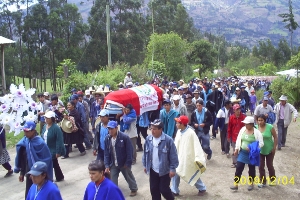
Over
the weekend, a reported 2,000 campesinos turned out to mourn the death
of the men in the remote rural province of Huancabamba where campesinos
have been opposing a Chinese and UK owned mine for the last six years.
The Rio Blanco project is principally owned by the Chinese Zijin
Consortium together with the UK's Monterrico Metals.
Juan
Amancio Romero, son of Vicente, asked authorities “to investigate what
took place and to respect the decisions of the people who don't want
the mine to continue in the area, nor a NGO [believed to be closely
linked to the company] or police.”
The
Front for the Sustainable Development of the Northern Border of Peru
(FDSFNP by its initials in Spanish) also called for further
investigation and reiterated “its will to dialogue” with the
government.
The incident brings the death toll in the area to seven. On Nov. 1, two security guards and the
mine site manager were killed in an armed attack by unidentified
perpetrators at the Rio Blanco mining camp, now the subject of reserved
investigations involving national police. Also, in 2004 and 2005, two
campesinos were killed as result of repression against protests.
According
to the People's Ombudsman (Defensoria del Pueblo), police report that
the deaths last week took place after they detained a man in the area
of the community of Cajas-Canchaque. The regional police chief Walter
Rivera said that the detention was part of investigations into the
November attack on the mine camp and that those implicated in this
prior incident had been refusing to cooperate. President Servando
Aponte of the campesino community challenged the police version saying
that officers acted “arrogantly” and that when they entered the home of
Lorenzo Rojas to detain him that his neighbours came out in his defence
because there was no official warrant for his detention.
For
the last six years, the Rio Blanco project, a proposed open-pit copper
and molybdenum mine, has generated opposition from campesino
communities on whose land it would be located given potential impacts
on water supplies and agricultural activities taking place within the
watershed. As a result, the company has never obtained the two-thirds
approval from local assemblies that it is required to have by law in
order to operate in the area. On Sept. 16,
2007, three rural districts in Huancabamba and Ayabaca participated a
popular referendum and reaffirmed their opposition to the mine in which
a majority voted against any mining activity in the area.
Earlier
attempts
at dialogue broke down because of government refusal to
discuss the results of the 2007 referendum. Since then, around 300
local leaders have faced legal processes believed to be a means of
political persecution for their role in the referendum. Most recently,
tensions have risen following the Nov. 1 attack on the mining camp for
which it is believed that those opposed to the mine are being
principally targeted as part of investigations by national police.
A Single Hypothesis
Javier Jahncke of the Ecumenical Foundation for Development and Peace (Fedepaz), whose organization is
part of a national network that promotes the sustainable use of natural
resources and the rights of rural and indigenous communities, says they
have concluded that police are leading investigations into the November
incident “with a single hypothesis in which they assume that the
campesinos were the authors of the crime.”
The
day
following the attack the FDSFNP, a coalition of local community
leaders opposed to the mine, expressed its condolences for the deaths
and urged that thorough investigations take place. According to the
Peru Support Group, the UK company Monterrico Metals was also “quick to
distance itself from any accusations blaming local community groups for
this latest violence and indeed thanked local communities for the help
they showed the mine camp's employees who escaped the attack.”
However,
Jahncke is
concerned that police have set aside other possible explanations for
the attack to focus on the possible involvement of the mine's
opponents. He suggests other theories, such that Rio Blanco's workers
might have been killed as part of an attempted robbery or that there
was a dispute among workers that led to reprisals, are being ignored.
He notes that they have not been privy to evidence being considered as
part of investigations since they have been reserved by police.
A
congresswoman from the northwestern department of Piura has also
received testimonies that police have detained and tortured people in
local communities as part of efforts to gain confessions concerning the
attack.
Jahncke
further questions the timing of the recent violence given that a judge
in the English High Court has only recently upheld an injunction to
freeze the assets of Monterrico Metals saying that 29 men and women
from Piura have a “good arguable case” against the company for
allegations of abuses which took place at the Rio Blanco mine site in
2005.
“This
lawsuit has seriously affected the image of the company Monterrico
Metals,” says Jahncke, “and by extension, Zijin.” This raises questions
in his mind about the recent violence and how it is being dealt with
“because of who is being affected by this situation, and if it isn't
the same campesinos that have been resorting to international channels
to be able to be heard since such a process has not begun in their own
country.”
Fears of Militarization
As a result, Jahncke sees last week's violence as part of a “clear effort at any cost” to make way for the mine. He
fears that by creating the public perception of a rural population that
is “unmanageable” and “violent” that the state will be able to “justify
the militarization of this area.”
Only
days after the November attack on the mining camp, Peruvian Prime
Minister Velásquez Quesquén indicated that the government was
evaluating the possibility of installing a military base in the area.
The
General Manager Jian Wu of the principal stakeholder in the Rio Blanco
project, the Chinese Zijin Consortium, was present at the meeting.
However,
says Jahncke, “These conflicts cannot be resolved with the military
protecting the company operations. This will just put more fuel on the
fire and generate more conflict... For this to go ahead would be the
worst thing possible.”
Overall,
he is concerned that the government continues to favour the company's
presence “over the property rights of the communities.”
He
concludes, “Until this situation is seen as the rights of some being
preferred over the rights of others, in a situation that is not legal,
and in which rights have been violated for a long time, the problem
will not be solved and you will see decisions that will collide with
community rights and the conflict will continue to grow, which is what
we least want and what hopefully the state least wants to see happen as
well.”
Upside Down World





 Print This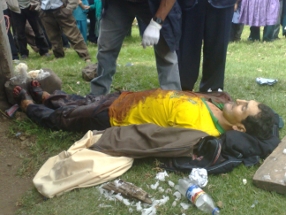
 Print This