 |
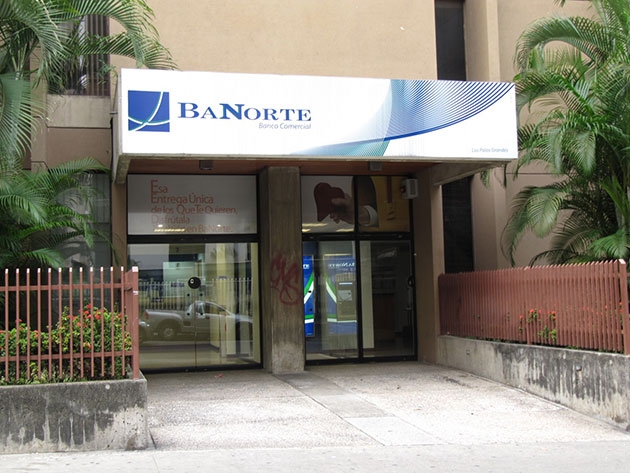
| BaNorte, the most recent bank to come under national investigation (YVKE) |
|
After national investigators announced that several banking
executives are suspected to have fled the country to avoid fraud
charges, Venezuelan President Hugo Chavez ordered the seizure of the
bankers’ financial and non-financial assets.
On Thursday, a prominent banker named Eligio Cedeño was scheduled to
appear in court, where he is charged with stealing millions in
depositor money. Cedeño is the former president of the Canarias and
Bolivar banks, which are among the eight banks in which the government
intervened over the past two weeks in a crack down on banking fraud.
However, a district judge granted Cedeño conditional freedom from
police custody, and Cedeño never attended his hearing. Police now
suspect he has fled the country; he is the fourth banker suspected of
doing so since public prosecutors issued arrest warrants for ten
bankers and prohibited nineteen others from leaving the country last
week.
Meanwhile, police arrested the judge who freed Cedeño from police
custody, alleging that she broke laws governing judges’ contact with
suspects during trials.
Asset Seizures
In public announcements on Thursday, President Chavez ordered
authorities to seize the assets of several bank owners who are charged
with fraud.
“The battle that we are waging against these bankers who sabotaged
and robbed many people is advancing rapidly,” Chavez declared.
“In this moment, I have ordered the takeover of tuna, fish, corn
processing, and rice companies, as well as [the bankers’] estates and
cattle... this will become wealth for the people,” Chavez continued.
The state also seized “more than 700 trucks from a transportation
company” that will now be “at the service of social production and
socialism,” said Chavez.
Many of these companies currently provide services to the
government’s subsidized food markets, and many are owned by Ricardo
Fernandez, the principal stockholder in four of the banks that are
under investigation. The Trade Ministry already intervened in the
administration of Fernandez’s companies last week in order to prevent
their collapse as a result of their owner’s arrest.
“We are confronting these problems in a coordinated manner with the
whole state, and we are recuperating companies that were forming a kind
of network,” said Chavez. “We cannot wait until tomorrow. At the first
sign, [we must take] immediate action and inexorable application of the
established laws and procedures.”
Attorney General Luisa Ortega filed requests for the seizure of the
bankers’ assets, and said public prosecutors will soon request that the
bankers’ assets abroad be frozen as well. She also emphasized that the
current intervention in the banking sector does not signify a financial
crisis, but “a specific case in which the owners of banks allegedly
committed crimes envisaged in the banking laws.”
Battle against Corruption
Chavez’s announcements on Thursday left no doubt that the government
is waging a full-scale battle against corruption in the financial
sector.
The state is cracking down on corruption, among the opposition
sectors and supporters of Chavez. On Thursday, President Chavez
appointed a new minister for science and technology, Ricardo Menendez.
Menendez replaced Chavez’s long-time ally, Jesse Chacon, who resigned
last week after his brother, Arne Chacon, was arrested on charges of
banking fraud.
“The traitors have many forms of connecting with each other, and we
have to unmask them. There are many forms of committing treason against
the revolution,” said Chavez. “To sell one’s values is treason against
the revolution. To steal even one bolivar, to not work, to be lazy, is
treason. To be selfish is treason, to neglect volunteer social work is
treason,” said the president.
Out of the eight banks that came under investigation in the last two
weeks, two of them, Confederado and Bolivar, were nationalized; and two
others, Canarias and Provivienda, were liquidated. Two others, Central
Banco Universal and Banco Real, will be incorporated into the
state-owned bank Banfoandes along with the nationalized banks,
according to Chavez’s announcements on Thursday.
The government transferred the deposits of the liquidated banks to
the state-owned Bank of Venezuela, and depositors have the choice of
withdrawing or transferring their money, or opening an account in the
Bank of Venezuela. So far, the approximately 30,000 depositors have
been processed, according to the government.
The president also ordered an increase in the amount of deposit
insurance offered by the government from 10,000 bolivars per depositor
to 30,000 bolivars per depositor. This will require banks to increase
their monthly contribution to the insurance fund from .5% to 1.5% of
total deposits, said the president.
The National Assembly is scheduled to renew its debate on reforms to Venezuela’s banking laws next week.
Venezuelan Analysis





 Print This
  Print This