Scientists have unlocked the entire genetic code of
two of the most common cancers - skin and lung - a move they say could
revolutionise cancer care.
Not only will the cancer maps pave
the way for blood tests to spot tumours far earlier, they will also
yield new drug targets, says the Wellcome Trust team.
Scientists around the globe are now working to catalogue all the genes that go wrong in many types of human cancer.
The UK is looking at breast cancer, Japan at liver and India at mouth.
China is studying stomach cancer, and the US is looking at cancers of the brain, ovary and pancreas.
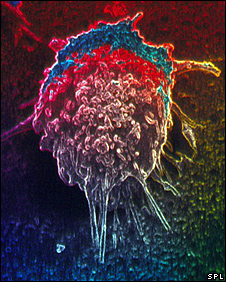 |
| Scientists are looking for new ways to fight lung cancer. (SPL) |
|
The International Cancer Genome Consortium scientists from the 10
countries involved say it will take them at least five years and many
hundreds of thousands of dollars to complete this mammoth task.
But once they have done this, patients will reap the benefits.
Professor
Michael Stratton, who is the UK lead, said: "These catalogues are going
to change the way we think about individual cancers.
"By
identifying all the cancer genes we will be able to develop new drugs
that target the specific mutated genes and work out which patients will
benefit from these novel treatments.
"We can envisage a time when following the removal of a cancer cataloguing it will become routine."
It
could even be possible to develop MoT-style blood tests for healthy
adults that can check for tell-tale DNA patterns suggestive of cancer.
Russian roulette
The scientists found the DNA code for
a skin cancer called melanoma contained more than 30,000 errors almost
entirely caused by too much sun exposure.
The lung cancer DNA code had more than 23,000 errors largely triggered by cigarette smoke exposure.
From this, the experts estimate a typical smoker acquires one new mutation for every 15 cigarettes they smoke.
Although many of these mutations will be harmless, some will trigger cancer.
Wellcome
Trust researcher Dr Peter Campbell, who conducted this research,
published in the journal Nature, said: "It's like playing Russian
roulette.
"Most of the time the mutations will land in innocent parts of the genome, but some will hit the right targets for cancer."
By quitting smoking, people could reduce their cancer risk back down to "normal" with time, he said.
The suspicion is lung cells containing mutations are eventually replaced with new ones free of genetic errors.
By
studying the cancer catalogues in detail, the scientists say it should
be possible to find exactly which lifestyle and environmental factors
trigger different tumours.
Treatment and prevention
Tom Haswell, who was successfully treated 15 years ago for lung cancer, believes the research will benefit the next generation:
"For
future patients I think it's tremendous news because hopefully
treatments can be targeted to their particular genome mutations,
hopefully... reducing some of the side effects we get".
Cancer experts have applauded the work.
The
Institute of Cancer Research said: "This is the first time that a
complete cancer genome has been sequenced and similar insights into
other cancer genomes are likely to follow.
"As more cancer
genomes are revealed by this technique, we will gain a greater
understanding of how cancer is caused and develops, improving our
ability to prevent, treat and cure cancer."
Professor Carlos Caldas, from Cancer Research UK's Cambridge Research Institute called the research "groundbreaking".
"Like
molecular archaeologists, these researchers have dug through layers of
genetic information to uncover the history of these patients' disease.
"What is so new in this study is the researchers have been able to link particular mutations to their cause.
"The
hope and excitement for the future is that we will eventually have
detailed picture of how different cancers develop, and ultimately how
better to treat and prevent them."
BBC News





 Print This
  Print This