A plainclothes cop walks
into a diner and finds no less than five gun-wielding criminals holding
up the crowded joint. “We’re not just going to let you walk out of
here,” the cop says. “Who’s we, sucka?” says one of the criminals.
“Smith and Wesson and me,” says the cop. He draws his Smith &
Wesson and – in a crowded diner – shoots four of the criminals and
advances on the last gunman, who’s holding a pistol to a hostage’s
head. One itchy trigger finger and the hostage could be dead. The cop
glares at the criminal. “Go ahead, make my day.” The cop is “Dirty
Harry” Callahan, but really he could be any Hollywood hero. The movie
is Sudden Impact, but really it could be any movie or book or manifestation of Western culture.
With a few modern updates, Western culture has been re-creating the same story over and over again since Homer collected The Odyssey
more than two and a half thousand years ago. Since the Greeks, the
ideal of the unique and strong individual has become so prevalent in
Western culture that we have stopped realizing that it is even part of
our culture. Often we mistake our perceptions of the world for how the
world really is.
Psychologists have long known that North Americans overestimate
their own distinctiveness, especially in comparison with East Asians.
When asked to describe themselves, Americans and Canadians tend to talk
about their individual personality and personal outlook more than
Japanese do. North Americans tend to settle arguments in terms of right
and wrong, whereas East Asians tend to seek compromises. Dirty Harry is
an extreme and violent example, but he is emblematic of Western culture
and he sums up our single-minded, goal-oriented behavior with aplomb.
“When I see an adult male chasing a female with the intent to commit
rape, I shoot the bastard. That’s my policy.”
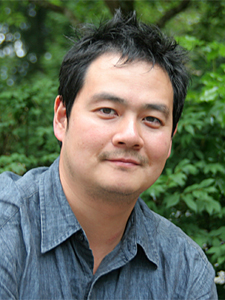 |
| Dr. Takahiko Masuda, University of Alberta |
|
New research shows that culture even affects our cognition. A study published in the Journal of Personality and Social Psychology
claims that Americans and Japanese intuit the emotions of others
differently based on cultural training. “North Americans try to
identify the single important thing that is key to making a decision,”
explains Dr. Takahiko Masuda, the study’s author, over the phone from
his office at the University of Alberta. “In East Asia they really care
about the context.” He studied the eye movement of Americans and
Japanese when analyzing a picture of a group of cartoon people. When
asked to interpret the emotion of the person in the center, the
Japanese looked at the person for about one second before moving on to
the people in the background. They needed to know how the group was
feeling before understanding the emotion of the individual. The
Americans (and Canadians in subsequent studies) focused 95% of their
attention on the person in the center. Only 5% of their attention was
focused on the background, and this, Dr. Masuda points out, didn’t
influence their interpretation of the central figure’s emotion. For
North Americans the foreground is all-important.
See more of Dr. Takahiko Masuda's research here.
|
Dr. Masuda is quick to point out that Americans and Japanese are
physiologically the same. The difference in eye movement is tied to the
roots of our respective cultures. When trying to explain the natural
world, the Ancient Greeks – the founders of Western civilization –
tended to focus on central objects and sought to explain their rules of
behavior. Funnily enough, Aristotle thought a rock had the property of “gravity.” It didn’t occur to him that a system
was working its powers on the rock. The Chinese on the other hand took
a more holistic approach. They believed that everything occurred within
a context, or a field of forces, and thus they unraveled the
relationship between the moon and the tides.
These differences in philosophy can be explained, at least in part,
by the environments that spawned them. “We are surrounded by socially
created information, which affects our perception,” Masuda explains.
And perception affects our culture. Research shows that North American
cities are less cluttered than East Asian cities, which means that
North Americans can spend more time considering salient objects. When
Americans or Canadians visit East Asia, they are often overwhelmed by
the amount of information they have to process. I have experienced this
phenomenon personally. The first time I bused from Incheon Airport into
Seoul, South Korea, I was dumbfounded by the number of buildings,
advertisements, lights, cars and people and had to turn away from the
window to stop my head from spinning. Dr. Masuda first arrived in North
America when he was 26. Compared to Japan, which was crowded with
people and objects and “complex pieces of information,” he felt North
American cities to be lonely places.
Masuda stresses that no way of perceiving the world is better than
another and refuses to interpret his studies too broadly. He has yet to
conduct his tests in Africa or South America. But it seems to me that
Masuda’s study is important: It reminds us that there is more than one
way of seeing the world.
North Americans have a tendency toward isolating singular goals and
working doggedly towards them. And we have achieved some remarkable
accomplishments. We put a man on the moon, invented the telephone and
the airplane and achieved a thousand more seemingly impossible tasks.
We congratulate ourselves on our individualism in our movies, our art,
our personal relationships and, of course, our politics. But as we do
so, we perpetuate this trait – perception informs culture, culture
informs perception – until we mistake the way we see the world for the
only way to see the world.
As alluring as the Dirty Harry approach may be, is it time to put away our Smith &
Wesson and start considering the other customers in the diner? The
problems we face today – the environmental degradation of our planet,
global recession, religious fundamentalism – don’t fit inside borders
or simple categories. Context is unavoidable. We need to start looking
for it.
Adbusters





 Print This
 Print This