 |
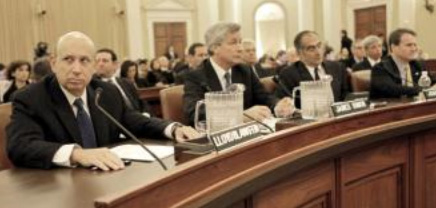
| Lloyd Blankfein, CEO of Goldman Sachs gives congressional testimony with other heads of banks: James Dimon (JPMorgan Chase), John Mack (Morgan Stanley), and Brian Moynihan (Bank of America) |
|
THE TIMING couldn't have been better for the Financial Crisis Inquiry
Commission, which held its first public hearings on January 13-14.
With their top employees set to enjoy huge bonuses thanks to taxpayer
bailouts, the CEOs of the country's big banks should have been in the hot seat
for their role in the financial panic of 2008. The Obama administration's
proposed levy on banks seemingly would have upped the pressure, too.
Instead, the bankers got away with a few sharp words and some finger-wagging
by commission members. Commission Chair Phil Angelides, a Democrat and former
state treasurer of California, sparred a bit with Goldman Sachs CEO Lloyd
Blankfein and hectored other bank executives. But Angelides was only posturing.
His commission has failed to make use of the few tools that it has to
investigate the banks reckless practices that helped cause the meltdown.
Even the New York
Times editorial board was taken aback by the commission's failures:
[T]he commission--which is supposed to file a final report by December
15--has not issued a single subpoena for documents. Instead, investigators have
apparently been relying on voluntary cooperation, public records and
information-sharing agreements that have been negotiated with federal agencies.
A thorough investigation requires source documents that reveal what people were
thinking and doing at the time of the events, and that illuminate, buttress or
contradict testimony.
Instead of a serious inquiry, Angelides settled for giving the bankers a
tongue-lashing, even as his party quietly tends to Wall Street's interests.
That's in keeping with the Democrats' approach to the financial crisis since
it broke in the fall of 2008. It was the Democratic Congress that worked with
the Bush administration to pass the $700 billion Troubled Asset Relief Program
(TARP) bill that funded the bank bailout.
And it was Treasury Secretary Tim Geithner, then head of the Federal Reserve
Bank of New York, who insisted that the nationalized insurance company AIG pay
its debts at 100 cents on dollar--which meant that tens of billions in U.S.
taxpayer money flowed through AIG into the coffers of big U.S. and European
banks. AIG paid $12.9 billion of taxpayer money to Goldman Sachs--and now,
Goldman is set to pay out around $22 billion in bonuses.
But the AIG-Goldman scam is only the most obvious of the Obama
administration's giveaways to Wall Street. So far, the U.S. government has
loaned or guaranteed up to $13 trillion to financial institutions and other
businesses--a figure nearly the size of the entire annual economic output of the
U.S.
The rationale for this aid, we were told, is that it would prevent a total
economic collapse and get credit flowing to businesses and consumers once again.
The bailouts did pull the financial system back from the brink. Thanks to
near-zero interest rates set by the U.S. Federal Reserve, the banks can borrow
cheaply and use the money to finance investments where a higher return seems
certain.
For example, some banks are borrowing from the government at virtually no
interests and buying U.S. Treasury bills that pay much higher interest. That is,
the banks are borrowing from one part of the U.S. government and profiting by
lending it back to another part of the government at a much higher rate. Many
financial institutions are also using funds borrowed from the Fed to invest in
foreign currencies to gain higher returns--the so-called carry trade.
But when it comes to helping hard-pressed working people, the bankers aren't
interested. Despite a ballyhooed government program to spur banks to help
homeowners who are underwater on their mortgages, the federal Home Affordable
Modification Program has permanently helped only 66,000 homeowners out of 4
million that may be eligible--even as foreclosures rise from 2.8 million in 2009
to an expected 3 million in 2010.
Instead, the banks are using government money to pad their balance sheets and
help them absorb losses resulting from risky investments in complex financial
instruments tied to mortgages.
- - - - - - - - - - - - - - - -
GIVEN THE banks' egregious role in the crash and their hoarding of government
cash amid the recovery, one might have expected that financial reform
legislation would be inevitable. Instead, Wall Street lobbyists have spread
enough money around both sides of the aisle in Congress to kill any meaningful
reform. Even the weak proposed consumer financial protection agency has been
pronounced dead.
As journalist
Chris Hedges put it:
These corporations don't make anything. They don't produce anything. They
gamble and bet and speculate. And when they lose vast sums, they raid the U.S.
Treasury so they can go back and do it again.
Never mind that $50 trillion in global wealth was erased between September
2007 and March 2009, including $7 trillion in the U.S. stock market and $6
trillion in the housing market. Never mind that the total amount of retirement
and household wealth trashed was $7.5 trillion, or that we saw $2 trillion in
401(k)s and individual retirement accounts evaporate. Never mind the $1.9
trillion in traditional defined-benefit plans and the $2.6 trillion in
non-pension assets that went up in smoke. Never mind the job losses, the
foreclosures and the 35 percent jump in personal and small-business
bankruptcies.
There are bundles of new money, taken again from us, to make deals and hand
out outrageous bonuses. And when these trillions run out they will come back for
more until our currency becomes junk.
So what about President Barack Obama's plan to squeeze the banks with a
special tax to recover $117 billion from the bailout?
At first glance, it seems like a delayed, but welcome, bid to claw back
taxpayer funds. But the proposed tax would be just a 0.15 percent levy on assets
beyond the banks' core capital--and it would be paid over a decade. All that
does is turn a taxpayer giveaway into a loan at rock-bottom interest rates. As
the Washington Post noted, "At a projected $9 billion per year, the
fee would be a mere sliver of the banks' estimated quarter-trillion-dollar
pre-tax profits."
Congressional Democrats, who are already panicking over their prospects in
the November elections, will pick up the banner of Obama's proposed bank tax to
try to get in front of voters' anger. But the Wall Street-White House axis has
already provided the Republicans with an incredible political gift.
Suddenly, right-wing politicians who usually serve as a mouthpiece for big
business are railing against the injustice of bailing out bankers while working
people have nowhere to turn. Of course, these Republican hacks are only playing
to the right-wing populist "tea party" crowd. They'd never seriously challenge
the business agenda.
But thanks to the Democrats' devotion to the bankers, the Republicans can
loudly denounce government bailouts to big business even as they further
Corporate America's agenda.
Whichever party is in office, the bankers win.
Socialist Worker




 Print This
  Print This