Honduras : Micheletti Becoming 'Second Pinochet'?
 Print This Print This
By David Holmes Morris
The Rag Blog
Thursday, Jan 21, 2010
Honduran coup consolidating
power:
Micheletti named 'Congressman
for Life'
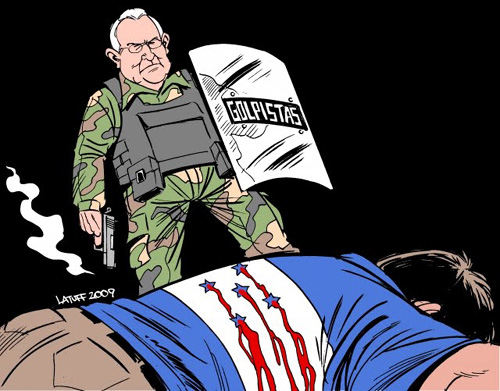 |
| (Carlos Latuff/IndyBay) |
|
As violent repression continues, the powers that be in Honduras have taken
symbolic and substantive steps to consolidate the coup d’état that deposed President Manuel
Zelaya last June 28.
The unicameral legislature has voted to name de
facto president Roberto Micheletti congressman for life, thus granting him
immunity forever from prosecution for crimes committed in connection with the
coup. Micheletti was president of the legislature at the time that body named
him to replace Zelaya in an act defenders of the coup insist was a
constitutional presidential succession.
Bolivian
President Evo Morales said the Honduran legislature has thus made Micheletti a
“second Pinochet.” Augusto Pinochet, the bloody dictator who ruled Chile after
the coup of 1973, had himself declared “senator for life” in 1989.
The
legislature left consideration of the question of a general amnesty for actions
taken in relation to the coup to the incoming government, thus avoiding the
question of legal action against Zelaya for his alleged crimes, which the golpistas claim as justification for deposing
him.
Meanwhile, the Honduran National Association of Industrialists held
a private ceremony recently at the home of wealthy businessman Adolfo Facussé to
honor Micheletti as a “true patriot” and “the first hero of Honduras in the 21st
century.” As he accepted the plaque the group presented him, Micheletti told the
audience, which included General Romeo Vásquez Velásquez and other military
commanders, that he had never doubted he had the support of the armed forces and
the police but “most importantly, God was with us.”
Vásquez Velásquez,
head of the joint chiefs of staff, led the group of soldiers that abducted
Zelaya on June 28 and delivered him to the airplane that flew him to Costa Rica.
And Adolfo Facussé is widely thought to have instigated the coup and to have
helped finance it. He and other members of the Honduran oligarchy are reported
to have distributed sizeable cash payments to military commanders and other
government officials immediately before Zelaya was kidnapped.
The
legislature has further guaranteed Micheletti’s safety by providing personal
body guards from the armed forces or the national police or, if government
personnel become unavailable, from private security firms, for the rest of his
life. Micheletti’s family will also have body guards. Some 50 other members of
the golpista government will be given
similar protection, including the attorney general, the six top commanding
officers of the armed forces, 17 ministers of the Micheletti regime and their 17
vice-ministers, and the president of the supreme court, the body that provided
the legal pretext for the coup.
Despite pressure from inside Honduras and
outside the country, Micheletti has refused to relinquish office until January
27, when the legitimate president’s term officially ends and President-elect
Porfirio Lobo takes office. In the meantime, Manuel Zelaya, the constitutionally
elected president, remains in the Brazilian embassy, where he has been in refuge
since entering the country secretly last September. Zelaya has rejected offers
of political asylum, insisting he be treated as the legitimate head of the
government.
The United States, Costa Rica, Colombia, Panama and Peru are
the only countries in the world so far to pledge to recognize the Lobo
presidency as legitimate.
In San Pedro Sula, the country’s second largest
city, a new street leading to a branch of the National Autonomous University has
been named Roberto Micheletti Boulevard.
In other actions, the
legislature has voted to withdraw the country from the Alternativa Bolivariana de las Américas (ALBA
– The Bolivarian Alternative for the Americas), proponents of the move arguing
that it violates the principles of self-determination and non-intervention.
Honduras’s membership in the regional affiliation was proposed by Zelaya and was
initially approved by the legislature, including then legislative president
Roberto Micheletti, but was attacked by conservatives adamantly opposed to the
leftist governments of Latin America making up ALBA and particularly to the
Venezuelan government and President Hugo Chávez, bête noire of the Honduran right. Membership
in ALBA was one of the factors that brought about the coup.
Tiempo, the only mainstream newspaper in the
country opposed to the golpista
government, says withdrawal from ALBA will cost the country 100 million dollars
in bonds purchased by Venezuela from the Honduran National Bank of Agricultural
Development, 100 tractors, money to teach literacy, technical support for
development of a government television channel, scholarships for medical
training and funds to establish enterprises to produce generic drug.
And
the minimum wage for Honduran workers, another sore point for the right, appears
likely to remain at the level established in January 2009 when a 60 percent
increase sponsored by Zelaya took effect, at 5,500 lempiras a month, about 290 U.S. dollars, for
urban workers, and 4,055 lempiras, or
$215.00 , for rural workers. After negotiations between union leaders and
business owners broke down last week, the final decision will be left to the
incoming president, Porfirio Lobo, who is more likely to decree a reduction than
an increase. The unions had initially proposed a 30 percent increase.
The Rag Blog
 Print This Print This

|