The dramatic events that unfolded
recently in the small southern Italian town of Rosarno highlight the
terrible conditions that immigrant workers have to suffer in many parts
of Europe. The bosses try and use the tactic of “divide and rule” to
pit poor immigrant against poor Italian workers. It is the task of the
labour movement organisations to offer an alternative and campaign to
unite all workers against the real enemies, the bosses.
 The
recent developments in a little town called Rosarno in southern Italy
reveal that in “civilised” Europe we already have elements of
barbarism, which are being aggravated by the economic crisis. Rosarno
is situated in the southern Italian region of Calabria, on the toe of
the boot. On 7th January hundreds of immigrant workers from
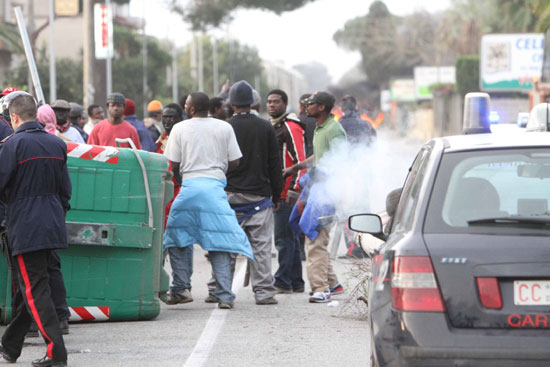
Africa were rampaging through the town, setting fire to rubbish bins,
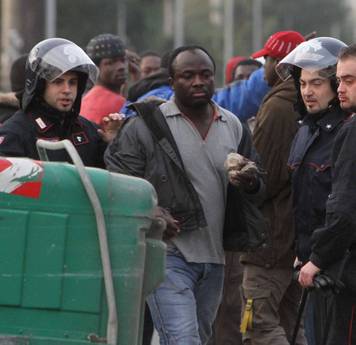
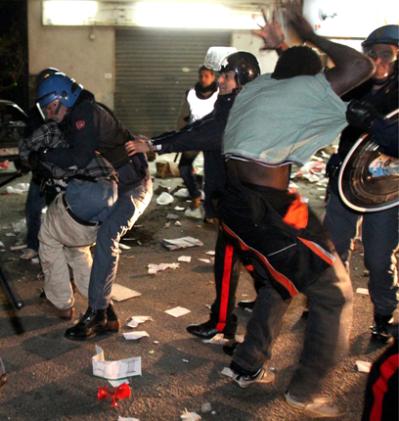
destroying shop windows and cars on their way and conducting a street
battle with the police. The trigger for this sudden explosion of anger
was when earlier in the day two Italian youths opened fire with an air
gun from a car, shooting and wounding two workers from Africa who earn
their money fruit picking in the town. One of them is an officially
recognised political refugee from Togo with legal papers to reside in
Italy.
The
recent developments in a little town called Rosarno in southern Italy
reveal that in “civilised” Europe we already have elements of
barbarism, which are being aggravated by the economic crisis. Rosarno
is situated in the southern Italian region of Calabria, on the toe of
the boot. On 7th January hundreds of immigrant workers from
Africa were rampaging through the town, setting fire to rubbish bins,
destroying shop windows and cars on their way and conducting a street
battle with the police. The trigger for this sudden explosion of anger
was when earlier in the day two Italian youths opened fire with an air
gun from a car, shooting and wounding two workers from Africa who earn
their money fruit picking in the town. One of them is an officially
recognised political refugee from Togo with legal papers to reside in
Italy.
It is not the first time African workers have protested in Rosarno.
In December 2008 two immigrant workers were shot and seriously wounded.
Then African workers also protested – at that time peacefully ‑ against
the way they were being treated and against their appalling living and
working conditions. This protest also led to the arrest of three
businessmen, as they had clearly been holding workers in slave like
conditions.
The region where Rosarno is situated is controlled by the
’Ndrangheta, the Calabrian mafia. They control everything. At their
will factories are opened and closed, especially the ones for the
processing of agricultural products like olives and oranges. In this
way they also get subsidies from the state and the European Union for
the “development” of the south. In 2007, for example, such a subsidies
fraud was exposed.
Around 2,500 immigrant workers were living in and around Rosarno.
They were either living in abandoned factories or shanties made out of
cardboard and wooden boards. For the 1,000 workers who lived in an
abandoned factory there were only 8 toilets and 3 showers. There was no
electricity and until last year no running water. The living conditions
of these workers were described by Médecins Sans Frontières (Doctors without Borders) simply as “terrible”.
Immigrant farm labourers earn around 25 Euros for a 12 to 14 hour working day. According to The Economist out of this they often “cede €5 to overseers suspected of links with the ’Ndrangheta.”
According to the CGIL trade union, about 50,000 immigrant workers
around the country live in poor conditions similar to those in Rosarno.
The union also says immigrants are paid “miserable salaries and have
terrible hours, similar to slavery”.(1)
All this hardship has been inflicted on these people after they left
their home countries, escaping from misery, unemployment, war and
famine. Tens of thousands of Africans – asylum seekers, political
refugees and unemployed ‑ every year attempt to make their way to
Europe in the hope of a better life. On their way they are often handed
from smuggler to smuggler, who make their money out of these desperate
people, and they are packed into makeshift boats trying to cross the
Mediterranean Sea, trying to reach countries like Italy, Spain, Malta
or Greece. An unknown number of them do not arrive at their destination
as they drown on the open sea after their boats sink. The bosses in
Europe then exploit these “illegal” immigrants, counting on the fact
that they will not rebel as they could easily be deported.
The Orange crop
 In
1992 the first African workers arrived in Calabria. They were forced to
work for very little money – being made to pay by the bosses for the
falling price of oranges in the recent years. But this year there was
not much work to do. The last season saw a much lower level of
production of oranges due to bad weather. But more importantly, oranges
from Rosarno became uncompetitive on the world market. The Economist writes:
In
1992 the first African workers arrived in Calabria. They were forced to
work for very little money – being made to pay by the bosses for the
falling price of oranges in the recent years. But this year there was
not much work to do. The last season saw a much lower level of
production of oranges due to bad weather. But more importantly, oranges
from Rosarno became uncompetitive on the world market. The Economist writes:
“On December 11th the Italian farmers’ confederation said that the
local citrus industry had been made ‘unsustainable’ by a flood of cheap
Spanish oranges and Brazilian orange juice. Imported concentrate could
be bought for €1.27 a kilo—53 cents less than production cost in Italy.
The Rosarno riots were thus partly about the failure of southern
Italy’s economy to cope with globalisation.“
We also read in the same article that:
“[…] many farmers preferred to leave their fruit to rot because it
would cost more to get it picked than they could earn selling it. The
lack of work (and profit) intensified the bitterness among outsiders
and locals alike.”(2)
Antonio Lupini, vice-president of the local farmers’ association, told the daily newspaper Corriere della Sera that 800 million kilograms of citrus fruit were rotting on the trees.(3)
This portrays in a twofold way the insanity of this inhuman economic
system. Tons and tons of foodstuff is lying waste in the field, while
millions of people worldwide suffer hunger, and thousands of workers
who are ready to work in order to earn their living are forced to sit
around doing nothing. These workers were only useful to their employers
as long as they could make money out of them, when they were treated
with disdain and forced to live like animals. This is the real reason
behind the latest rebellion in Rosarno. The racist attack was only the
straw that broke the camel’s back. The workers have said enough is
enough and have rebelled.
The rebellion continues
One day after the above mentioned rebellion the protest continued.
The protestors carried placards saying “We are not animals”, calling
attention to their desperate situation. They marched to the town hall
where they demanded to see a government representative. The situation
got heated when local residents set up a barricade near a meeting place
for the immigrants. Media reports say that despite heavy police
presence two immigrants were beaten with metal bars so ruthlessly, that
one of the wounded had to be taken to hospital for brain surgery. Five
other immigrants were deliberately run over by vehicles and two other
immigrants were hit in the legs with shotgun pellets. In all 67 people
were injured: 31 immigrants, 19 police and 17 residents.
 Francesco
Forgione is a former head of Italy's parliamentary anti-mafia
commission. He said that “This is the very first time the Africans
rebel against the local 'Ndrangheta mafia which dominates the fruit and
vegetable businesses.” He continued that, “during their protest they
even surrounded the house of an old boss in the Pesce clan, which is
powerful locally, something the Calabrians have never done.”(4)
Francesco
Forgione is a former head of Italy's parliamentary anti-mafia
commission. He said that “This is the very first time the Africans
rebel against the local 'Ndrangheta mafia which dominates the fruit and
vegetable businesses.” He continued that, “during their protest they
even surrounded the house of an old boss in the Pesce clan, which is
powerful locally, something the Calabrians have never done.”(4)
A few days later, on January 11, bulldozers began demolishing the
shanty towns and the few possessions the fruit pickers had. Over 1,000
African workers had either been evacuated by police or had fled
voluntarily. Seven of them were left behind in local hospitals,
recovering from gunshot wounds and savage beatings. These workers were
brought to holding centres in other parts of the south. The prefect of
Bari, where 324 immigrants were taken to, said more than half of those
who had been examined had temporary residence permits. The others were
taken for internment at a so-called centre for identification and
expulsion.
Racism – divide and rule
The interior minister, Roberto Maroni, who is from the right-wing
and xenophobic Lega Nord [Northern League] party, claimed the tensions
were a result of “too much tolerance towards clandestine immigration”,
thus trying to put the blame on the African workers. But in fact,
millions of immigrants, from Africa or Eastern Europe, are an important
pillar of the Italian agricultural economy, especially of the south.
Through racist laws, or the fact that many of them are illegal in
Italy, they constitute a very cheap labour force. According to The Economist, “many sustain parts of the economy that would otherwise be uncompetitive.”
In a video published on France24, the news agency says that
“some accuse the African workers of stealing their jobs, but Human
Rights organisations say many Italians refuse to do the backbreaking
work the immigrants accept in order to survive.” The interviewer in
this video asks a local farmer “Who will pick the mandarins now?”, to
which he replies “That is a question that neither I nor the others can
answer.”(5)
So when Roberto Calderoli from the Lega Nord suggests that with
unemployment at 18% in the south, jobs should go to Italian citizens,
this is pure demagogy.
 The
Berlusconi government is on the one hand trying to further tighten
racist laws, and on the other is also coming out with vote catching
statements like the ones above once these immigrant workers start to
resist. It is no wonder that the right-wing agitation “against
foreigners” is getting some echo in times of rising unemployment,
precarious working conditions and the erosion of purchasing power –
especially when there is no clear alternative put forward by the trade
unions and the working class parties. The division between “residents”
and “foreigners” is consciously promoted in order to provoke a conflict
within the working class, thus allowing the mafia and employers to
profit. It is a conflict between the most exploited layers of society,
which only further deteriorates their working and living conditions.
This war between the poor is only increasing the power of a few
privileged. The polarization in the last decade between rich and poor
has grown considerably. According to the Bank of Italy, in 2008 ten
percent of Italian households held 48% of the country's wealth (in 2000
this figure was at 41%), whereas half of Italian families owned only
10% (in 2000 this was 23%). The rich are getting richer, while millions
of working families are becoming poorer. The poison of racism is always
a powerful tool of the ruling class in times when the anger that should
be directed against the very system that is responsible for their dire
situation is directed against the brothers and sister of their own
class.
The
Berlusconi government is on the one hand trying to further tighten
racist laws, and on the other is also coming out with vote catching
statements like the ones above once these immigrant workers start to
resist. It is no wonder that the right-wing agitation “against
foreigners” is getting some echo in times of rising unemployment,
precarious working conditions and the erosion of purchasing power –
especially when there is no clear alternative put forward by the trade
unions and the working class parties. The division between “residents”
and “foreigners” is consciously promoted in order to provoke a conflict
within the working class, thus allowing the mafia and employers to
profit. It is a conflict between the most exploited layers of society,
which only further deteriorates their working and living conditions.
This war between the poor is only increasing the power of a few
privileged. The polarization in the last decade between rich and poor
has grown considerably. According to the Bank of Italy, in 2008 ten
percent of Italian households held 48% of the country's wealth (in 2000
this figure was at 41%), whereas half of Italian families owned only
10% (in 2000 this was 23%). The rich are getting richer, while millions
of working families are becoming poorer. The poison of racism is always
a powerful tool of the ruling class in times when the anger that should
be directed against the very system that is responsible for their dire
situation is directed against the brothers and sister of their own
class.
The Left must put forward a clear class based alternative
The struggle for human living and working conditions, to live in
dignity and against every form of discrimination of skin colour,
origin, race, religion or gender must be a focal point of the trade
unions and the left, in the case of Italy especially of the PRC. It is
necessary to effectively oppose every legal discrimination in the form
of racist laws, oppose the attacks of the employers and also tackle the
problems of the employment situation for workers in general, be they
immigrant or resident. Racial hatred and violent attacks against
immigrant workers and their organisations must be responded to not with
empty appeals to the state or the police to intervene, but by
organising defence for these class brothers and sisters.
It is vital for the working class parties all over the world to link
up the struggle of immigrant workers with resident workers, as for
example the struggle of the African fruit pickers with the struggle of
Italian workers. There is no fundamental difference between the
immigrant worker who is exploited in the orange groves in Calabria and
the resident worker who works in underpaid precarious conditions in a
factory or a shopping mall, or the young unemployed. They are all
victims of an exploitative system which is driven by the logic of the
market and profit. And the mafia is just an extreme expression of this
logic. The events in Rosarno are an extreme example when the
contradictions in a society that were building up over a time suddenly
come to surface in an explosion. It is maybe the tip of the iceberg,
but not an isolated case. All over Italy there are groups of workers
involved in industrial action or are occupying their factories. For
example the workers of Eutelia, a telecommunication company, have been
occupying several plants of the company for months as a response to the
sacking of around 2,000 workers. They can be an important ally of the
immigrant workers, as they share the same economic concerns and the
same class interests. We have to build for the unity of all workers, no
matter of which origin, skin colour, language or religion, in the fight
against capitalism. Not just in Italy. The contradictions of capitalism
exist in the rest of Europe and in all the other countries of the
globe. In the words of the Communist Manifesto: “The working men have
no country.”
In Defense of Marxism





 Print This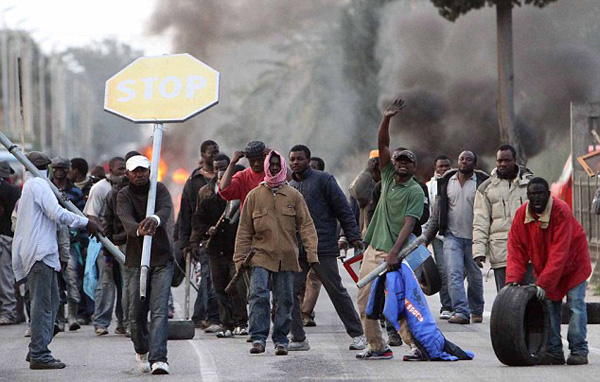
 Print This