 |
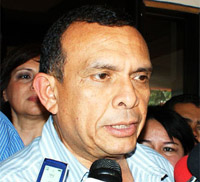
| Porfirio "Pepe" Lobo |
|
Tomorrow, January 27th, as the world’s eyes continue to be
riveted on the unfolding disaster in Haiti, Porfirio “Pepe” Lobo will
be installed as Honduras’ president, succeeding de facto president
Roberto Micheletti. Lobo, a supporter of the June 28th military coup
that ousted President Manuel Zelaya, was chosen in a November election
held under conditions of qualified state terror.
As the
majority of Hondurans boycotted the elections, and dozens of candidates
for lower offices withdrew, the vast majority of countries around the
world classified the ballot as illegitimate.
In the hours and days following the election, the
illegally-appointed Supreme Electoral Tribunal committed fraud by
announcing a voter turnout that was indisputably more than 12
percentage points higher than its own officially-published numbers. The
doctored higher figure was cited repeatedly by Lobo, Secretary of State
Clinton, and other friendly faces to legitimize the disputed ballot.
Many Honduran and foreign observers argue that later international
support for the Lobo Administration will eventually ensure the
invalidation of Zelaya’s most important reforms. This support will
guarantee long-term repression and a growing degree of tight-fisted
control in the country, as well as endangering democratic institutions
and social justice reforms throughout the hemisphere as the result of
an echo effect.
Though State Department officials insist that the Honduras election
process was transparent, in fact, no international observers were
present to confirm the tally because—as announced by U.N. Secretary
General Ban Ki-Moon on September 23rd—the conditions for a free and
fair election were not present. A scathing 147-page report released
Wednesday, January 20th, by the Inter-American Human Rights Commission
corroborates this, citing a litany of well-documented human rights
abuses, including numerous political assassinations committed prior to,
and following the election. The report describes a militarized
environment in which dissonant or critical opinions have been
officially prohibited in “an egregious, arbitrary, unnecessary and
disproportionate restriction, in violation of international law, of the
right of every Honduran to express himself or herself freely, and to
receive information from a plurality and diversity of sources.”
While no official international observers were on the ground
election day, the National Democratic Institute (NDI) and the
International Republican Institute (IRI) sent “monitors” to oversee the
Honduran election that the OAS and Carter Center had refused to
legitimize with their presence. Both the NDI and IRI are funded by the
U.S. Congress through a highly conservative Reagan-era umbrella
organization, the National Endowment for Democracy (NED). The archly
conservative IRI has supported efforts implicated in the ousting of
democratically-elected presidents in Haiti and Venezuela in recent
years. The day of the election, the NDI had its monitors caught on tape
refusing to discuss police violence, which they had witnessed outside
the polls in Honduras’ industrial city of San Pedro Sula.
The parallels between Honduras and Haiti are striking; each country
has been saddled by a history of undeserved debt—an enduring legacy of
colonialism—and in each country’s case (after over a century of often
U.S.-installed dictatorships) an elected president who was responsibly
engaged with bringing social justice to its citizens, was evicted from
office. The vehicle for this was a military coup at least tacitly
backed by Washington. By aiding the foes of Manual Zelaya in Honduras
and Haiti’s Jean-Bertrand Aristide, Washington indirectly or directly
ousted from power those who had been prepared to protect public
resources from the pressing demands of the IMF for privatization, and
shrink the public sector infrastructure of both countries. The skewed
development of these countries, as well as guidance from private
entities and the U.S. government, subjected the national interests of
Haiti and Honduras to be hostage to the view of these outsiders. This
is a situation that could turn the smallest windstorm into a hurricane,
when it comes to a natural disaster’s impacts on the average resident
and outside political manipulations.
Although President Obama initially joined the international
community in condemning the Honduran coup and calling for the
restoration of democratic order as a precondition for recognition of
elections in that country, Washington in fact has been aggressively
lobbying other Latin American presidents to recognize the incoming Lobo
government. Despite the de facto government’s refusal to reinstate
Zelaya or follow the time line and process laid out by the Guaymuras
Accords, the Obama Administration has signaled its intention to
recognize a “unity” government representing only the coup leaders, and
to support the Honduran Congress’ decision to give amnesty to those
responsible for the military coup and the thousands of human rights
abuses that followed. In a recent interview with COHA, independent
Honduran journalist and filmmaker Oscar Estrada expressed some of the
opposition’s apprehensions about Lobo:
“With the entrance on the scene of Porfirio Lobo Sosa, there begins
a new phase in the project of domination begun by the June 28th coup
d’état. [Lobo’s] recent reconciliation agreement is nothing more than
an attempt to whitewash the coup and demobilize the popular
resistance.”
Lobo, the man who speaks today of dialogue and peace, has offered
safe conduct for Mel Zelaya to leave the country. But, just days ago,
he proposed a neoliberal “national plan” for the next 28 years. By
means of his own legislative bloc, he seeks to approve an amnesty that
principally favors the country’s violators of human rights, and plans
to govern with the backing and protection of the paramilitary
structures that have terrorized the people during the past six months.
Honduran opponents of the coup, who since June 28th have organized
almost daily protest actions, including numerous marches numbering in
the hundreds of thousands, similarly plan to protest Lobo’s
inauguration.
The Obama Administration has so profoundly bungled the situation in
Honduras that it has destroyed hope among many of its citizens as well
as Latin Americans that a ‘new era’ of relations with the United States
is in the making. Add to that the multiplication of U.S. military bases
in Colombia, the mistakes being made in response to the tragedy in
Haiti, and the missed opportunities in Cuba, and one cannot claim with
any degree of optimism that Obama is off to a robust start to implement
an energized and enlightened new Latin American policy.
COHA Senior Research Fellow Adrienne Pine, Ph.D, also serves an
Assistant Professor of Anthropology at American University. Dr. Pine
recently authored the book Working Hard, Drinking Hard: On Violence and Survival in Honduras (University of California Press).
Council on Hemispheric Affairs





 Print This
  Print This