The Pentagon's advanced research division has set aside $6 million
from its next budget for research on the creation of "synthetic
organisms" whose DNA can be altered to make them live forever, or die
on command, and even keep a genetic record of what they have been doing.
In its 2011 budget
(PDF, 522 pages), the Defense Advanced Research Projects Agency lays
out its intention to create "BioDesign," a project to create artificial
life, presumably with military purposes in mind.
"BioDesign
eliminates the randomness of natural evolutionary advancement primarily
by advanced genetic engineering and molecular biology technologies to
produce the intended biological effect," the DARPA document states.
The
agency says it wants to develop "a robust understanding of the
collective mechanisms that contribute to cell death" so as to "enable a
new generation of regenerative cells that could ultimately be
programmed to live indefinitely."
But, if those organisms should malfunction or run the course of
their usefulness, the agency also wants to have the ability to have
them die on command, what it calls a "self-destruct option."
The
agency also wants to create "tamper-proof" genetic codes, so that enemy
forces can't reprogram the life forms to switch sides.
And
finally, DARPA also wants these organisms' genetic sequences to
"record" what they have been doing, presumably for surveillance
purposes, "similar to a traceable serial number on a handgun."
Reporting at Wired.com, Katie Drummond says the Pentagon is "up against some vexing, fundamental laws of nature."
First,
they might want to rethink the idea of evolution as a random series of
events, says NYU biology professor David Fitch. “Evolution by selection
is nota random process at all, and is actually a hugely efficient
design algorithm used extensively in computation and engineering,” he
e-mails Danger Room.
Even if Darpa manages to overcome the
inherent intelligence of evolutionary processes, overcoming inevitable
death can be tricky. Just ask all the other research teams who’ve made
stabs at it, trying everything from cell starvation to hormone
treatments.
"And then there's all of the ethical dilemmas involved in literally playing God," comments John Funk at The Escapist. "But that's only if the science actually works."
Raw Story





 Print This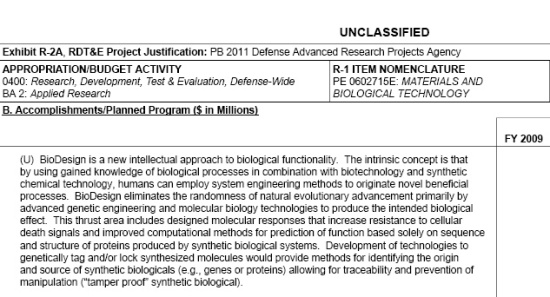
 Print This