General Dynamics. Shell. Apache Corporation. Philip Morris. Pfizer.
These are weapons manufacturers, oil companies, mining corporations,
tobacco companies, and pharmaceutical giants. Notorious war profiteers,
environmental destroyers, and human rights violators. Morally and
ethically, these are not the types of firms with which one would expect
Ottawa's Carleton University to have any sort of affiliation.
And yet, despite Carleton President Roseann Runte’s characterization
of the university as an institution that is “engaged in solving
real-world problems,” and her proclamation that it emphasizes human
rights and social justice, Students Against Israeli Apartheid –
Carleton (SAIA) has discovered that the Carleton University Pension
Fund has tens of millions of dollars invested in these and other
companies, which are willing contributors to the litany of social and
political ailments that plague our global community.
The Pension Fund, which provides retirement income for Carleton’s
staff and faculty, invests in some 550 companies, for a total value of
about $766,194,000. Institutions with pension funds of this size often
adopt ethical guidelines or socially responsible investment policies
(SRI), which seek to achieve both financial return and social good. SRI
encourages investment in companies that protect the environment,
respect human rights, and have ethical labour practices. In Canada,
several universities including McGill, Queens, and UBC have adopted
elements of SRI, while many institutions in the UK have implemented
ethical investment guidelines and divested from the arms trade. In the
USA, Yale and other schools have policies prohibiting them from
conducting business with companies engaged in ‘socially injurious’
activities.
These relatively progressive investment policies can be sharply
contrasted with Carleton’s fund, whose only mandate, according to the Statement of Investment Policies and Procedures for the Trust Fund created Under the Carleton University Retirement Plan,
is to maximize profit. Carleton appears to have no qualms about
investing in and profiting from companies that reap their gains by
fuelling wars, spreading ecological devastation, and committing blatant
violations of international law.
Beginning this month, SAIA will take action against Carleton’s
decidedly unethical investment practices by launching a divestment
campaign against five companies that are complicit in human rights
violations and crimes under international law in Palestine: Motorola,
BAE Systems, Northrop Grumman, L-3 Communications, and Tesco
supermarkets.
Motorola, BAE, and Northrop Grumman are perhaps the most egregious
of the bunch, as they all supplied Israel with military equipment that
was used in the 2008-2009 bombardment of Gaza. BAE and Northrop Grumman
are among the world’s largest arms companies, and their products sold
to Israel include components for F-16 aircraft, Hellfire missiles, and
Apache helicopters. Motorola’s involvement in Gaza was through its
subsidiary, Motorola Israel, which was the leading Israeli company in
developing and manufacturing electronic fuses for aircraft bombs and
guided munitions used during the three-week assault.
The Report of the UN Fact Finding Mission on the Gaza Conflict (the
Goldstone Report), released in September, found clear evidence that
Israel committed major war crimes and possible crimes against humanity
during bombardment of Gaza, which killed over 1,400 people. Many of
these crimes would have been committed using the munitions provided by
Motorola, BAE, and Northrop Grumman.
In the occupied West Bank, meanwhile, Motorola and Tesco actively
breach the Fourth Geneva Convention on a daily basis. Article 49 of the
Convention states that an occupying power may not change the
demographic composition of the occupied territory and must not
interfere, in an arbitrary manner, in the lives of the occupied
civilian population. This stipulation renders Israel’s continued
construction of Jewish-only settlements to be illegal.
In defiance of Article 49, Motorola manufactures a multitude of
perimeter surveillance systems and “virtual” electronic fences that are
installed around dozens of settlements in the occupied West Bank. These
virtual fences can often extend up to 700 metres outside of the
settlement, thereby confiscating not only the area upon which the
settlement is built, but also a vast swath of land around the
settlement itself. By establishing such equipment inside the occupied
West Bank, Motorola entrenches the infrastructure of occupation, and
solidifies illegal settlements as “facts on the ground.”
Tesco is also complicit in developing the settlements, as it sells
products that originate in the illegal colonies. By selling settlement
produce, Tesco ignores the blatant illegality of the settlements, and
facilitates their expansion and economic growth. The settlements are
allowed to flourish and export their products, while Palestinian
agricultural life – and thus the Palestinian economy – is decimated.
Furthermore, Tesco’s supplier for these settlement products is an
Israeli export company called Carmel-Agrexco, which is notorious for
implementing slavery-type working conditions in which Palestinian
children as young as 9 years old are put to work in its factories.
Workers in the factory are paid less than $3 per hour, are not allowed
breaks during 8-hour shifts, cannot unionize, and are forced to work
without contracts. Palestinian workers require 3 hours of travelling
time to reach their jobs because they are forced to cross the Hamra
checkpoint, which is the largest in the occupied West Bank. At this and
other checkpoints, the workers are often strip-searched and humiliated
daily.
Motorola and Tesco’s facilitation of settlement expansion and their
development of the settlements themselves renders them in direct
violation of the Fourth Geneva Convention.
Additionally, the activities of Motorola and L-3 Communications, a
U.S.-based “homeland security and defence” company, put them in
contravention of the International Court of Justice (ICJ). In 2004, the
ICJ ruled Israel's Apartheid Wall, which cuts deep within occupied
Palestinian territory, to be illegal, and declared that no aid or
assistance should be given for its construction. In spite of the ICJ
decision, both companies continue to supply Israel with equipment such
as body scanners, motion sensors, and watchtowers, which are used to
fortify the Wall and the hundreds of Israeli military checkpoints that
control the West Bank.
In essence, each of these firms reaps great benefit by supporting
and entrenching the regime of apartheid that has been imposed on the
Palestinian people. The companies’ actions conflict with Carleton’s
legal responsibility to adhere to the principles of international law,
as stipulated in the Nuremburg Principles I and II. As such, by
investing in and profiting from the firms in spite of their crimes, the
university itself becomes complicit in violations of international law.
Boycott, Divestment, and Sanctions Campaign
While the legal obligations alone should be sufficient grounds for
divestment, there is another strong impetus for SAIA’s campaign. In
2005, 171 organizations from the full spectrum of Palestinian civil
society came together to call for an international boycott, divestment,
and sanctions campaign (BDS) against Israel until it complies with its
obligations under international law.
Although the Palestine-centred BDS campaign
is separate from the more broad-based call for SRI, the two demands are
by no means mutually exclusive. Inspired by the movement to boycott
South African apartheid, BDS is driven by the idea that it is
unacceptable for states, institutions, and individuals to continue
business as usual relations with Israel as long as it practices
apartheid in Palestine. Instead, the international community has a
responsibility to end Israeli impunity by cutting ties with apartheid,
stripping away Israel’s liberal-democratic facade, and exposing it as a
pariah state.
For the past 4 1/2 years, BDS has spread like wildfire, becoming a
truly global movement. BDS activism is especially strong on university
campuses, as student mobilization has brought about many concrete
successes worldwide. The most notable victory came at Hampshire
College, where in February 2009, the administration gave in to massive
student pressure to divest from six companies complicit in the Israeli
occupation. Additional successes have come in the UK, where several
universities have agreed to divest from BAE Systems and other companies
involved in Israeli crimes.
These victories are models for SAIA’s divestment campaign at
Carleton, which is the first Palestine-centred divestment initiative in
Canada. By mobilizing the university community, SAIA will call on the
administration to immediately divest from the five companies mentioned
here, and to work with the Carleton community to adopt SRI for future
investments. Hopes are high that, through a well-planned local
campaign, as well as the natural growth of BDS, momentum will pick up
at universities across the country and similar initiatives will emerge
to form a national movement to cut campus ties with Israeli apartheid.
Adopting SRI would go a long way toward making Carleton a more
ethical institution, and would align it with its obligations under
international law. Similarly, divesting from these companies would be a
major step for the BDS movement, and for the pursuit of justice for the
Palestinian people. The international precedents for both actions have
been set. The pressure is now on for Carleton to do the right thing.
Socialist Project





 Print This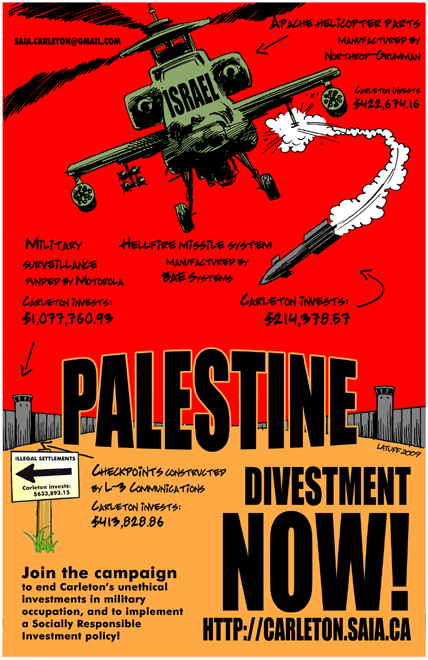

 Print This