 |
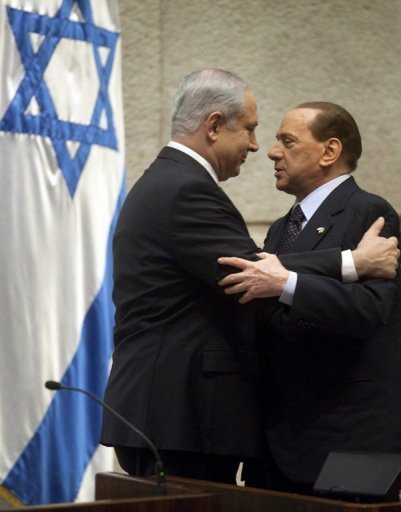
| Italian Prime Minister Silvio Berlusconi shares affections with Israeli Prime Minister Benjamin Netanyahu in Jerusalem. |
|
After the three-day visit of Italian Prime Minister Silvio
Berlusconi to Israel and a short visit to the Occupied Palestinian
Territories, a judgement is due. Berlusconi came with a large Italian
ministry delegation (Foreign Minister Franco Frattini, Economy Minister
Giulio Tremonti, Defense Minister Ignazio La Russa, Interior Minister
Roberto Maroni, Public Works Minister Altero Matteoli and Health
Minister Ferrucio Fazio) for the first Israeli-Italian joint cabinet
meeting. It was the second joint-cabinet meeting for the Israeli
government, after the joint German-Israeli session which was held in
2008. The same announcements and topics dominate speeches and actions
of the Italian and Israeli politicians these days.
Holocaust, EU and the Big Brother
Berlusconi started his visit to Israel at Yad Vashem, the Holocaust
Museum in Jerusalem. And the reference to the Holocaust pervaded the
entire visit. The day before coming to Israel, Berlusconi delivered a
written interview published in Haaretz
on 31 January. In answer to the first question about the close
relationship between his government and Israel (in a certain way new
for the Italian political tradition), Berlusconi made reference to the
Holocaust: “The visit I made to Auschwitz made a deep impression on me.
I told myself there that it was impossible not to be Israeli.” But the
most relevant nuance in Berlusconi’s words is that he presented a link
between Israeli “struggle for freedom,” the process of European
construction and the Holocaust. The result of that equation is that
“Israel is part of Europe. It belongs to the West.” In his speech in
front of the Knesset on 3 February, Berlusconi continued that “as both
Pope John Paul II and Rabbi Eliyahu Tuaf said, Italy is like a ‘big
brother’ to Israel, a bond which originates in the friendship and
fraternity and common fate.”
In the present period when freedom of speech has become a sensitive
issue in Italy with Berlusconi’s continuous attacks against journalists
and when Israel restricts the possibilities for foreign journalists to
enter, work and live in Israel and Palestinian Territories, the
reference to Italy as a Big Brother of Israel reminds one more of the
Orwellian 1984 scenario, rather than the particular “brotherhood”
between Israelis and Italians.
Iran and the Economy
Iran was a top agenda topic during this visit. In his parallel between
the current situation and the age of totalitarianism, Berlusconi
stigmatized the Iranian president Ahmadinejad: “We must watch out,”
because “we’ve already had one such madman in history,” clearly
referring to Adolf Hitler. On 1 February, during the official dinner,
talking about the Iranian regime, Israeli Prime Minister Benyamin
Netanyahu stated that “humanity today is facing one of its most
difficult challenges since World War II” and he added that “I must tell
you, Silvio, my dear friend, you have a clear vision, you have
determination and you have the courage of a genuine leader.”
In the Iranian chapter in the agenda of international relations, a
large part is occupied by the economic issue. Meeting the Italian Prime
Minister, the Israeli Foreign Minister Avigdor Lieberman asked
Berlusconi on Tuesday to increase pressure on Russia to drop their
opposition to economic sanctions against Teheran. Berlusconi’s personal
story and career is strictly linked with business and he used that in
every context: in the same Haaretz interview, he proudly
declared that “for my entire life, first as an entrepreneur and later
as prime minister, I have had a love of freedom.” He also proposed “the
beautiful town of Arice as a location for future peace talks.” And to
please the “little brother,” Berlusconi stated that from 2006, Italy
has reduced trade with Iran. But Italy remains the largest European
trading partner of Iran, more than 1,000 companies are involved in the
Islamic Republic and prominent enterprises like Fiat, Eni and Ansaldo
have offices and factories in Iran.
The Arab World
Except for Iran, during this three-day visit, the Arab world was the
great absent in the political speeches and references. Even if
Berlusconi states that “Italy today is an essential stop, sometimes the
first, that Middle Eastern leaders make in Europe,” and that Italy is
“involved in a lasting and comprehensive solution to the Palestinian
question,” the marginality of the Palestinian cause and reality during
this visit is clear to everybody.
Before his meeting with the Palestinian President Abu Mazen, the
Italian Prime Minister denied the validity of the Goldstone report,
because, according to him, Operation Cast Lead against Gaza last year
was a “justified firing on Hamas’ rockets.” As the most important Italian newspaper, La Repubblica, noted, the adjective “justified” is not present in the written version of the speech spread in the Italian government website.
This means that the Prime Minister voluntarily added this adjective at
the eleventh hour. Moreover, during the press conference with Abu Mazen
in Bethlehem, in answer to a question of what kind of feeling the
Separation Wall in Bethlehem provoked in him, he replied that he didn’t
see the Wall because he was too busy reading his notes.
Kissinger of Arcore
In one of the most important left-wing Italian newspaper, Il Manifesto,
on 2 February, there appeared an article written by Zvi Schuldiner,
professor of Political Science in the Israeli Sapir College, ironically
defining Berlusconi as the “Kissinger of Arcore” (from the name of the
village near Milan where Berlusconi lives). The reference to the
American Secretary of State during the Nixon era is not casual:
Berlusconi himself, in answer to the Haaretz correspondent’s
questions, quoted Kissinger to draw a future scenario of war or peace
in the Middle East: “Henry Kissinger used to say that there could never
be war in the Middle East without Egypt, but no peace was possible
without Syria.” However, behind these sentences, Israel knows that,
despite his words and declaration, Berlusconi is one of the world’s
most controversial men, morally, financially and politically. After
this visit, in the next weeks and months the meaning of “brotherhood”
between the Italian and Israeli governments will be revealed.
Alternative Information Center





 Print This
  Print This