 |
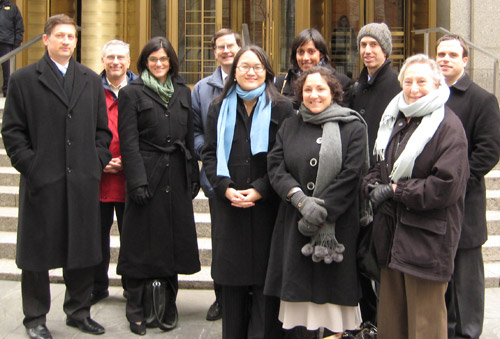
| Plaintiffs, experts, and the ACLU and PUBPAT legal team outside the courthouse. Back row, from left to right: Dan Ravicher, PUBPAT; Robert Nussbaum, University of California, San Francisco; Tania Simoncelli, ACLU; Chris Hansen, ACLU; Sabrina Hassan, PUBPAT; Aden Fine, ACLU; Chris Mason, Cornell. Front row, from left to right: Sandra Park, ACLU; Lenora Lapidus, ACLU; Elsa Reich, NYU |
|
February 3, 2010
The courtroom was packed for yesterday's [February 2, 2009] hearing in the breast cancer gene patents case,
a testament to the significance of our challenge. Both sides argued
that the judge should rule in their favor without a trial. (You can
read our motion for summary judgment here.)
The lawsuit, Association for Molecular Pathology, et al. v. U.S. Patent and Trademark Office, et al.,
challenges the government's granting of and Myriad Genetics' control of
patents on the BRCA1 and BRCA2 human genes, which are associated with
breast and ovarian cancer.
Basically what was at issue in this hearing, and what is at the
legal core of the case, is whether the challenged patent claims cover
"products of nature" and "laws of nature" and are therefore invalid.
There are actually many things that everyone involved in this case
agrees on. Everyone agrees that researchers are free to patent new
drugs, new therapeutic methods, devices, or specific DNA sequencing
methods. Everyone agrees that patent law prohibits the patenting of
natural phenomena and laws of nature, as these are not human inventions
and no person should be able to own exclusive rights to something that
occurs in nature.
Everyone also agrees that DNA in the body is a product of nature and
therefore not patentable. But the defendants claim that the "isolation"
of the BRCA genes — or the separation of the gene from the rest of the
DNA— that is necessary to test and study them somehow makes them
patentable. Chris Hansen and Sandra Park, arguing for our side, refuted
this claim, explaining that isolating a gene, no matter how difficult
and ingenious, does not alter the structure of the DNA itself, and so
what has been patented is indeed a product of nature. Chris made an
elegant point:
"Isolated DNA" must not be markedly different from DNA in
the body because when a woman sends a blood sample to Myriad to find
out if she has a mutation that puts her at increased risk for cancer,
Myriad gives her results about the DNA in her body; they don't say, "We
found a mutation in the DNA we isolated from your blood, but that's
different from the DNA in your body, so we don't know what it means for
your risk for cancer."
The plaintiffs also contend that Myriad's patent claims over the
correlations between mutations and cancer are invalid because mutations
are created by nature and the fact that some mutations lead to cancer
is a phenomenon of nature. As Chris put it:
Uncovering a law of nature — while deserving of praise for
the time, ingenuity, and hard work that it takes — is not patentable.
Einstein certainly deserved praise and awards for discovering E = mc2, but he could not patent it.
In addition to the patent law arguments, and the reason the ACLU is
involved in this case, are the First Amendment and constitutional
arguments. The attorneys argued that by granting patents on the genes
themselves, the government has given Myriad exclusive control of all
knowledge about the gene, a clear violation of First Amendment
freedoms. And unlike other patentable subject matter, such as a
carburetor, where someone else can invent an alternative, other
researchers cannot "invent around" a gene that has been patented. So,
contrary to the purpose of the patent system as set out in Article I of
the Constitution, gene patents do not "promote the progress of science
and useful arts," but rather hinder research, clinical testing, and
development of new tests.
Chris refuted Myriad's claim that patents were a necessary incentive
for researchers to discover the BRCA genes and develop commercial
testing, pointing out that there were researchers and clinicians doing
BRCA testing before the patents were granted; Myriad shut them down
once it got the patents. Today there are thousands of researchers and
clinicians who have the ability to conduct BRCA testing and provide
results to women, but are prohibited from doing so by the patents.
Sandra highlighted the human impact of gene patents, calling attention
to the six individual women plaintiffs in this case who have been pre-empted from knowing about their own genetics by Myriad's patents.
(If you're interested in reading our legal arguments in more detail,
including a review of relevant patent case law that Sandra outlined in
the hearing, take a look at our motion for summary judgment.)
At the end of more than two hours of oral argument, Judge Robert
Sweet complimented all of the attorneys on their clear and skillful
arguments. He highlighted that this case is of great concern to the
scientific community, the biotechnology industry, people concerned with
the very serious issue of breast cancer (and pointed out that probably
everyone in the room has been touched by it through someone they know),
and those who provide care, analysis, and diagnosis to breast cancer
survivors. He acknowledged the sharp difference of opinion expressed in
the arguments, and thanked the plaintiffs for bringing this fascinating
and complex issue to him.
We expect a ruling sometime in the next few months. Stay tuned, and
if you haven't already, be sure to watch a video of our plaintiffs and
sign a message of support for them at www.aclu.org/brca.
ACLU Blog of Rights





 Print This
  Print This