By W.T. Whitney, Jr.
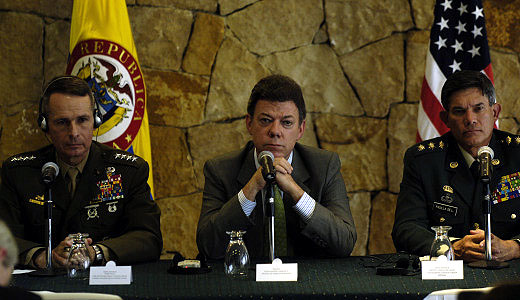 |
| U.S. Chairman of the Joint Chiefs of Staff Marine Corps Gen. Peter Pace, Colombian Defense Minister Juan Manuel Santos and Chairman of Colombia's Joint Chiefs of Staff Gen. Freddy Padilla hold a press conference in Bogota, Colombia, Jan. 19, 2007. (Defense.gov) |
|
In 1921, socialist writer Scott Nearing wrote that the United States
"has guaranteed to her by all the leading capitalist powers practically
an exclusive privilege for the exploitation of the Western Hemisphere"
as part of the post World War I settling of international affairs.
With military cooperation treaties dating back to 1952, Colombia now
serves as a prime tool for U.S. regional control. Analyst Narciso Isa
Conde notes that with new U.S. bases, Colombia becomes "a factor of
regional aggression," part of a "fatal triangulation involving
Colombia, Honduras, and now Haiti."
Colombia's assigned role is to provoke Venezuela, claims a recent Bolivarian News Agency report.
"The center of gravity of the strategy is the Bolivarian revolution and
the leftist ALBA alliance," it indicates. Colombia has been "converted
into a gigantic air, naval and land forces base to attack Latin
America." Its own military "is being converted into a rapid reaction
force."
Bases along Columbia's border with Venezuela are being
strengthened. Colombian paramilitaries carry out destabilization
forays in Venezuela. Colombia is accused of inserting CIA and Israeli
trained assassins into Venezuela to target some of those attending the
December congress in Caracas of the anti-imperialist Continental
Bolivarian Movement. Panama hosts four U.S. bases, and Curacao and
Aruba off Venezuela host one each. Fourth Fleet naval power is on call.
For empires power is of the essence. But what of the Colombian people?
Last December horror overwhelmed visiting British unionists and parliamentarians. They learned that leaders of the FENSUAGRO agricultural union confederation are being attacked, jailed, and killed. Families
in Soacha told of young men killed by the Army. Dressed as guerrilla
combatants, their bodies were displayed as tokens of anti-guerrilla
victories. Congresspersons' telephone calls are monitored. Women
political prisoners at the Buen Pastor prison live under "appalling"
conditions. The British delegation came under police surveillance.
Community leaders in La Macarena showed them "hundreds of
unidentified bodies" in a common grave. The unearthing of 2,000 corpses
with British visitors looking on made the news headlines. Azalea Robles' report is titled: "Largest common grave of the continent is uncovered - Colombia in a paroxysm of horror cries out for solidarity."
Paramilitary chieftains had revealed gravesite locations to
authorities, who took little action. Victims' families began digging on
their own. Under Colombia's 2002 Law of Justice and Peace, paramilitary
capos confessing crimes and demobilizing their commands received short
jail terms and could keep properties.
According to jurist Jairo Ramírez, the buried victims represented
"social leaders, peasants, and community defenders, not as the Army
head told us, guerrillas killed in combat." Azalea Robles says terror
is used "to dissuade [people] from social commitment and to empty
extensive territories." The Army and paramilitaries are engaged in a
"dirty war." Paramilitaries are a "tool of the state," engineered in
part by the CIA. "They subsist on plunder and payments from landowners
and multinational corporations." Sponsoring corporations as determined
by the 2008 Permanent Tribunal of the Peoples include CocaCola, Nestle,
Chiquita Brands, Monsanto, Dyncorp, BP and Occidental Petroleum among
others.
Paramilitary leaders testified to wholesale killings. To inculcate
terror, underlings dismembered bodies or threw the dead and dying into
crocodile pens and rivers. The Army wanted bodies to vanish so as to
exempt the state from legal obligations regarding murder.
Over 25 to 30 years, 50,000 people "disappeared," the Patriotic
Union political party died, and 38 indigenous communities approached
extinction. A "scorched earth" policy left 4 million people displaced.
During President Alvaro Uribe's time, 2.4 million Colombians have lost
lands and homes, 286,389 during 2009. Multinationals, large landowners,
paramilitary bosses and drug traffickers have appropriated 15 million
acres. Some 2,700 labor activists have been murdered since 1986, 40 of
them last year.
Azalea Robles explains:
"Class struggle in Colombia is at its most absolute paroxysm. To
preserve the privileges of the oligarchy and above all the plunder of
resources perpetrated by multinationals, the Colombian state has
implanted total war against the population."
The Colombian government's symbiotic relation with the U.S.
government exacts a ghastly toll. For Washington, Colombia's dedication
to landowners, urban elites, and multinational corporations bespeaks
reliability. Faith in military power pervades both capitals, even
though in Colombia it leads to murder, fear, and land stripped of
inhabitants.
To enable Colombia to service its imperial ambitions, the U.S.
government provides military training, supplies and funding. Part of
the bargain is a blind eye toward terrible suffering.
People's World





 Print This
  Print This