 |
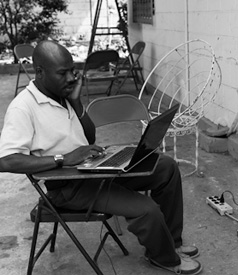
| "For us, community and popular radio isn't an end in itself. It's part of a global plan of social change, of transformation of the society." Sony Esteus at work in his post-earthquake office. (Roberto 'Bear'Guerra) |
|
Sony
Esteus is squeezed into an elementary school chair, the kind with the
curved piece of wood in front, in a courtyard. Around him are chickens,
a fly-swarmed pile of compost, a truck and a tent. Sony runs his laptop
off of an extension cord running out a window. The cord and the
courtyard are on loan from a nonprofit, and they have formed Sony's
work station since the earthquake's destruction of his own
organization's building. Sony is director of the Society for Social
Mobilization and Communication - SAKS by its Creole acronym - which
provides training, technical support, equipment and production to help
popular radio stations educate and inform the community.
Along
with SAKS' building went all its equipment, some of which had been
bound for small community radio stations throughout rural Haiti. Many
other Haitian popular and community radio networks and stations also
lost their offices and equipment. They include: SOS Journalists, the
Women's Community Radio Network, the Star Radio of the Peasants of
Fondwa, Groupe Médialternatif, AlterPresse, Accès-Médias, Telecenter of
Youth, one office of the Haitian Journalists' Association and its
Internet center, and others.
According to journalist Guy Delva, at least 11 journalists were killed in the earthquake.
I
ask Sony to tell me about the importance of community radio in Haiti,
the first priorities for rebuilding it, and the role it can play in
reconstructing a just Haiti. First, he clarifies my terminology. SAKS
works with community radio, but views itself as part of the network of
popular radio, which he defines as radio in the struggle to transform
society.
"First, we need to
reestablish our own office and see how we can help community and
popular radios reestablish themselves. We have to get new materials for
ourselves and other radio stations and networks.
"And
then, little by little, we need to resume producing alternative
information to give the communities, to help them understand what's
going on in the country. Now they're mainly just hearing the elite and
political leaders who are on the radio all day. But from the
progressive sector, we have our own analysis of this political moment.
"Even
in the areas that weren't affected, community and popular radio is
playing a big role in isolated areas that have no information, or only
information from the same political class and bourgeois civil society.
Alternative information is being emitted especially from youth these
days. Many of them can't go to school [since their schools were
destroyed] and so they're going out to the countryside, participating
in community radio and doing consciousness-raising. We're also
addressing issues that [mainstream] radio isn't dealing with:
environmental protection, human rights, women's rights, children's
rights.
"For us, community
and popular radio isn't an end in itself. It's part of a global plan of
social change, of transformation of the society. We're going to
continue to do popular education to change the mentality and behavior
of people, as well as to denounce what's being done against the people
today. As we move forward, we want to help people understand how to
organize themselves and also how to fight the projects now underway,
which are going to reinforce their poverty."
I
ask Sony if he has anything else he'd like to say. "I want to thank all
the grassroots people and organizations everywhere that are standing
with us. We see the U.S. government taking advantage of a humanitarian
crisis to send in 20,000 soldiers, reinforce our dependence, and pursue
its own policies. But we know that there are people in the U.S. and
elsewhere who are helping us get out of this situation."
Sony
excuses himself for a meeting. He starts up a conversation on his cell
phone as a chicken picks bugs from the dirt by his right foot.
TruthOut





 Print This
  Print This