Editor's Note: In the following article, Robert Alvarez responds to Daniel Indiviglio's praise of Obama's proposal for new nuclear energy plants in the the United States, Five Reasons to Cheer Obama's Ambition, published in The Atlantic on February 16. We have edited Alvarez' article to include all of Indiviglio's comments in order to make sure that Indiviglio receives a fair hearing and also to make more clear who is saying what. - LMB
|
|
| Barack Obama speaks about creating new energy jobs. He announced plans to fund two new nuclear power plants. (Photograph: Mark Wilson/Getty) |
Robert Alvarez: Yesterday, President Obama announced that the Energy department will provide an $8.3 billion loan guarantee to the Southern Co. for its proposed nuclear power plant near Augusta, GA. "The loan guarantee program for new nuclear power plants not only will further the nation's commitment to clean energy, Obama said, "but also will assist in creating jobs in American communities." Unfortunately, nuclear energy isn't safe or clean and it's too costly for the nation.
Barack Obama speaks about creating new energy jobs. He announced plans to fund two new nuclear power plants. (Photograph: Mark Wilson/Getty)
News coverage has been mostly supportive and, in some cases, bordering on cheerleading. In his blog for the Atlantic magazine, Editor Daniel Indiviglio laid out "Five Reasons to Cheer Obama's Ambition."
Let's take a closer look at these "five reasons."
Daniel Indiviglio: Reason #1 (published in The Atlantic):
"I've complained several times about the government making bets on funding business propositions, like electric cars, that have not yet proven their profitability. If the government is going to throw money at something, then the target should be a known quantity. Nuclear power fits that criterion. The U.S. has been successfully using this energy source for a very long time. As a result, we can be fairly certain that such projects will ultimately be profitable and won't need government life support forever."
Robert Alvarez responds: "Nuclear power is a known quantity. The U.S. has been successfully using this energy source for a very long time." Nuclear power is certainly well known to Wall Street, which despite its recent debacles, has refused to fund power reactors for more than 30 years because of their financial risks. Reactor construction costs climbed as high as 380 percent above expectations during the boom period for nuclear in the 1970s. Nuclear investors eventually wrote off about $17 billion. Consider the 1979 Three Mile Island Accident, in which TMI investors lost about $2 billion in about an hour, when the reactor core started to melt. Nuclear energy has depended primarily on the financial burden being born by the tax payer and rate payer. This is hardly a success story.
Daniel Indiviglio: Reasons #2 Semi-Shovel Ready
"As far as the endeavor as a jobs effort, this project also gets a good grade. According to Reuters, it will create as many as 3,500 construction jobs. I also saw White House Office of Energy and Climate Change Policy Director Carol Browner on CNBC this morning explaining that the bulldozers are standing by for the go-ahead from the Nuclear Regulatory Commission's green light. In other words, those construction jobs shouldn't take a few years to materialize, but should relatively quickly -- assuming that there aren't significant regulatory hold-ups."
Daniel Indiviglio: Reason #3 - Jobs Now, Jobs Later
"And unlike some infrastructure projects like building roads or bridges, this one actually helps job growth in perpetuity. Reuters also reports that it will create 800 permanent jobs in the area. And these aren't any jobs: they're stable, high-paying jobs. So this stimulus effort will result in the kind of real permanent job growth that the U.S. needs."
Robert Alvarez responds (#2 and #3)
A new nuclear reactor might provide 800 near-term jobs and as many as 3,500 new construction jobs later. This is comparable to the number of home weatherization jobs created in State of Ohio last year. Unlike energy conservation, in which jobs are created relatively quickly, nuclear reactor construction jobs may take several years to come about.
Daniel Indiviglio: Reason #4: Probably not very costly
"It's also important to note that this isn't a direct funding -- it's a loan guarantee. So long as the project can earn back its costs, the U.S. government may end up spending nothing. It's essentially just making banks more willing to take a risk on the power endeavor. While the taxpayers will ultimately be on the hook if the project goes awry, most government jobs efforts cost taxpayers no matter what. As a result, we should get all this job creation for free."
Robert Alvarez responds: Costs for nuclear power have nearly doubled in the past five years. Currently reactors are estimated to cost about $8 to $10 billion. Moreover, the Congressional Budget Office and the Government Accountability Office estimate these loan guarantees have more than a 50-50 chance of failing -- something Energy Secretary Chu told the news media yesterday he was unaware of before signing off on them. Because of the way the $54.5 billion in loan guarantees are structured, the Federal Financing Bank (otherwise known as the U.S. Treasury) will provide the loans. Guess who will be left holding the bag if things go south?
Daniel Indiviglio: Reason #5: Preparing for America's Energy future
"Finally, as Browner said on CNBC this morning (clip below), this will help continue to expand Americans' use of clean energy. Wind, solar and other green sources are also being targeted by the Obama administration, but it's nice to see nuclear energy in the mix. A few months back, I noted how China is in the process of vastly expanding its nuclear power creation. The U.S. would be crazy to ignore this source. It should serve as a major part of its future energy consumption. With as much energy as the U.S. consumes, it must have a broad, diverse plan to ensure it creates sufficient energy in the years to come.
"At this point, I can see really see only one negative about the project: why did it take so long? I would have liked to have seen such an announcement about a year ago. The jobs created by this and similar projects would have helped to employ some of the many Americans who have found themselves unemployed over that time period. And given all of the benefits explained above, projects like this are pretty much a no-brainer."
Robert Alvarez responds: Assuming that all $54.5 billion in nuclear loan guarantees being sought by Obama are successful -- this will provide less than one percent of the nation's current electrical generating capacity. Replacing the existing fleet of 104 reactors which are expected to shut down by 2056 could cost about $1.4 trillion. Add another $500 billion for a 50% increase above current nuclear generation capacity to make a meaningful impact on reducing carbon emissions. This means the U.S. would have to start bringing a new reactor on line at a rate of once a week to once a month for the next several decades.
Meanwhile, Obama has pulled the rug out from under the nuclear industry by terminating funds for the Yucca Mountain nuclear waste disposal site in Nevada. After nearly 30 years of trying, disposal of high-level radioactive waste is proving to be extremely difficult. So Obama has convened a "blue ribbon" panel of experts to go back to the drawing board and recommend what to do two years from now.
The accumulation of spent power-reactor fuel is expected to double at reactor sites and poses new safety issues, which will be the reality for several decades to come. Spent fuel pools currently contain about four times what their original designs envisioned and may be more vulnerable to terrorist attacks than reactors. In 2004, a National Academy of Sciences panel concluded that drainage of water from a spent fuel pond by an act of malice could lead to a catastrophic radiological fire. One thing is certain. Republicans and Democrats do not want to restart a national radioactive waste dump selection process that's guaranteed to anger voters before the 2012 elections and beyond.
Nuclear Energy is an intriguing idea until you start to think about it.
© 2010 Huffington Post





 Print This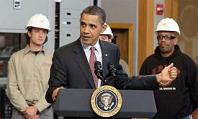
 Print This