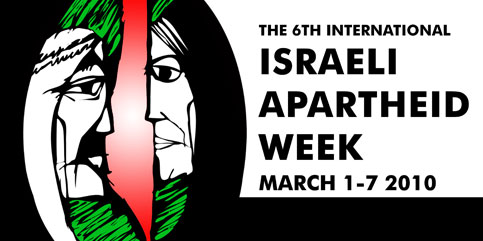
Building international solidarity during Israeli Apartheid Week
 Print This Print This
By Ilaria Giglioli
Electronic Intifada
Tuesday, Mar 2, 2010
In March 2005, a group of
activists from the Arab Student Collective at the University of Toronto
launched the first Israeli Apartheid Week (IAW). The aim of the week
was two-fold. On one hand, it sought to break the wall of silence and
misrepresentation around what was happening in the occupied West Bank
and Gaza Strip at the time of the second Palestinian intifada. On the
other hand, it aimed to situate direct military violence against
Palestinians within the broader context of Israel's apartheid policies.
Focusing on the broader system of Israeli apartheid allowed activists
to link the construction of the Apartheid Wall in the occupied West
Bank, settler violence and home demolitions to a broader system which
systematically discriminated against the civil and political rights of
Palestinian citizens in Israel, or 1948 Palestinians, and denied the
right of return of Palestinian refugees to their homeland.
Six years later, IAW is taking place in more than 40 cities in five
continents, and is a key event in the yearly calendar of the boycott,
divestment and sanctions (BDS) movement, launched by more than 170 Palestinian civil society organizations on 9 July 2005.
Outside its North American and European centers, IAW is also taking
place in South Africa, Palestine, Lebanon and Australia. South African
anti-apartheid activists have played a key role in the promotion of
IAW, including former African National Congress member Ronnie Kasrils
who opened IAW in London, New York and Toronto in 2009.
Situating the Palestinian struggle in the context of anti-racist and
anti-colonialist movements has also allowed strong alliances to be
forged at the local level. In Canada, for instance, IAW has worked to
build solidarity with First Nations communities, and is endorsed by a
broad base of progressive organizations. This focus is also reflected
in the themes tackled during the week itself. In Toronto, for example,
the 2010 IAW program includes a night focusing on the environmental
costs of apartheid, another on queer solidarity activism in the
anti-apartheid movement and one on "Fighting Racism, Fighting
Apartheid." Overall, IAW has become an arena to promote a broad
anti-colonial and anti-racist vision and to build solidarity between
movements working towards this vision and resisting settler colonialism
throughout the world.
Forming these types of alliances has been important to resist attempts
to shut down IAW. These are not limited to harassment and verbal abuse
by Zionist groups on campuses; over the years, organizers have faced
ongoing institutional harassment, including last-minute cancellation of
room bookings and the banning of Apartheid Week materials. In fall
2008, for instance, room bookings for an IAW organizing conference in
Toronto were cancelled on short notice by the university under pressure
of local Zionist groups. Similarly, in March 2009, the University of
Pisa, Italy, denied university venues to IAW organizers. In the same
year, the poster for the 5th International Israeli Apartheid Week was
banned at Carleton University in Ottawa and Trent University in
Peterborough.
IAW has also been the object of investigation by the Canadian
Parliamentary Coalition to Combat Anti-Semitism (CPCCA), a highly
contentious initiative that has been defined by the Canadian
Independent Jewish Voices as an "attempt to attack free speech and
silence criticism of the Israeli government's oppressive and illegal
policies" and "to label criticism of Israel and its behavior, as well
as organized efforts to change them, as anti-Semitic and to criminalize
both."
Attempts at shutting down IAW on campuses are in line with growing
efforts of the Israeli government to crush the BDS movement. To the
present time, this crackdown has primarily targeted Palestinian
grassroots activists within the occupied West Bank, including Mohammad
Othman Jamal Juma' from the Stop the Wall Campaign, recently released
from prison.
However, a recent report published by the Reut Institute, an Israeli
think tank, and presented at the 10th Herzliya Conference in February
2010 identifies a global campaign of "delegitimization" of Israel --
which includes the BDS movement and IAW -- as one that "is effective,
possesses strategic significance, and may develop into a comprehensive
existential threat within a few years." As such, it also underlines the
need for Israel to engage in a substantial diplomatic counter-effort to sabotage the movement.
While this means that organizers will face increasing obstacles in the
coming years, it also testifies to the growing strength of the BDS
movement, which has reached fundamental targets in the last year,
including the divestment of the Norwegian state pension fund from Israeli military contractor Elbit Systems
in September 2009. On university campuses, the year 2009 marked the
first campus-based divestment, as on 7 February the Board of Trustees
at Hampshire College in the United States divested from six Israeli companies directly involved in human rights violations against Palestinians. Similar divestment campaigns have been launched on various university campuses, including Carleton University in Ottawa. Last year also saw the Canadian Union of Public Employees pass a motion in support of the boycott at its provincial meeting in Windsor.
It is in this context that the 6th International Israeli Apartheid Week
is centered around "Solidarity in Action: Boycott, Divestment and
Sanctions," celebrating the achievements of the past five years and
preparing the next ones. A diverse program of events -- lectures,
demonstrations, film screenings and other cultural activities -- will
take place throughout the world between 1-14 March 2010.
Ilaria Giglioli is an IAW organizer at the University of Toronto.
Related Links: Israel Apartheid Week
Electronic Intifada
 Print This Print This

|