 |
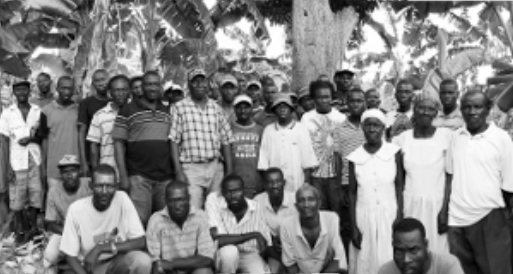
| Peasant groups – even those with historic distrust of each other – and other allies are meeting regularly to plan their advocacy and mobilization for reorienting Haiti’s political economy in favor of agriculture, based on the following priorities.(Roberto "Bear" Guerra ) |
|
"We
plant but we can’t produce or market. We plant but we have no food to
eat. We want agriculture to improve so our country can live and so we
peasants can live, too."
- Rilo Petit-homme, peasant organizer from St. Marc, Haiti
What
would it take to transform Haiti’s economy such that its role in the
global economy is no longer that of providing cheap labor for
sweatshops? What would it take for hunger to no longer be the norm, for
the country no longer to depend on imports and hand-outs, and for
Port-au-Prince’s slums no longer to contain 85% of the city’s
residents? What would it take for the hundreds of thousands left
homeless by the earthquake to have a secure life, with income?
According
to Haitian peasant organizations, at the core of the solutions is a
commitment on the part of the government to support family agriculture,
with policies to make the commitment a reality.
Haiti
is the only country in the hemisphere which is still majority rural.
Estimates of the percentage of Haiti’s citizens who remain farmers span
from 60.5% (UN, 2006) to 80% (the figure used by peasant groups).
Despite
that, food imports currently constitute 57% of what Haitians consume
(World Bank, 2008). It didn’t used to be that way; policy choices made
it so. In the 1980s, the U.S. and international financial institutions
pressured Haiti to lower tariffs on food imports, leading to a flood of
cheap food with which Haitian farmers could not compete. At the same
time, U.S.A.I.D. and others pressured Haiti to orient its production
toward export, leaving farmers vulnerable to shifting costs of sugar
and coffee on the world market.
Because of the poor state of
their production and marketing and the lack of basic services, 88% of
the rural population lives in poverty, 67% in extreme poverty (UNDP,
2004). Things have grown worse for them since the 2008 hurricane
season, when four storms battered Haiti in three weeks, destroying more
than 70% of agriculture and most rural roads, bridges, and other
infrastructure needed for production and marketing. At least during the
earthquake, only one farming area, around Jacmel, was badly damaged.
There
is a direct relationship between the state of agriculture and the
earthquake’s high toll in deaths, injuries, and homelessness. The quake
was so destructive because more than three million people were jammed
into a city meant for a 200,000 to 250,000, with most living in
extremely precarious and overcrowded housing. This is partly due to the
demise of peasant agriculture over the past three decades, which has
forced small producers to move to the capitol to enter the ranks of the
sweatshop and informal sectors. It is also due, in part, to the fact
that government services effectively do not exist for those in the
countryside. ID cards, universities, specialized health care, and much
else is available exclusively, or almost exclusively, in what Haitians
call the Republic of Port-au-Prince, forcing many to visit or live
there to meet their needs.
“It’s
not houses which will rebuild Haiti, it’s investing in the agriculture
sector,” says Rosnel Jean-Baptiste of Tèt Kole Ti Peyizan Ayisyen
(Heads Together Small Peasant Farmers of Haiti). Those interviewed for
this article, including dozens of peasant farmers from five
organizations as well as economists and development experts, agree that
the current moment offers opportunities for secure employment for the
majority, rural development, diminished hunger, and resettlement with
employment of those displaced from earthquake-hit areas.
If
reinforced, agriculture could help feed the nation, which is currently
suffering a dire food crisis. More than 2.4 million Haitians are
estimated to be food-insecure. Acute malnutrition among children under
the age 5 is 9% and chronic malnutrition for that age group is 24%
(World Food Programme, 2010). The poverty is political in origin,
largely due to World Bank and IMF conditions on loans which have
squeezed the poor, and free trade policies which have made it
impossible for farmers to grow enough food to meet the needs. Securing
adequate and affordable Haitian-grown food is one step toward
diminishing that poverty, while another is rejecting IMF prescriptions.
Agriculture
could also offer a solution for the hundreds of thousands of internally
displaced people now residing in rural areas. In interviews with dozens
of Port-au-Prince residents who are taking refuge in the Central
Plateau, most say they would stay there if they could find a way to
sustain themselves. If they could be given the land and resources
necessary to begin farming, they would not need to return to city
sweatshops, with their lack of living wage, job security, or health or
safety protections. Port-au-Prince could become a livable city, without
its overcrowded and inhumane conditions, without more than eight out of
ten people residing in slums (as suggested by UN Human Settlements
Program reports).
“We are meeting with different sectors to
construct a Haiti where all Haitians feel like children of the land,”
says Sylvain Henrilus of Tèt Kole. Peasant groups – even those with
historic distrust of each other – and other allies are meeting
regularly to plan their advocacy and mobilization for reorienting
Haiti’s political economy in favor of agriculture, based on the
following priorities.
- Food
sovereignty, the right of a people to grow and consume its own food.
With trade policies which support local production, Haiti’s levels of
self-sufficiency could increase. Chavannes Jean-Baptiste of the Peasant
Movement of Papay and the National Peasant Movement of the Papay
Congress says, “The country has the right to determine its own
agricultural policies, its own food production policies, to produce for
family and for local consumption in healthy and simple agriculture
which respects the environment, Mother Earth, as the mother of future
generations.”
- Decentralization
of services. The ‘people outside,’ as rural inhabitants are known, must
have access to services equal to the people of Port-au-Prince. The
ability to meet their needs where they are is both their right and a
way to keep Port-au-Prince from again becoming overcrowded. Rosnel
Jean-Baptiste says, “We need to deconstruct the capital, bringing
services into the country and helping people find jobs there.”
- Technical
support, especially for sustainable, ecological farming. Farmers in the
region of the Artibonite, for example, stated that their melons,
bananas, and tomatoes are not producing well, but they don’t know what
the problem is or how to resolve it. They need advice from agronomists.
They also need credit to help them buy equipment, support with storage
and marketing, reforestation, and assistance with irrigation and water
management. Elio Youyoute, a member of a community peasant association
in the South, says, “We are trying to grow enough food to feed the
cities, but we need help from the state.”
- Land
reform. Those who work the land need secure tenure. Otherwise they will
continue to be unable to support themselves on what Haitians call ‘a
handkerchief of land,’ plots sometimes no larger than 15’ x 15’. Land
reform must be not just a one-time hand-off, which would quickly revert
to its previous concentration as struggling farmers are forced to sell
their small gardens, but a change in tenure laws accompanied by
technical support. Sylvain Henrilus of Tèt Kole says, “The land reform
we need is not what Préval did in his first term, which was to just
divide a bit of land into very small plots without any support, but
where those who work the land have the right to that land with all the
infrastructure and means - not just to adequately feed the people but
to export as we used to do, to have our sovereignty in all dimensions.”
- Seeds,
what Doudou Pierre of Vía Campesina’s coordinating committee calls “the
patrimony of humanity.” Haiti’s seed stock is not going towards the
March planting season as intended, but rather toward feeding the flood
of internally displaced people. Farmers need help in procuring seed
supplies, which they insist not be genetically modified. Chavannes
Jean-Baptiste insists that “If people start sending hybrid, NGO seeds,
that’s the end of Haitian agriculture.”
- A
ban on food aid in the medium- to long-term. U.S.A.I.D. alone is giving
$113 million in food aid this year, according to an Associated Press
article on February 26. Farmers agree that aid is critical in this
moment of crisis, but say that the government needs to quickly do
everything it can to shore up production so that domestic agriculture
can begin replacing the aid. Otherwise, Haiti will grow even more
dependent, and multinational food and seed companies will overtake
Haiti’s market even more.
The
challenges are many. They include advanced environmental destruction
and concentration of land. The chief challenge is securing the state’s
commitment of the priorities outlined above. The government has a long
history of responding not to peasant farmers but to the needs of the
large landowning class and more recently, to the U.S. and other foreign
powers looking to dump or sell food in Haiti.
Farmer
after farmer interviewed indicated a resolve to work to change this
state of affairs, recognizing that it will be a long haul. Says Tèt
Kole’s Rosnel Jean-Baptiste, “It’s up to us social movements to put our
heads together to change the situation of food production and the model
of the state in Haiti.”
Beverly
Bell has worked with Haitian social movements for over 30 years. She is
also author of the book Walking on Fire: Haitian Women's Stories of
Survival and Resistance. She coordinates Other Worlds,
www.otherworldsarepossible.org, which promotes social and economic
alternatives. She is also associate fellow of the Institute for Policy
Studies.
Upside Down World





 Print This
  Print This