 |
| Popular opposition to Arcelor Mittal's plans is grounded in the Fifth Schedule, article 244 of the Indian Constitution. Taking effect in 1950, it guaranteed indigenous people the right to administer and control their lands in nine states: Andhra Pradesh, Jharkhand, Gujarat, Himachal Pradesh, Maharashtra, Madhya Pradesh, Chattisgarh, Orissa, and Rajasthan. |
|
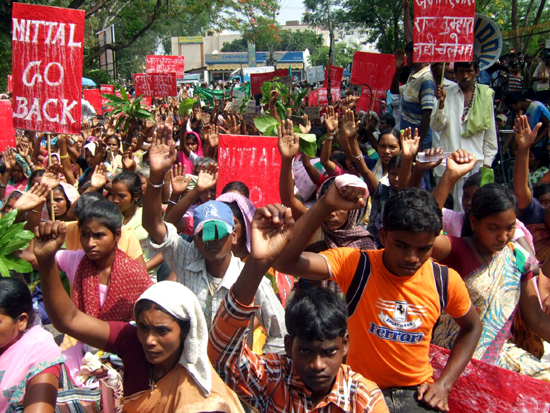
In the rural, tribal lands of Eastern India, protesters are going
head-to-head with world steel giant Arcelor Mittal. "We may give away
our lives, but we will not part with an inch of our ancestral land,"
the villagers cry. "The forest, rivers and land are ours. We don't want
factories, steel or iron. Arcelor Mittal Go Back."
Arcelor Mittal calls itself "the world's number one steel
company," and had 2006 revenues of $88.6 billion. Operating in more
than 60 countries, it "led the consolidation of the world steel
industry and today ranks as the only truly global steelmaker,"
according to its website.
It is here in the mineral rich states of Jharkhand and Orissa that Arcelor Mittal is proposing to invest $201 billion
to establish its "Indian presence" with two plants capable of producing
12 million tons/year each. But first, the family-based company needs to
acquire land that has been the ancestral legacy of thousands of poor
Indians.
A vociferous tribal activist, Dayamani Barla, is
spearheading the Jharkhand movement under the banner of Adivasi
Moolvaasi Asthitva Raksha Manch (AMARM, Forum for the Protection of
Existence of Tribal and Native Population). She has pled her people's
cause from the villages of rural India to the centers of European
power. (See sidebar.)
Barla argues that the Indian Constitution protects
Scheduled Tribes / adivasi (tribal) people in the affected areas by
barring non-tribals and private parties from transfer or purchase of
tribal lands and natural resources.
The two affected Jharkhand districts, Gumla and Khunti
have a preponderance of Munda tribes, while Keonjhar in Orissa is
dominated by Gond, Munda, Dehuri, and Saunti tribes.
“For any tribal community, land is not an asset to be
sold, but it is their heritage,” says firebrand Barla. "They are
neither masters nor its owners, but its protectors for future
generations. The natural resources to us are not merely means of
livelihood, but a symbol of our identity, dignity, autonomy and
culture, for generations."
The stiff resistance the company has faced in the last five
years from AMARM activists in Jharkhand may have produced results. The
steel giant recently decided to settle for a new site in the Petarwar
and Kasmar blocks of the Bokaro district in the state: “The new site is
in the vicinity of the
Bokaro Steel plant under the Steel Authority of India Limited, and we
have had the first dialogue with the local villagers there and got
positive vibes” said Vijay Bhatnagar, CEO, Arcelor Mittal, India and
China.
The activists see the move as spurred by a series of demonstrations
and
actions.In October, Mittal Pratirodh Mamch (MPM, Mittal Opposition
Forum) staged a massive demonstration, replete with anti-Mittal banners
and placards, in the Orissa district of Keonjhar. Activists asserted
that apart from massive population displacement, Arcelor Mittal's
proposed project would destroy forests, water sources, and ecosystems,
thereby imperiling the environment and the subsistence economy of a
tribal society that is rooted in agriculture and forest produce.
"For instance, the place of our worship or, Sarna Sthal,
consists of groves of trees that we consider sacred, sasandari, and the
site in our village that bears stones erected in memory of the
ancestors of our clan," says Barla. "Is it possible to rehabilitate or
compensate for such land?"
The district of Keonjhar is rich in deposits of iron ore
and manganese, and holds 75 percent of the Orissa's iron ore deposits.
“Nearly 10,000 people would be displaced and chunks of prime
agricultural land taken away. …Why can’t the company instead go for
waste lands without forest and agriculture which are available in the
district?" asks Prafulla Samantra, an activist with MPM.
A company official had a ready answer: “These states are very well
endowed with mineral reserves and thus industrialization is essential
to usher growth and development here," he said on condition of
anonymity. "In sharp contrast, the potential for agriculture is rather
low here. The areas that were selected in both the states for the
project were on the basis of technical considerations as soil texture,
availability of water, possibilities of better road and rail
connectivity, favorable for the plant."
The official said that villagers’ needs were being taken
into account. "We cannot go ahead without making the local population
partners to the company in terms of generation of opportunities for
livelihood and growth, through direct and indirect employments." He
said that the company was eager to educate and train youths through
“tying up with various technical institutes in the state," and
incorporating women in various financial activities, "through self help
groups." Even the section of illiterate population involved in
agricultural work can be given training in various unskilled work. The
idea is to give a boost to the general economy of the region.”
Staking out the Territory
Arcelor
Mittal chairman and CEO LN Mittal have had long-standing plans to
expand steel production the country of his birth. In October 2005
Mittal Steel Company N.V. and the Jharkhand government signed a
memorandum of understanding (MoU) for setting up a 12 million tons/year
steel plant, for an estimated $9.3 billion investment. In August 2006,
Mittal Steel was acquired by its key rival Arcelor, and the new entity
signed a similar MoU with Orissa a year later.
The two proposed steel projects would be set up in two
phases capable of producing 6 million tons each, along with a captive
power plant. The first phase is expected to be completed within 48
months from the date of agreement on the detailed project report, and
the second phase 54 months after completion of the first phase.
The Jharkhand mega steel project will require 8,856 acres of land in
the districts of Gumla and Khunti and encompass up to 16 villages,
according to State Industry Department figures.
However, Barla along with the local villagers, assert that the above
figures "may be regarded conservative just to make a beginning. But if
the plant is actually set up the requirement of land would obviously go
up manifolds, by way of growing infrastructure, township etc., in the
process of which about 30 to 40 villages are likely to be displaced,"
and the land despoiled, "thereby imperiling the environment and the
very source of sustenance of the local aborigines."
Arcelor Mittal's Orissa deal projects 7,800 acres,
spanning more than 15 villages in the Patna block of Keonjhar District.
It includes facilities for coke smelting and steel making, as well as
rolling mills and a captive 750 megawatt power plant. In addition, the
company will explore the feasibility of setting up a 2,500 megawatt
capacity power plant in Jharkhand and set up townships and water supply
infrastructure.
The central government has approved Arcelor Mittal's
request to lease 202 hectares of Karampada Iron ore Mines, with
reserves of 65 million tons, located in the reserve forest in the West
Singbhum district of Jharkhand. The deposits are mineralized and of
very good quality.
So far, the refusal by significant numbers of farmers and
other villagers in Jharkand and Orissa to sell their lands essential to
the projects has resulted in delays that are “unacceptable,” LN Mittal
told the Financial Times (London) in October. People have to be
“educated” into supporting gradual industrialization including the need
to build new steel plants on agricultural land, said Mittal's CEO. “If
we cannot make progress in these two sites we will have to abandon the
idea of starting the projects there and look for other places in India
for our expansion.”
But within a day of this threat the steel magnate issued a
softer statement from his New Delhi office: "ArcelorMittal has no plans
to quit India. India is an important country for steel demand growth
and is an important part of Arcelor Mittal's long-term strategic plans.
The company continues to work on its two Greenfield projects in
Jharkhand and Orissa. However, in the event that land acquisition
continues to prove difficult, we will start to search for alternate
sites in India."
Orissa Chief Minister Naveen Patnaik described Mittal's warning as
unexpected. "I have no such information from the company," he told an
Indian news agency. "I believe that land acquisition for that company's
project is on. We have been trying our best to facilitate the project
[and] want to get over the land acquisition problem in a peaceful
manner and to mutual satisfaction, with the villagers."
Secretary to the government of Orissa, Dr. AMR Dalwai,
said that while no land has so far been allotted to the company, the
process is underway. The company has been meeting with Gaon Sabhas
(Village Assemblies) in eight villages, and the remaining seven
villages would also be covered soon. These assemblies are legally
tasked with safeguarding and preserving the traditions and customs of
the people, their cultural identity, community resources, and the
customary mode of dispute resolution.
Jharkhand officials reacted differently. Governor K. Sankaranarayanan
advocated dialogue between the company and the villagers "who own the
land, first have to agree to part with it," he stressed. "If the
company decides to shift [to another location], how can I help it? The
state will not lose; others are ready to step in."
However, in a recent development, CEO Vijay Bhatnagar,
along with group management board member Sudhir Maheshwari and Vice
President MP Singh, met the new government of Jharkhand, led by the
Chief-Minister Shibu Soren. “We came to reaffirm our commitment, that
we are determined to carry out the project in the state for which
support of the state government is required. The chief minister has
pledged all support to the project," said Bhatnagar.
Meanwhile activists with AMARM in Jharkhand are fighting
the project tooth and nail. In October, undeterred by a heavy downpour,
thousands of men and women assembled at district headquarters in the
proposed site in Gumla. They were armed with the traditional bow and
arrow and carried brooms, sickles, grain threshers and tangi
(machetes). The placards and banners they held aloft read “Mittal Go
Back.”
The villagers were protesting the sale of 1,025 acres of
alleged “government” land for which the company paid the district
administration 80 percent of cost (Rs.12.39 crores or $2.8 million).
The villagers called for the immediate abrogation of the deeds, arguing
that the land included community-owned natural resources such as
rivers, streams, forests, and hills covering 10 villages in the
district.
Despite the odds, the locals are holding out hope of
retaining their ancestral lands. “Keeping in mind the protests of the
villagers," said head of Gumla administration Rahul Sharma, "the issue
is pending with the divisional commissioner [and] no land has so far
been given to the company."
Corp Watch





 Print This
  Print This