Joshua Frank, co-author with Jeffrey St. Clair of Red State Rebels: Tales of Grassroots Resistance in the Heartland, looks at a new report that shows that the Environmental Protection Agency is letting coal companies pollute with impunity.
---------------------------
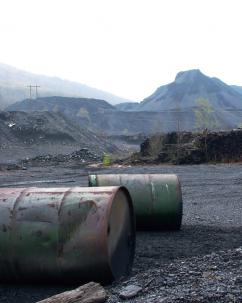 |
| Debris is piled high at the site of a former coal mine in Pennsylvania (Eric Hart) |
|
THE ENVIRONMENTAL Protection Agency (EPA) has severely underreported
the severity of coal ash waste pollution and its threat to human and
environmental health throughout the U.S., a new independent study
released February 24 by the Environmental Integrity Project (EIP) and
Earthjustice says.
The EPA's tally of coal ash contamination locations last year did
not include an additional 31 sites that should have been included in
the totals, stated the study, entitled "Out of Control: Mounting
Damages From Coal Ash Waste Sites."
Annually, coal-fired power plants in the U.S. produce approximately
140 million tons of fly ash, scrubber sludge and additional combustion
waste from the burning of the fossil fuel. This coal ash, which
contains numerous toxins like arsenic and lead, is contaminating
groundwater, drinking supplies and wetlands in dozens of states.
Using a similar methodology as the EPA to identify these sites,
Earthjustice and EIP found that since the EPA's coal waste list is
missing 31 toxic areas, the agency is failing to allow the public to
fully understand the gravity of the problem. The Obama administration's
Office of Management and Budget (OMB) is reviewing a coal-ash
contamination rule proposed by the EPA, but despite mounting pressure
from environmental groups OMB has not yet allowed the EPA to monitor
coal waste.
"At 15 of the 31 sites, contamination has already migrated off the
power plant property (off-site) at levels that exceed drinking water or
surface water quality standards," authors of the report contend. "The
remaining 16 show evidence of severe on-site pollution. Because
off-site monitoring data at 14 of these 16 sites were not available,
damage may be more severe and widespread than indicated in this report."
In all, 14 states were mentioned as having coal waste sites that are
not currently listed as polluted by the EPA. The report also noted that
these unregulated areas pose "clear and present danger" to nearby
communities.
- - - - - - - - - - - - - - - -
THE COAL industry and some members of Congress don't want to see
coal ash deemed a toxic material for fear that it will affect the way
coal-fired power plants operate, inevitably hurting the company's
bottom line as well as jobs in their respective states.
On February 4, 2010, six members of the Illinois Congressional
delegation, led by Democrat Jerry Costello and Republican John Shimkus,
sent a letter to the OMB urging it not to give the EPA authority to
regulate coal waste.
"[R]egulating [combustion by-products] as hazardous waste will
impose steep costs on Illinois energy consumers while producing little
environmental benefit beyond what can be achieved through non-hazardous
waste authority," the letter stated. "Hazardous waste regulation will
require significant engineering changes, capital expenditures and
operating costs. These costs will be passed to consumers, increasing
utility bills in a difficult economic climate."
However, environmentalists counter that without regulating coal
waste, companies will continue to operate with impunity. Last year's
spill at the Tennessee Valley Authority's (TVA) Kingston plant, where 1
billion gallons of sludge destroyed countless homes and poisoned
drinking water in several communities, is often cited as a prime
example of what can happen when these sites go unregulated.
"While the catastrophic spill at TVA's Kingston plant has become the
poster child for the damage that coal ash can wreak, there are hundreds
of leaking sites throughout the United States where the damage is
deadly, but far less conspicuous," said Jeff Stant of the EIP, said in
a statement released along with the report.
Additionally, the EPA acknowledges that most coal ash ponds and many
coal waste landfills are unlined and unregulated. As such, authors of
the report argue, the EPA cannot adequately assess the amount of
contamination these ash dumps are contributing to groundwater supplies.
"Water sources contaminated by coal ash may eventually be cleaned
up, but only at great expense and over long periods of time,"
Earthjustice and EIP write in their joint study. "Injury to human
health or wildlife, however, cannot always be reversed. The evidence is
overwhelming--these 31 sites sound a clear warning that the EPA must
heed before more damage is done."
Socialist Worker





 Print This
  Print This