 |
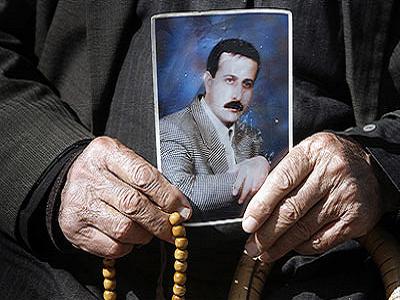
| Al-Mabhouh has been callously deprived of his own relevance to the story. |
|
The killing of Palestinian activist Mahmoud al-Mabhouh on January
19, 2010 was clearly a well-planned, violent and sadistic act,
committed by Israeli assassins in the supposed safety of a sovereign
country.
Yes, Mahmoud al-Mabhouh was a Palestinian activist. We
have no reason to believe otherwise. He spent years of his life in
Israeli prison – and one year in an Egyptian jail – for his political
activism. This, however, gives no credibility to Israel’s accusation
that al-Mabhouh was a killer of Israelis. This assertion becomes even
more problematic when considering that al-Mabhouh’s assassination was,
according to British media, ordered by accused Israeli war criminals
and rightwing politicians.
According to the Sunday Times, Meir
Dagan, the current director of Mossad briefed Israeli Prime Minister
Benjamin Netanyahu on the assassination plan during a meeting in early
January. "The people of Israel trust you. Good luck," Netanyahu
reportedly said at the end of this meeting.
It is disgraceful
enough that the assassins used ‘fraudulent’ European passports, as well
as credit cards linked to an American bank to carry out their plans.
But more upsetting is the fact that this cruel and calculated action
has inspired little more than expressions of ‘outrage’. Have we become
this resigned to Israeli impunity?
What about the sanctity of
life, the sovereignty of nations and the respect for international law?
Are these immediately disposable when the victim is Palestinian and the
location of the crime an Arab country?
Al-Mabhouh has also been
callously deprived of his own relevance to the story. We don’t really
know much about the man aside from what Israeli wants us to know – a
senior Hamas operative who was responsible for the abduction and
killings of two Israeli soldiers; one of the founders of the militant
arm of Hamas, Izz al-Din al-Qassam; the middleman between Hamas in Gaza
and al-Quds Force of the Revolutionary Guard in Iran.
Who has
weaved this fascinatingly reductionist account of al-Mabhouh’s life in
such a short span of time? His family? Hamas? The Palestinian media?
No, none of these. The creator of this biography is Israel, the very
country that assassinated him. Now that is truly outrageous: the
murderer writes and convinces the world of the story of the murder
victim. And the media gladly runs with it.
Expectedly, a
Palestinian would tell al-Mabhouh’s story in entirely different terms.
He was born in Jabalia, one of Gaza’s poorest and most crowded refugee
camps. These key words alone – Gaza, poor, crowded, refugee - helps to
unravel the real story of al-Mabhouh. It is the story shared by so many
people who still live a life of utter anguish, poverty and resistance
in the Gaza Strip – and elsewhere - which is under inhumane siege and
successive wars by the world’s fourth strongest army. The story is not
about abducted occupation soldiers, but about millions of refugees, not
about Iran, but about Gaza and Palestine, not about luxury hotels, but
about horrifyingly desolate refugee camps.
But Palestinians –
like many oppressed peoples around the world – have no right to their
own narrative. Their story is negligible, if not wholly irrelevant.
Israel commits the murder, Israel offers the explanation, and
eventually Israel gets away with both the crime and the lie.
Al-Mabhouh’s murder might eventually inspire several documentaries that
highlight the murderous nature of Palestinian militants, and the
unequalled brilliance of Israeli retaliation. Another Steven
Spielberg’s Munich might already be in the making. The first scene of
this would not be al-Mabhouh’s family forced to flee their village in
Palestinian after untold butchery by Zionist militants in 1948. Instead
it might show a dark-skinned, menacing Palestinian slaughtering two
helpless Israeli soldiers pleading for their lives.
We are,
more or less, told to forget about al-Mabhouh. After all, his name is
used along with Hamas and Iran in the same sentence. That should be
enough to tell us that his life is dispensable - just like the lives of
over 1,400 Palestinians who were killed by the Israeli army in Gaza
between December 2008 and January 2009. Israel may well be preparing
for yet another attack on the impoverished Strip. The tunnels that
represent the lifeline for the vast majority of Palestinians in Gaza
are being routinely blown up by Israeli warplanes, detonated by
dynamites and blocked by an Egyptian steel wall. Gazans cannot be
allowed any weapons to defend themselves either. The ‘international
community’ has held many meetings to ensure that no weapons find their
way to Gaza. The US in particular is utterly firm regarding this issue
- although not at all firm about ensuring that food or medicine reach
the Strip. Al-Mabhouh may have been killed due to Israel’s belief he
was arming the resistance. This partly explains why the ‘international
community’ is not at all moved by the murder. Al-Mabhouh might have
been involved in breaking the Western consensus on denying Gaza both
food and arms.
The EU is only worried about its link to the
story, and not the murder itself. An EU statement issued in Brussels on
February 22 condemned the “fact that those involved in this action used
fraudulent EU member-states passports.” They didn’t name Israel though.
As the Financial Times resolved, “criticism of Israel was as strongly
worded as the EU could manage, given that Germany, Italy and several
other countries place great emphasis on close relations with Israel.”
One
can only imagine what would happen if Hamas decides to strike back,
expanding the battleground from Gaza to the rest of the world. Would
the EU express disapproval of Hamas’ use of fraudulent passport, but
then refrain from actually naming the group - due to a fear, say, of
upsetting Muslim countries?
No. But when the victim is a
Palestinian and the murderers are Israelis – 27 of them so far – it’s
an entirely different story, and an entirely different concept of
justice.
The Palestine Chronicle





 Print This
  Print This