MONTREAL—Algonquin hip-hop artist Samian raps about the realities of
life on First Nations reserves in Quebec. With a growing following on
reserves and in Quebec's cities, he's also struck a chord with hip-hop
communities everywhere.
Exploding the classic political binary of Quebec's two solitudes,
Samian raps about Indigenous people and their history in the province.
His chart-topping hit "La Paix Des Braves," a duet with Quebec hip-hop
crew Loco Locass, appeals for solidarity between Quebecois and
Indigenous people. Samian's recent collaboration with Sans Pression on
their single "Premieres Nations" helped cement his role as a key voice
in the Montreal contemporary hip-hop scene.
Stefan Christoff sat down with Samian to discuss contemporary
hip-hop in Montreal and the ways the genre is increasingly speaking to,
and representing the struggles of, First Nations communities in Quebec,
in Canada and throughout the Americas.
Hip-hop's origins in New York City were rooted in rhymes
that addressed social injustices, especially the racism and social
exclusion faced by African-Americans. Today in Canada, Indigenous
people face similar systemic social exclusion: racism, incarceration,
substandard housing and medical options and poverty. Hip-hop is
increasingly used as a response to this reality and artists are rapping
about the social injustices faced by Indigenous people. Can you talk
about how your work relates to the history of hip-hop as a socially
conscious art form? How do you connect your work to hip-hop history?
Hip-hop has always been
an art form through which people have made demands, appealed for change
and denounced the social injustices faced by African-Americans in US
ghettos. Certainly the history of African-American struggle in the US,
like we saw with the Black Panthers, is tied to hip-hop music [and]
culture.
Indigenous people in Quebec, in Canada, have lived through a history
of oppression like African-Americans. Today we are still calling for
justice, and hip-hop is a vehicle to call for this change. As an
artist, I love hip-hop because it allows for free expression: You can
talk about whatever issues are important to you. Hip-hop is a space for
me to express myself on many subjects, to denounce injustices. It's
also a space to propose positive solutions for social ills, and to
reflect on the world around me.
What are you trying to make people more aware of through your music?
Our reality, the life on the reserves, the fight to retain our
culture, the fact that we are struggling to keep our language. Also I
want to make people aware that Indigenous people have a rich history
and culture that is ignored by the mainstream.
Through hip-hop we are opening people's eyes to our culture and also
to our long, long history on this land. I want to speak to youth in
Quebec who don't always learn about real indigenous history in the
school system. Quebecois and Indigenous peoples' history in Quebec are
interlinked. This relationship between our cultures has shaped what we
know to be Quebec today, and who we are. Sadly our Indigenous history
is often shoved to the side because it shows an underlying brutality in
the national narrative.
Many Montrealers don't know about the situation facing
Indigenous people on the reserves here and in Quebec. In this context,
how do you see hip-hop as a way to educate people about the Indigenous
reality here? How do you address these issues in your music?
I think my music has the biggest impact on the reservations. The
music sparks the spirits of the new generation on the reserves, and
gives youth pride in our culture, and in our language.
But for everyone in Quebec, I hope my music inspires a more open
spirit towards the realities faced on reserves, because people need to
wake up to the difficulties and poverty we experience. The mainstream
media don't address our situation thoroughly, so I am trying to
communicate our reality. Simply put, there are two different realities,
two different worlds, two different experiences of life in Quebec—one
on the reserves and one off the reserves.
In Quebec, we have a national slogan: Je me souviens.
But really, what do we remember in Quebec? In Quebec we forget some of
the biggest parts of our own history. How was Quebec and Canada
founded? What ever happened to the people who originally lived here?
Why does the world forget that there are over 500 languages spoken
across Canada, and not just English and French? So much about our
history has been hidden or erased, and so young people never learn
about the first peoples. These are all questions that—incredibly—aren't
well answered in our schoolbooks. The government is also directly
responsible for the lack of knowledge about our history, because
Indigenous culture and history is not a priority, and not taught
seriously within the public school curriculum.
Recently, I looked up "Algonquin" in the dictionary and was shocked.
The definition read something like "a people that don't exist." I was
shaken to the core after reading this—how absurd. I am an Algonquin
artist today in Quebec, I exist and my people exist. Today, after
thousands of years, we are still on this land as Indigenous people. We
are still here and are gathering strength; my hip-hop verses express a
pride for Indigenous people in Quebec.
Samian: Algonquin alert
As an artist, your hip-hop is unique and has struck a chord
in Quebec. What do you think makes your work compelling to so many
different audiences?
I wrote poetry before ever thinking about rap. I eventually fell
into rapping almost as an accident. Today I work with amazing musicians
who are able to complement my verses with music. I think the
relationship between my verses and the musicians that I collaborate
with has become richer with time.
My second album is much deeper musically than the first album, and
now it feels like things are constantly developing for me in exciting
ways as an artist. All my first songs weren't written with, or for,
specific music, so now that I work with musicians in developing my
verses, the creative process has changed a lot.
At the root, I am an artist, not a politician. My songs are about
real issues, but I address those issues as an artist. Many people say
that my work is really political, but actually I know nothing about the
political world. I address issues that are important to me.
But you are linked to grassroots political movements. Do you mean you aren't tied to the world of politicians and government?
I am interested in speaking out against injustice and trying to
build towards solutions that solve those injustices. I'm not at all
interested in official politics or political parties. Actually there
hasn't been a major politician in North America, in the US, or in
Canada who has proposed something really good for First Nations people.
No proposal deals with the historical injustices we faced and the
contemporary situation.
Perhaps we could look to Evo Morales in Bolivia as an example?
[Laughing] Today Bolivia is an exception in the Americas, because
Morales is an Indigenous president! In Bolivia, Indigenous people are
the majority, while in Canada we are such a small minority today.
In Bolivia the government of Evo Morales signed the United Nations
Declaration on the Rights of Indigenous Peoples into the national
constitution. Here, Stephen Harper refused to sign the letter or even
vote in favour of the charter at the UN. Harper made that apology for
residential schools, but he voted against the United Nations
Declaration on the Rights of Indigenous Peoples.
The government in Canada wants us to remain in an unequal position
and as a minority, with no political power. Indigenous people live in
Third World conditions right here in Quebec and throughout Canada. So,
is Canada progressive? In the US there is an African-American
president; could you ever imagine a First Nations prime minister in
Canada? Indigenous people in Canada should take inspiration from the
African-American struggle, which won many rights for black people in
the US. Actually, we need to wage a similar struggle in Canada, a civil
rights struggle.
Can you talk about the concerts that you've given in
Indigenous communities across Quebec? Do you feel different about the
concerts that you give on reserve and those in the city?
Actually my concerts on reservations are really, really special for
me. I feel that the most meaningful impact from my music is on the
reserves. To meet youth on different reserves and to connect with
youth, to talk about their realities—this is a big source of
inspiration for me. I can connect strongly with this, given that my own
experiences are linked.
My work tries to project the true voice of First Nations people:
Those on the reserve that I meet who are always struggling to survive,
struggling for justice... I hope my music inspires youth to dream
louder and create a better future.
If you appreciated this article, please consider making a donation to Axis of Logic.
We do not use commercial advertising or corporate funding. We depend solely upon you,
the reader, to continue providing quality news and opinion on world affairs.Donate here





 Print This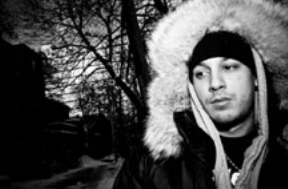
 Print This