 |
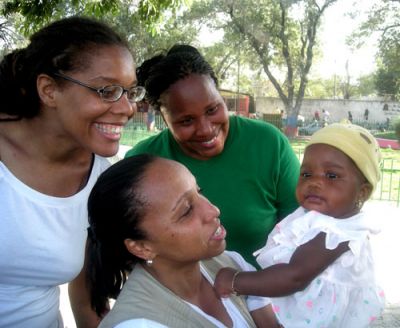
| BABY LOVE: Cuban-trained U.S. doctors Melissa Barber, Elsie Watler and Keyshia Covington look after a Haitian baby during a day of children’s activities designed to assess symptoms of post-traumatic stress disorder.(IFCO) |
|
After the Jan. 12 earthquake that devastated Haiti, Dr.
Melissa Barber received a call asking her to help treat people left
injured and living in squalid conditions.
“There was no question,” said Barber, 30, who was born and raised in
the Bronx and worked in quality assessment at St. Barnabas Hospital in
the heart of the borough. “I actually resigned and I made plans to go
to Haiti for a month. That is how much it’s ingrained in me to help the
underserved communities when they are in need.”
Barber’s sense of service stems from her training at the Latin
American School of Medicine in Havana, Cuba (See sidebar). Like
thousands of fellow graduates from poor and indigenous communities in
Latin America, the Caribbean and Africa, she received a full
scholarship to attend the school in exchange for a commitment to work
in areas that lack adequate access to healthcare. Haiti no doubt fit
that definition before the earthquake, and even more so afterward.
So Barber joined six other Cuban-trained doctors from the United
States — all of them women — who packed their bags full of donated
medical supplies and arrived Jan. 26 in the Dominican Republic,
beginning a commitment that could last for years.
ON THE GROUND IN HAITI
On the bus ride into Haiti, the physicians from New York City,
Houston and Oakland got a crash course in Creole from their
Haitian-American colleague, Dr. Martine Pierre. She taught them useful
phrases like, “What’s your name?” and “What’s wrong with you?” For the
next month the doctors would use these phrases while treating hundreds
of patients a day.
Their home base was a clinic in Croix des Bouquets, a suburb of
Port-au-Prince that lies eight miles northeast of the ruined capital.
Cuban doctors working in Haiti before the quake set up the makeshift
hospital a week before they arrived, and already word had spread to
longtime residents and newly arrived refugees living nearby in tent
villages.
“The line to see us would start at four in the morning,” Barber
said. “Once they realized there is free medical care and medicine, they
were like ‘Oh my god, I can finally see a doctor.’”
Many of the patients treated at the clinic had never seen a doctor
before. In addition to receiving treatment for quake-related injuries
and water-borne diseases, they sought help for chronic conditions like
diabetes and high blood pressure. The doctors relied on their
Cuban-training that focused on primary care medicine, as well as two
years of training in disaster relief.
But nothing could prepare Barber for experiences like treating a
4-year-old boy who was brought in by his mother in a state of severe
dehydration. Within 10 minutes of his arrival he died. The mother said
she had left her son to search for his father when he went missing
after the earthquake. By the time she returned home he had been
suffering from diarrhea for four days.
“That kind of stuff is so preventable,” Barber said. “It speaks of a lack of healthcare that they need.”
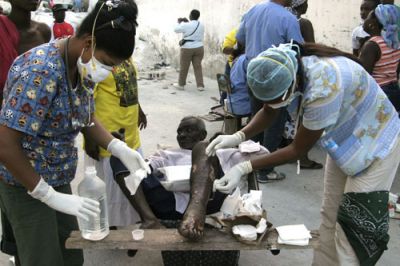 |
| MAKESHIFT MEDICINE: Cuban-trained doctors treat an earthquake survivor at a clinic in Croix des Bouquets. (IFCO) |
|
INTERNATIONAL RESPONSE
Barber and her fellow physicians from the United States inspired the Comandante
himself, Fidel Castro, to send an invitation to all of the school’s
graduates to volunteer in Haiti. By February, more than 250 alumni from
25 countries responded. They came from Bolivia, Mali, Lebanon and
Nigeria — among other nations. About 300 Haitians in their final two
years of medical school returned home as well.
For the first time ever, an international contingent of
Cuban-trained doctors joined the 230 Cuban members of the Henry Reeve
Emergency Medical Brigade, which specializes in disaster response. Many
of them had provided medical support after recent earthquakes in
Pakistan and China.
All of these volunteers bolstered the contingent of about 350 Cuban
doctors who were in Haiti before the earthquake. Cuba initiated a
medical cooperation agreement in 1998 to meet the primary care needs of
the impoverished nation.
“The responsibility that was placed on our shoulders was
tremendous,” said Dr. Melissa Mitchell, a member of the Cubantrained
U.S. delegation. “Some of us were delivering babies alone for the first
time ever. The first time that happened it was a very emotional
experience, but then it became normal.”
HOLISTIC HEALING
In addition to dealing with primary care and treating disease, the
Cubans expanded their focus to address the need for physical and
psychological rehabilitation.
Physical therapy programs have been set up at several clinics to
assist those with injuries or amputations. Specialists are also
available to treat post-traumatic stress disorder among survivors.
At the field hospital in Croix des Bouquets, which occupies what had
formerly been a playground, physicians worked to reduce psychological
damage suffered by children. With help from parents in the community
they put together a children’s festival that included watercolor
painting, singing, and sports.
Now, the children’s gathering has become a weekly event. “Every
Thursday they would gather all the kids in the community together to do
activities,” Barber said.
Volunteers translated several children’s books from Spanish into
Creole, and sent the translations to Cuba, which sent back copies to
use for storytelling. Prensa Latina reports plans are
underway to introduce the children’s festivals in other devastated
areas, “permitting children to put their nightmares off to one side, at
least for a while.”
Dr. Cristóbal Martínez told Prensa Latina that, “Although
there had been a terrible disaster, if children eat, play and can enjoy
themselves, in their consciousness the disaster has already passed.”
The doctors who took a break from their work to paint and play games
with the children said they also benefited from the mental break.
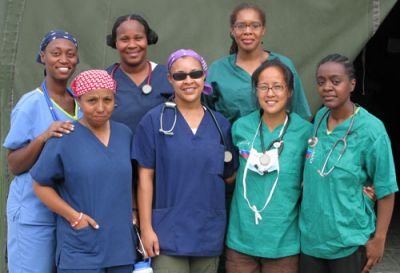 |
| THE U.S. DELEGATION: Cuban-trained U.S. doctors serving in Haiti: (back row left to right) Martine Pierre, Keyshia Covington, Melissa Barber; (front row left to right) Elsie Watler, Melissa Mitchell, Wing Wu, Nyla Manning. (IFCO) |
|
CREATING A HEALTHCARE SYSTEM
“It was difficult for us to leave because our presence is still
needed,” said Mitchell, who joined the seven-member U.S. delegation
after they returned in early March during a press conference at the New
York City headquarters of Transit Workers Union Local 100.
“It’s not about just being there for the crisis. We need to be there
for the long term,” she said. “We need to be able to help establish
some type of medical system.”
In fact, the makeshift clinics where the doctors worked are
essentially pilot projects for long-term heathcare centers. They will
expand upon the hospitals Cuba established prior to the earthquake.
Several hundred recent graduates from the Latin American School of
Public Health are staffing the hospitals until Haitian students finish
their training and replace them. Many of the graduates committed to
stay in Haiti for a year or more. In return, they will receive two more
years of free medical training in the specialized field of their choice.
Cuban Vice President Esteban Lazo Hernández said his country’s
commitment to Haiti “has to be at that level, above all in something as
significant as the population’s health.”
Many of the women in the U.S. delegation expressed a desire to return to Haiti when their schedules permit.
Dr. Martine Pierre spoke with one of the doctors back at the clinic
in Croix des Bouquets the day after the delegation left. He said the
patients they had treated for chronic diseases came looking for the
U.S. doctors and were sad to find they were gone. “That really hurt
their feelings,” Pierre said. “But the Haitian doctors told them we
will soon be back.”
For now, Barber is back in the Bronx focusing on studying for exams
that she hopes will get her into a residency program for Obstetrics and
Gynecology. But her mind is still on Haiti.
“The treatment needs to be continuous,” Barber said. “Because we’ve only put a dent in what is needed for the population.”
The Indypendent





 Print This
  Print This