More than half (27) of the nation's 50 worst power plants for
mercury emissions increased their mercury emissions from 2007 to 2008
(the latest year for which data is available), according to a new report from the nonprofit and nonpartisan Environmental Integrity Project (EIP).
The six leading U.S. power suppliers with three or more plants on the
mercury emission list by total pounds include Luminant (formerly TXU),
American Electric Power (AEP), Southern Company, Entergy, Ameren, and
NRG.
The power plants that provide electricity to run America's homes,
businesses, and factories are also the single largest source of mercury
air pollution, responsible for more than 40 percent of all mercury
emissions nationwide. Mercury is a highly toxic metal, and once
released into the atmosphere, it settles in lakes and rivers, where it
moves up the food chain to humans. According to the U.S. Environmental
Protection Agency, roughly half of the nation's lakes and reservoirs
have levels of mercury that exceed safe levels. Each year, more than
300,000 newborn babies may have an increased risk of learning
disabilities due to in utero exposure to mercury, which is a neurotoxin
that causes impaired neurological development in fetuses, infants and
children.
Other key EIP report findings include the following:
| • |
The
top 50 power plant mercury emitters were essentially flat from 2007 to
2008, with mercury emissions off by a paltry 0.26 percent. |
| • |
Texas
is home to the largest mercury emitter-- Luminant's Martin Lake power
plant, which reported a 4.56 percent increase from 2007 to 2008. In
fact, the Lone Star State claims five of the 10 largest power plant
mercury air pollution sites in the nation. Dallas-based Luminant
(formerly TXU) has three of the nation's top five largest mercury
emitters, in terms of total pounds emitted, all operating in East
Texas. |
| • |
A
total of 15 states had two or more of the 50 largest power plants for
mercury emissions – Texas (7), Alabama (4), Pennsylvania (4), Indiana
(3), North Dakota (3), Ohio (3), West Virginia (3), Arkansas (2),
Arizona (2), Georgia (2), Illinois (2), Kansas (2), Louisiana (2),
Missouri (2), and Wisconsin (2). |
| • |
Overall,
power plant mercury emissions from electric utilities decreased 4.7
percent from 2007 to 2008, at the same time that gross power generation
declined roughly 2 percent. |
Environmental Integrity Project Senior Attorney Ilan Levin said: "Despite
years of promises, the electric power industry has barely made a dent
in its mercury emissions this decade. This slow progress is nowhere
near the levels that would be achieved if all plants installed modern
pollution controls. The nation's power plants are not even close to
meeting the levels that EPA forecasted under a weak Bush Administration
power plant mercury rule that was subsequently thrown out by a federal
court."
Glen Hooks, regional director, Sierra Club Beyond Coal Campaign said: "Texans
and other Americans do not need to live with the dangerous risks posed
by mercury pollution from power plants. Pollution controls that
dramatically reduce mercury emissions are widely available, and are
already being used at many power plants. But, until the public and
policymakers hold the electric power industry to its promises to shut
down or clean up the nation's oldest and dirtiest plants, Americans
will continue to bear unnecessary health and environmental costs."
Other key findings in the EIP report include the following:
| • |
Power
plant mercury emissions have actually risen since 2000 (the first year
this data was reported) in several states, including Arkansas, Arizona,
Georgia, Iowa, Illinois, Kansas, Louisiana, Missouri, Nebraska, North
Dakota, Texas, and others. |
| • |
Six
Southern Company plants in Georgia and Alabama are ranked among the top
50 power plant mercury emitters for overall mercury emissions. |
| • |
Six
American Electric Power (AEP) plants in Texas, Ohio, Indiana and West
Virginia are ranked among the top 50 mercury emitters. AEP's Gavin
Power Plant in Ohio emitted 937 pounds of mercury in 2008, a 115.4
percent increase from 2007. This drastic increase in mercury emissions
appears to be due largely to a change in the coal burned at the plant
in 2008. |
| • |
NRG's
Limestone County, Texas plant emitted 1,251 pounds of mercury in 2008,
a 4.55 percent increase over its reported 2007 emissions. NRG is
currently constructing a third coal-fired boiler at this plant. |
| • |
In
terms of pounds of mercury emitted per gigawatt hour, the following
companies have three or more power plants on the list: Ameren (4);
Luminant (4); Reliant (RRI Energy) (4); Southern Company (4); AEP (3);
and NRG (3). |
The EIP report rates the power plants both in terms of sheer mercury
pollution and mercury pollution adjusted per gigawatt-hour.
For a copy of the full EIP report, click here
The Environmental Integrity Project report ranks the top fifty power
plant polluters for mercury, according to: "total amount emitted,"
which measures the total pounds of mercury reported by each power
plant; and "emission rate," which measures the amount of pollution per
gigawatt-hour of electricity generated.
The EIP report contains mercury emissions data obtained from EPA's
Toxics Release Inventory (TRI), and electric generation data obtained
from EPA's Clean Air Markets (also known as the Acid Rain program)
databases. In 2008, the U.S. EPA's Toxics TRI tracked mercury emissions
from approximately 470 electric generating facilities across the United
States and its territories. (There are hundreds of power plants that
release less than 10 pounds of mercury per year that are not included
in the TRI database.) This report analyzes mercury emissions reported
by the electric power sector to TRI. TRI data are publicly available on
EPA's website at http://www.epa.gov/triexplorer. All data is
self-reported by the utility industry to EPA.
Environmental Integrity Project





 Print This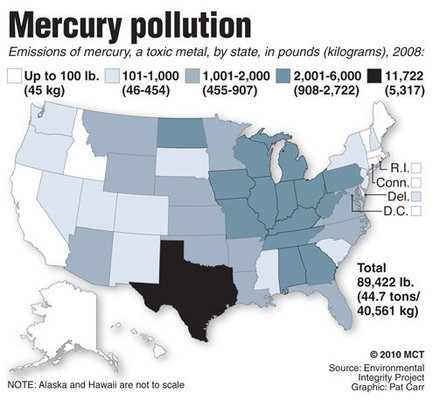
 Print This