Long lines at store checkouts could be history if a new technology created in part at Rice University comes to pass.
Rice researchers, in collaboration with a team led by Gyou-jin Cho
at Sunchon National University in Korea, have come up with an
inexpensive, printable transmitter that can be invisibly embedded in
packaging. It would allow a customer to walk a cart full of groceries
or other goods past a scanner on the way to the car; the scanner would
read all items in the cart at once, total them up and charge the
customer's account while adjusting the store's inventory.
More advanced versions could collect all the information about the
contents of a store in an instant, letting a retailer know where every
package is at any time.
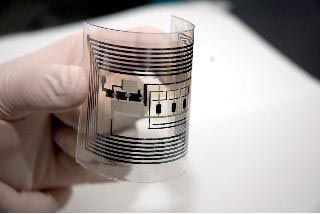 |
| RFID tags printed through a new roll-to-roll process could replace bar codes and make checking out of a store a snap. (Gyou-Jin Cho) |
|
The technology reported in the March issue of the journal IEEE Transactions on Electron Devices
is based on a carbon-nanotube-infused ink for ink-jet printers first
developed in the Rice lab of James Tour, the T.T. and W.F. Chao Chair
in Chemistry as well as a professor of mechanical engineering and
materials science and of computer science. The ink is used to make
thin-film transistors, a key element in radio-frequency identification (RFID) tags that can be printed on paper or plastic.
"We are going to a society where RFID is a key player," said Cho, a
professor of printed electronics engineering at Sunchon, who expects
the technology to mature in five years. Cho and his team are developing
the electronics as well as the roll-to-roll printing process that, he
said, will bring the cost of printing the tags down to a penny apiece
and make them ubiquitous.
RFID tags are almost everywhere already. The tiny electronic
transmitters are used to identify and track products and farm animals.
They're in passports, library books and devices that let drivers pass
through tollbooths without digging for change.
The technology behind RFID goes back to the 1940s, when Léon Theremin,
inventor of the self-named electronic music instrument heard in so many
'50s science fiction and horror movies, came up with a spy tool for the
Soviet Union that drew power from and retransmitted radio waves.
RFID itself came into being in the 1970s and has been widely adopted
by the Department of Defense and industry to track shipping containers
as they make their way around the world, among many other uses.
But RFID tags to date are largely silicon-based. Paper or plastic
tags printed as part of a package would cut costs dramatically. Cho
expects his roll-to-roll technique, which uses a gravure process rather
than ink-jet printers, to replace the bar codes now festooned on just
about everything you can buy.
Cho, Tour and their teams reported in the journal a three-step
process to print one-bit tags, including the antenna, electrodes and
dielectric layers, on plastic foil. Cho's lab is working on 16-bit tags
that would hold a more practical amount of information and be printable
on paper as well.
Cho came across Tour's inks while spending a sabbatical at Rice in
2005. "Professor Tour first recommended we use single-walled carbon
nanotubes for printing thin-film transistors," Cho said.
Tour's lab continues to support the project in an advisory role and
occasionally hosts Cho's students. Tour said Rice owns half of the
patent, still pending, upon which all of the technology is based.
"Gyou-jin has carried the brunt of this, and it's his sole project,"
Tour said. "We are advisers and we still send him the raw materials" --
the single-walled carbon nanotubes produced at Rice.
Printable RFIDs are practical because they're passive. The tags
power up when hit by radio waves at the right frequency and return the
information they contain. "If there's no power source, there's no
lifetime limit. When they receive the RF signal, they emit," Tour said.
There are several hurdles to commercialization. First, the device
must be reduced to the size of a bar code, about a third the size of
the one reported in the paper, Tour said. Second, its range must
increase.
"Right now, the emitter has to be pretty close to the tags, but it's
getting farther all the time," he said. "The practical distance to have
it ring up all the items in your shopping cart is a meter. But the
ultimate would be to signal and get immediate response back from every
item in your store – what's on the shelves, their dates, everything.
"At 300 meters, you're set – you have real-time information on every
item in a warehouse. If something falls behind a shelf, you know about
it. If a product is about to expire, you know to move it to the front –
or to the bargain bin."
Tour allayed concerns about the fate of nanotubes in packaging. “The
amount of nanotubes in an RFID tag is probably less than a picogram.
That means you can produce one trillion of them from a gram of
nanotubes – a miniscule amount. Our HiPco reactor produces a gram of
nanotubes an hour, and that would be enough to handle every item in
every Walmart.
"In fact, more nanotubes occur naturally in the environment, so it's
not even fair to say the risk is minimal. It's infinitesimal."
Co-authors of the paper include Rice graduate student Ashley
Leonard; Minhun Jung, Jinsoo Noh and Gwangyong Lee of Sunchon National
University; and Jaeyoung Kim, Namsoo Lim, Chaemin Lim, Junseok Kim,
Kyunghwan Jung and Hwiwon Kang of the Printed Electronics Research
Center, Paru Corp., Sunchon, Korea.
Paper available here.
Rice University





 Print This
  Print This