 |
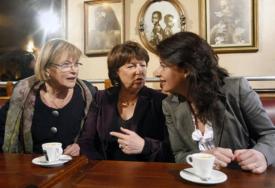
| Marie-George Buffet, France's Communist leader, left, with Martine Aubry, the Socialist leader, centre, and Cécile Duflot, the Green leader, right. The left parties and the Greens look likely to take at least 21 of the 22 regions in this weekend's elections |
|
A resurgent left, and the rapid growth of the Greens, look certain to
condemn President Nicolas Sarkozy to two years' hard labour when French
regional elections are completed this weekend. Opinion polls suggest
that an alliance of the Socialists, the Greens and the harder left is
likely to sweep at least 21 of the 22 regions in Metropolitan France
after the second round of voting tomorrow.
Despite the low turnout,
last Sunday's first round suggests France has undergone a severe
electoral earth tremor, if not an earthquake. Jean-Marie Le Pen's
far-right National Front has regained some ground, but far more
threatening to President Sarkozy may be the recovery of the left.
The Socialists, the Greens and two somewhat harder-left parties
scored 49.9 per cent of the vote last Sunday - the highest score for
the left in an equivalent nationwide poll for more than half a century.
The
vote changes many of the calculations for the next presidential
election in 2012. For the first time since the collapse of the
Communist vote in France, the combined left appears to have the
electoral ammunition to enter a presidential race with confidence.
All
that the left lacks is a credible presidential contender. There has
been serious talk this week of a combined left and Green presidential
primary next year to pick a single candidate. This would be a
revolution in French politics but, given the dispiriting list of likely
runners and riders, it would not necessarily produce a "French Blair"
or a "French Obama".
The Socialist leader, Martine Aubry, is
given much credit for rebuilding her party but may lack the charisma to
run successfully for the presidency. Some French journalists have
started comparing her to the German Chancellor, Angela Merkel, but Ms
Aubry is no Merkel and France is not Germany.
All the same, the
resurgence of the centre-left, dismissed as moribund a year ago, has
produced deep depression, and recriminations, within President
Sarkozy's centre-right: its total vote last Sunday - just over 27 per
cent - was the lowest in any poll since the Fifth Republic was founded
in 1958.
Mr Sarkozy, and his close aides and allies, have refused to accept that this is the President's fault.
Senior
figures in his own party, the Union pour un Mouvement Populaire (UMP),
say the poor score can only partly be explained by the global
recession. They say Mr Sarkozy has paid the price for his erratic
reforms, his veering between statist and liberal attitudes, and his
monarchical approach to issues such as the aborted promotion of his
23-year-old son, Jean, to a senior political post.
They also
complain that Mr Sarkozy has made two serious electoral
miscalculations. He has absorbed part of the old French political
centre, and part of the harder right, under his own banner. And his
political appointments have reached out to the left.
Far from
broadening his electoral base to an unassailable size, as intended, Mr
Sarkozy suddenly finds he has no electoral allies outside his own
party. He has managed to offend part of his core vote and reduce the
centre-right to its lowest level in half a century.
Less than a
year ago, Mr Sarkozy was regarded, within his own camp, as invincible.
Many grumbling voices have been heard this week. Senator Philippe
Dallier, said that the President's policies had become "unreadable".
Claude Goasguen, a UMP deputy on the economically liberal right of the
party, said that the President's "ouverture" to left-wing appointments
and his lurches into statism had "done us terrible harm".
Jean-Marie
Le Pen's score last Sunday - nearly 21 per cent in Provence - has also
embarrassed Mr Sarkozy. The President appeared to have ended the
far-right threat by reducing Mr Le Pen's share to 10.4 per cent in the
first round of the 2007 presidential election.
Nationwide,
though, the NF scored only 11.5 per cent, compared with 14.7 and 15 per
cent in the last two regional elections of 2004 and 1998. With the
81-year-old Mr Le Pen expected to retire next year, and the party
divided and underfunded, the chances of a far-right resurgence are
slight.
The Independent.uk





 Print This
  Print This