 |
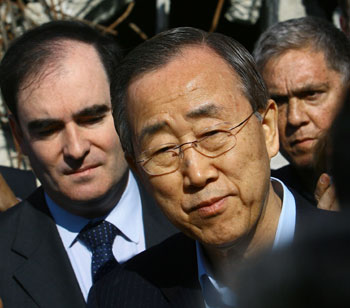
| Ban: Israeli siege of Gaza 'causes unacceptable sufferings' to Palestinian civilians. |
|
KHAN YUNIS, Gaza - UN
chief Ban Ki-moon slammed Israel's blockade of the Gaza Strip during a
tour of the war-battered coastal territory on Sunday, saying it was
causing "unacceptable sufferings."
"I have repeatedly made it
quite clear to Israel's leaders that the Israeli policy of closure is
not sustainable and that it's wrong," Ban told reporters in the
southern Gaza Strip town of Khan Yunis.
"It causes unacceptable
sufferings to... the people and population" of Gaza, he said, adding he
was saddened to see that teenagers and children were the worst affected.
"This policy is also
counterproductive. It prevents legitimate commerce and encourages
smuggling. It undercuts moderates and empowers extremists."
The UN chief crossed into
the besieged territory earlier Sunday, expressing solidarity with the
plight of the Palestinians and urging Israel to end its tight blockade.
This was his second visit to the impoverished Gaza Strip since Israel's 22-day offensive on Gaza ended in January 2009.
Ban toured some of the
hardest-hit areas of Gaza before inaugurating projects to build 150
homes, a flour mill and a sewage treatment plant.
However, Ban said more reconstruction was needed, calling the projects a "drop in the bucket."
"I have seen much damage (to many) houses, it is quite distressing," he said.
In the Israeli-occupied
Palestinian West Bank on Saturday, the UN Secretary General had said
his visit to Gaza was to show support for Palestinians.
"I'll go to Gaza... to
express my solidarity with the plight of the Palestinian people there
and to underscore the need to end the blockade," Ban told reporters.
He said in Khan Yunis that
"the United Nations will stand with you through this ordeal" and
continue to deliver humanitarian aid.
But he also urged all Gazans "to choose the path of non-violence."
Ban had insisted ahead of a
meeting with Israeli President Shimon Peres on Saturday that the
closures imposed "unacceptable hardships" on civilians.
"I am confident the blockade can be lifted while addressing Israel's legitimate security concerns."
The closures have prevented the rebuilding of thousands of homes that were damaged or destroyed by Israel.
The military offensive in December 2008 and January 2009 ended with an Israeli-Hamas ceasefire.
Hamas has taken steps to
rein in the rocket fire since the war, and a deadly attack was claimed
by a radical Al-Qaeda-inspired group which has clashed with Hamas in
the past.
Israel, which wants to
crush any Palestinian liberation movement, responded to Hamas's win in
the elections with sanctions, and almost completely blockaded the
impoverished coastal strip after Hamas seized power in 2007, although a
‘lighter’ siege had already existed before.
Gaza is still considered under Israeli occupation as Israel controls air, sea and land access to the Strip.
Ban's visit came on the
heels of a statement by the Middle East diplomatic Quartet -- the
United States, United Nations, European Union and Russia -- ordering
Israel to halt all settlement activity.
Ban said the international
community "strongly supports" Palestinian efforts to build an
independent state, and reiterated that all Israeli settlement activity
is illegal.
Meanwhile, Israeli troops
shot dead a young Palestinian protester who throwing stones and
critically wounded another in the West Bank, Palestinian medics and
security officials said.
Israeli troops entered the
village as fighting broke out between indigenous Palestinian villagers
and radical Jewish settlers at nearby Bracha.
Villagers said the clash
broke out when illegal settlers attacked the village and was unrelated
to the organised protests against Israeli settlements that have rippled
through the West Bank and East Jerusalem over the past week.
But the Israeli army said
the Palestinians had been heading for the settlement and had hurled
stones at soldiers trying to stop them. Troops had used tear gas and
rubber bullets but not live rounds, an army spokesman said.
In an interview with the
Germany weekly Spiegel to be published on Monday, Israel's extremist
Foreign Minister Avigdor Lieberman said East Jerusalem will remain part
of part of the Israeli capital.
"Jerusalem is not negotiable," he said.
Lieberman said that "We now expect the Americans to put pressure on the Palestinians".
Israel occupied Palestinian
East Jerusalem in 1967 and calls all of Jerusalem its "eternal and
indivisible" capital, contrary to international law which states land
cannot be legitimately won through invasion or occupation.
East Jerusalem is
considered by the international community to be illegally occupied by
Israel, in contravention of several binding UN Security Council
Resolutions.
In these resolutions, the
United Nations Security Council has also called for no measures to be
taken to change the status of Jerusalem until a final settlement is
reached between the sides.
Declaring Jerusalem as Israel's capital is an attempt to change this status, and is thus a violation of these resolutions.
All Jewish settlements are
illegal under international law because they are built on Arab land
(mainly Palestinian), illegally occupied by Israel since 1967.
Around 200,000 illegal
Jewish settlers are estimated to have moved into the dozen or so
Israeli settlements in Palestinian East Jerusalem.
East Jerusalem is home to about 270,000 indigenous Palestinians.
Middle East Online





 Print This
  Print This