Children are increasingly served very unhealthy food in order to kowtow to the Kings of Big Ag.
Senate lawmakers moved Wednesday to make school lunches more healthful
by cutting farm conservation programs, while leaving intact the crop
subsidies that many experts say contribute to the high fat and starchy
diets behind the obesity epidemic.
A costly remake of the $17 billion school lunch program, which feeds
32 million children a day, is under way in Congress in tandem with
first lady Michelle Obama's high-profile campaign to end childhood
obesity.
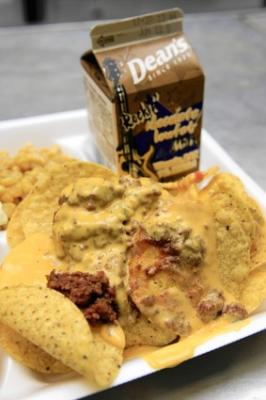 |
| An entree of nachos, smothered with cheese and meat, is often consumed with chocolate milk for lunch, at Von Steuben Metro Science High School. (Alex Garcia) |
|
There is widespread agreement in both parties that corn
chips with cheese sauce, fried chicken nuggets and other staples of the
school lunch menu have to go. Obesity has risen dramatically in
children, and the cost of treating the conditions linked to being
overweight have reached nearly $150 billion a year, or 50 percent more
than the cost of the new health care law.
In addition, Mars
Candy, Coca-Cola and other food manufacturers have agreed with the
American Academy of Pediatrics and other public health advocates to
national standards that could ban junk foods sold in vending machines
and other school locations outside the lunch and breakfast programs.
The
Senate Agriculture Committee approved a $4.5 billion increase for
school nutrition over the next decade, with broad bipartisan support.
That is less than half the $10 billion that the White House wants. The
problem for Congress is that new pay-as-you-go budget rules require
cutting other spending or raising taxes to offset the cost.
To
pay for the increase, the committee targeted for cuts a farm
conservation program called the Environmental Quality Incentives
Program, or EQIP, that goes to farmers of all crops, many of them
small. Left untouched were the much larger crop subsidies that go to
big corn and other grain and cotton growers.
Environmental
advocates contend there is more than enough money available for school
nutrition if lawmakers would be willing to trim those payments. Many
public health advocates fought a losing battle against the crop
subsidies in the 2008 farm bill, arguing that they make the corn and
corn sweeteners that are the basis of many packaged foods artificially
cheap in relation to fruits, vegetables and other more nutritious foods.
"Pitting
kids against clean water instead of looking for savings in the much,
much larger crop insurance and farm subsidy accounts is just wrong,"
said Craig Cox, an official with Environmental Working Group, an
advocacy organization. "It's more than wrong, because it also reduces
the increase in child nutrition funding that could otherwise be
achieved."
Among other things, the conservation program helps
farmers create grass buffers to prevent runoff of fertilizers,
chemicals and sediment from their fields into streams; reduce air
pollution from wind erosion of soils; and create habitat for wildlife.
The
program is vastly oversubscribed and popular in California and other
states. It is especially popular with ranchers and specialty-crop
farmers who are ineligible for grain subsidies.
Grain subsidies
have long been heavily skewed to large producers and have contributed
to the rapid consolidation of farming. The federal government last year
paid $4.8 billion in these direct payments, more than it spent on all
farm conservation programs, according to Environmental Working Group.
The
largest 10 percent of farmers received 58 percent of the money. These
payments go automatically to farmers based on their history of growing
subsidized crops. In addition, the federal government spent $5.1
billion on crop insurance.
Democrats and Republicans on the Agriculture Committee made clear they have no intention of shaving crop subsidies.
Chairwoman
Blanche Lincoln, an Arkansas Democrat who is a staunch supporter of
rice payments, said funding for the environmental program will rise,
just not as much as the 2008 farm bill mandated. She said she planned
to strike a balance between the environment and nutrition.
Committee
Republicans opposed the cuts to the environmental program and instead
recommended cutting a different conservation program that offers "green
payments" to farmers.
A Bay Area Democrat, Rep. George Miller of
Martinez, is working on a House version of the child nutrition bill and
has not yet identified where he will find money to pay for increases in
funding.
San Francisco Chronicle





 Print This
  Print This