 |
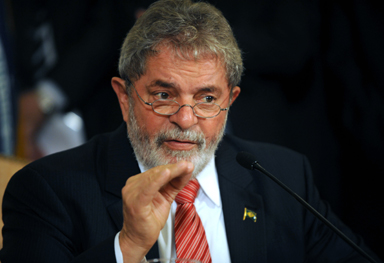
| "There are people who don't know how to do politics without having an enemy," said Lula, in reference to the US administration. |
|
BRASILIA - Brazilian
President Luiz Inacio Lula da Silva hit out at the United States
Thursday, challenging its muscular approach on Iran that sidelined
diplomatic efforts he made this week to resolve the showdown.
Newspaper columnists "say
that it was none of Brazil's business to be an intermediary with Iran.
But who said it was a matter for the United States?" he asked after
returning from an overseas tour that included Tehran.
"The blunt truth is, Iran is being presented as if were the devil, that it doesn't want to sit down" to negotiate.
To the contrary, said Lula,
"Iran decided to sit down at the negotiating table. It wants to see if
the others are going to go along with what (it) has done."
"There are people who don't know how to do politics without having an enemy," said Lula, in reference to the US administration.
The remarks to reporters in
Brasilia came three days after Lula and Turkish Prime Minister Recep
Tayyip Erdogan met with Iranian President Mahmoud Ahmadinejad in Tehran
to secure a deal meant to stave off UN sanctions the United States is
pushing for.
Initially hailed as
diplomatic master stroke, the deal fell by the wayside on Tuesday when
the United States submitted a UN resolution calling for a new round of
sanctions against Iran, saying the Tehran agreement was insufficient.
Brazil and Turkey, the two
non-permanent members of the UN Security Council most opposed to the
resolution, immediately sent a letter calling for the resolution to be
dropped and their deal to be considered.
Lula said he believed his contribution upheld the spirit of multilateralism.
"We went to Iran and we
succeeded, after 18 hours of meetings... to get Iran to do what the UN
Security Council had been asking it to do for the past six months," he
said.
He also highlighted the
case of a young French teacher, Clotilde Reiss, accused of being a
French spy by Iran, who was released to return home during his visit to
Tehran, although he stopped short of saying that was a bargaining chip
in the deal negotiations.
"We were talking for four and half months to get her freed. Nobody knew that, except us," Lula said.
Meanwhile, US Defense Secretary Robert Gates said Thursday that fresh UN sanctions would underscore Iran's isolation.
While previous UN
resolutions had failed to alter Tehran's policy, "the ratcheting up of
what other countries are willing to do on their own using the
resolution as a basis does have the potential to change behavior."
"If the resolution did not
have an impact in Iran, it's not clear to me why the Iranians would
have made -- are making and have been making such an extraordinary
effort to prevent it from being passed," Gates said.
"If it were irrelevant as
far as they were concerned, I don't think you'd see them expending the
kind of diplomatic and other kinds of energy to try and prevent its
passage."
The fourth round of sanctions would include measures against Iran's banking sector, according to a US official in New York.
Gates said "the resolution
provides a new legal platform that allows individual countries and
organizations, such as the EU, to take significantly more stringent
actions on their own that go way beyond, well beyond what the UN
resolution calls for in and of itself."
France expects a majority of the 15-member Security Council to support the resolution, diplomats said Thursday.
Middle East Online





 Print This
  Print This