Modern mobile phones offer basic web access that has the potential to accelerate social and economic change in the developing world, says the worldwide web inventor.
|
|
|
Tim Berners-Lee and British former Prime Minister Gordon Brown were at Geneva University on Wednesday to talk about the future of the web and its role in initiating change. |
After helping create the web in 1989 and guiding its technological development, the British scientist, who is director of the World Wide Web Foundation, is interested in expanding access to the 80 per cent of the world’s population who do not have access to the web.
The foundation is currently trying to help people in Africa, Asia and Latin America put useful local content in their languages on the web and access it via simple, ubiquitous, mobile phone technology.
“In Uganda even though there is no internet connectivity via cables, almost everywhere you go you have a signal on your mobile phone and the number of mobile phones is shooting up. So the question is how do we get the web to work on phones?” said Berners-Lee.
His organisation has piloted a web entrepreneur project in Ghana that teaches people to build simple websites that work on mobile phones. The initiative has now moved to Senegal and Kenya and the hope is to replicate it worldwide with minimum resources.
The aim is to encourage rural communities and the poor to create and gain access to useful education, health, weather, and market and business information.
“In rural villages where there is an option between developing web access and installing water pipes, I initially assumed that getting a PVC pipe was the first priority,” Berners-Lee noted.
“But people in the field told me that was naive as when you get internet connectivity people can get jobs that bring in money... that allow you to quickly acquire the pipe."
Infrastructure in place
Today, the minimum infrastructure required for providing mobile browsing is available. Some 95 per cent of existing phones worldwide have a basic browser or possibility to have one, and 90 per cent of the world is covered by a minimum GSM mobile telephone network.
“There is too much focus on broadband but today there are five billion mobile phones worldwide. We should focus on what’s available to make a difference rather than the next technology,” Stéphane Boyera, programme manager at the World Wide Web Foundation, told swissinfo.ch.
“What’s important is the content, services and information. We have to teach people how to develop HTML sites that fit low capacity browsers and bandwidth.”
It was also important to work on a low-cost pre-paid web access model for developing countries, he added.
Developing vision
Berners-Lee has a wider vision of what the web should become as it expands outside the industrialised world.
“The web is not just like a sophisticated TV where you read information, it has to be participative,” he said.
“What I would like to see is even in small communities with local dialects there are local web servers with local blogs and people are producing stuff and creating their own communities and being first-class citizens of the web.”
Alongside the mobile entrepreneur initiative, the foundation is also working on voice-based web access technology for people who may be illiterate and speak languages that do not yet exist on the web.
“If you look at Africa’s future development, yes it will need good trade relations, massive infrastructure investment and for us to honour our aid commitments, but it’s also true that Africa needs to have access to the newest and most innovative technologies,” said Gordon Brown, who recently joined the foundation board.
Human right
Brown is convinced of the benefits of internet access, which he considers a human right.
“Our ability to connect and communicate with each other, to form friendships and connections across the internet is an essential element for the creation of a global society where strangers see people as neighbours rather than people to be afraid of,” he commented.
As British prime minister, Brown had been instrumental in getting Berners-Lee to create Data.gov.uk, giving online access to a wealth of British public data.
After Britain, the United States and Canada, the foundation is working with Ghana, Colombia and Chile to open up public data with a view to boosting accountability, transparency and economic value.
Berners-Lee urged other countries, including Switzerland, to follow their example.
“By being open the government psychologically puts itself on the same side as the public,” he said.
Source: Swiss Info
Related





 Print This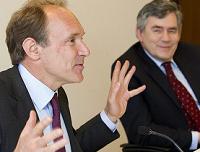
 Print This