 |
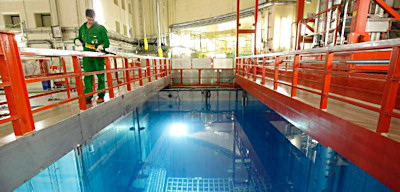
| A radiation protection worker walks over a bearing basin containing nuclear fuel elements at Germany's Biblis nuclear reactor. |
Angela Merkel's government has decided to phase out nuclear
power by 2022, in a reversal of its previous policy. German commentators
are split over the wisdom of the decision, with one newspaper comparing
the move to the fall of the Berlin Wall and another saying it will harm
future generations.
Angela Merkel's government has decided to
phase out nuclear power by 2022, in a reversal of its previous policy.
German commentators are split over the wisdom of the decision, with one
newspaper comparing the move to the fall of the Berlin Wall and another
saying it will harm future generations.
"This is nothing more and nothing less than a revolution in energy
supply," said Chancellor Angela Merkel. It was September 2010, and she
was referring to her government's newly minted energy strategy. That
plan included
extending the operating lives
of Germany's 17 nuclear plants, which had been scheduled to go offline
by 2021. All of this had been intended to help Germany meet its
ambitious goals for reducing climate-killing CO2 emissions.
But on Monday, less than nine months later, the German government
announced a new energy plan
that could also be fairly described as a revolution -- even if it
represents a 180-degree reversal of the administration's previous
policy.
In marathon talks that went into the early hours of Monday, the
government hammered out the details of its plans to phase out nuclear
power. The new strategy foresees all Germany's reactors going offline by
2021 if possible and 2022 at the latest. Eight plants which are
currently temporarily offline will be shut down immediately. The
phaseout will be accompanied by a massive increase in the use of
renewable energy, and the government intends to pass a law making it
easier to construct the new energy infrastructure that will be needed.
Merkel's
U-turn on nuclear power
happened in the wake of the Fukushima disaster, with the chancellor
quickly realizing the impact the accident would have on attitudes to
nuclear power in Germany. A majority of Germans oppose atomic energy.
'Great Opportunity'
The government's new plan is broadly based on recommendations by an ethics commission
that Merkel set up after Fukushima to study the future of nuclear
energy in Germany. Critics claimed that the chancellor only set up the
panel to lend legitimacy to her sudden about-turn on nuclear power,
which was widely seen as an electioneering tactic ahead of a key state
election.
The commission delivered its findings to the government on Sunday
afternoon, recommending that Germany phase out nuclear power by 2021.
The panel's final report was officially presented on Monday morning. The
head of the commission, former United Nations Environment Program
executive director and ex-German environment minister Klaus Töpfer, said
that the transition to renewable energy presented a "great opportunity"
for Germany to develop a sustainable economy. Speaking at the
presentation of the report, Merkel said the government would use the
commission's recommendations as a "guideline."
There is likely to be stiff opposition to the new nuclear roadmap.
German manufacturers and energy companies have already criticized plans
to phase out nuclear power, warning that Germany could face blackouts,
and utilities have threatened to take legal action against a withdrawal.
A spokesman for the energy giant RWE said that "all legal options" were
on the table.
On Monday, Germany's main newspapers take a look at the ethics commission's proposals and the coming energy revolution.
The conservative Die Welt writes:
"The nuclear phaseout marks a creeping rejection of the economic
model which has transformed Germany into one of the richest countries in
the world in recent decades. ... What will the new energy age cost us
Germans in terms of money and jobs? And are we completely indifferent to
the risk of a major power outage? Just recently, the Federal Office of
Civil Protection and Disaster Assistance warned that Germany is totally
unprepared for a large-scale blackout."
"It is certainly true that our economic system can survive without
nuclear power in the long term. But it is careless to carry out a
phaseout under extreme time pressure, rushing it through with scant
regard for how fast the economy can adapt. Energy is the lifeblood of
industry, which in turn is the basis of our economy and our prosperity. A
stable energy supply is taken for granted in Germany and is an
enormously important locational advantage when attracting foreign
investment. The mere impression that this supply is no longer 100
percent guaranteed would be enough to scare off investors."
"A look back at the oil crisis in the 1970s is enough to show how
sensitive the energy issue is. This time, however, it would not be the
whole world that has a problem, but only us Germans. The government
should be careful not to risk creating a homemade energy crisis on the
basis of politically expedient decisions."
The center-right Frankfurter Allgemeine Zeitung writes:
"The ethics commission had been given the task of 'reevaluating' the
risks of nuclear energy. But by 'reevaluate,' what was meant was that
the slightest possibility of a nuclear accident similar to the one in
Fukushima -- no matter how unlikely -- was now to be classified as
unacceptable. What is being ignored in the process is the fact that each
form of energy is associated with incalculable risks."
"It took humanity a hundred years to realize the dangers that burning
fossil fuels pose to the environment and to people's health. The
harmful effects of an overhasty energy revolution will be mainly felt in
economic and social terms -- and it is future generations that will be
affected."
The center-left Süddeutsche Zeitung writes:
"The ethics commission has looked far beyond the nuclear phaseout
itself. The group has focused less on shutting down reactors and more on
the process that such a phaseout would trigger. After all, simply
taking the nuclear plants offline is not enough by itself."
"In many areas, the experts have called for exactly those changes
which an energy transition would require: renovating buildings (to make
them more energy-efficient), the intelligent use of energy and the
construction of new power lines. This transition, not the nuclear
phaseout, is the real challenge for politics and society. The ethics
commission has highlighted the opportunities that the transition holds
for Germany as an industrial power, but it also shows the risks. If the
switch goes wrong, the nuclear phaseout will turn out to be very, very
expensive."
In an editorial titled "A Moment Like the Fall of the Berlin Wall," the left-leaning Die Tageszeitung writes:
"Usually one does not recognize historic moments if one is too close
to them. It's a label that should be used sparingly in any case. But
this is one: An industrialized country now has a roadmap for switching
to a sustainable energy supply, moving beyond dangerous and expensive
nuclear power and dirty coal. That has never happened before. It is a
step in the right direction -- and the world is watching."
"The interesting question is whether this government will take the
ethic commission's recommendations to heart. From a political and
economic perspective, the report gives it all the ammunition it needs to
act. In terms of domestic politics, Angela Merkel cannot retreat now,
given her sudden violent aversion to nuclear power. And the new
direction also makes sense in terms of party politics: Only a
business-oriented conservative government can pull off such a
revolution, because the loudest opponents are within its own ranks. ...
Only Merkel's center-right administration can phase out nuclear power
without Germany descending into a crippling conflict."
Der Spiegel





 Print This
  Print This