|
|
| The developing wasp bursts out through the ladybird's abdomen |
A parasitic wasp protects itself from predators while cocooned by turning its ladybird host into a "bodyguard".
After a female wasp injects its egg into the ladybird, the larva munches on its host's internal tissues before breaking out through the abdomen.
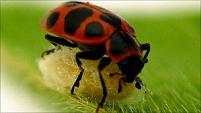
In some cases the partially paralysed ladybird remains sitting on the parasite as it spins a cocoon.
Researchers think venom from the wasp makes the ladybird twitch and grasp - warding off predators.
This uncharacteristic behaviour by the ladybird begins at the point that the parasite breaks out of its body.
Details of the work have been published in the Royal Society journal Biology Letters.
Jacques Brodeur, Fanny Maure and colleagues from the University of Montreal in Canada found that cocoons attended by a living ladybird were preyed upon significantly less by natural enemies such as the lacewing than did those that were alone or covered by dead ladybirds.
It'll cost you
However, by co-opting the ladybird into guarding its cocoon, the parasitic wasp Dinocampus coccinellae seems to incur a cost, the researchers found.
The parasite's need to sustain the spotted lady beetle (ladybird) Coleomegilla maculata, while it is on the cocoon and its need to develop eggs are competing demands - dependent on the same resources, argue the researchers.
|
|
| Unwilling bodyguard: lady birds "twitch" and "grasp" whilst sitting on the cocoon |
This in turn means that "guarded" wasps produce fewer eggs, though their longevity remains unaffected.
After injection into the ladybird, the wasp larva develops for 20 days within the host's abdomen. It then "egresses" and spins a cocoon between the ladybird's legs.
Writing in Biology Letters, the team from Montreal explained: "Both in the laboratory and under field conditions, we observed... the [ladybird], which is partially paralysed, displays a grasping behaviour on top of the cocoon and twitches at irregular intervals."
"We hypothesised that this attending behaviour results from host manipulation by the parasitoid to convert the ladybird into a bodyguard."
The exact mechanism used to manipulate the ladybird remains unclear, but the researchers surmise that it involves venoms left by the larva inside the ladybird's body.
Of the ladybirds converted into bodyguards by the wasps, the researchers found that about 25% recovered from the ordeal.
Source: BBC





 Print This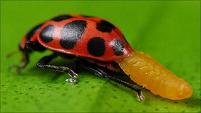
 Print This