A European proposal would designate fuel from tar sands as resulting in
22 percent more greenhouse gas emissions than that from conventional
fuels. But not if the UK has its way.
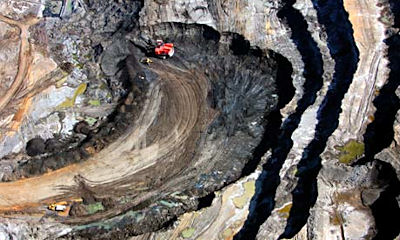 |
| Aerial view of Shell Albian mine north of Fort McMurray, Alberta, Canada. Photograph: Jiri Rezac/Jiri Rezac /eyevine |
The UK government has been giving secret support at the very highest levels to Canada's campaign against European penalties on its highly polluting tar sands fuel, the Guardian can reveal.
At the same time, the UK government was being lobbied by Shell and BP, which both have major tar sands projects in Alberta, and opened a new consulate in the province to "support British commercial interests".
At
least 15 high-level meetings and frequent communications have taken
place since September, with David Cameron discussing the issue with his
counterpart Stephen Harper during his visit to Canada, and stating
privately that the UK wanted "to work with Canada on finding a way
forward", according to documents released under freedom of information
laws.
Charles Hendry, the energy minister,
later told the Canadian high commissioner: "We would value continued
discussion with you on how we can progress discussions in Brussels,"
with Hendry's official asking the Canadians if they had "any suggestions
as to what we might do, given the politics in Brussels".
Canada's vast tar sands – also known as oil sands – are the second largest reserve of carbon in the world after Saudi Arabia, although the energy needed to extract oil from
the ground means the process results in far more greenhouse gas
emissions than conventional oil drilling, as well as causing the
destruction of forests and air and water pollution.
Nasa scientist James Hansen says if the oil sands were exploited as projected it would be "game over for the climate".
The
European proposal is to designate transport fuel from tar sands as
resulting in 22% more greenhouse gas emissions than that from
conventional fuels. This would make suppliers, who have to reduce the
emissions from their fuels by 10% by 2020, very reluctant to include it
in their fuel mix. It would also set an unwelcome precedent for Canada
by officially labelling fuel from tar sands as dirtier.
The
UK and Canada's shared opposition to the European plan puts the UK in a
minority among EU countries and will be deeply embarrassing as a new
round of global negotiations on tackling climate change begins in Durban, South Africa on Monday. Chris Huhne, the energy and climate change secretary, claimed on Thursday that the UK was showing "leadership" in the UN negotiations, while Canada's prime minister has blocked climate laws. The revelations are also the latest blow to Cameron's claim to be the "greenest government ever".
The vote to approve the European fuel quality regulations takes
place on Friday. In advance of that, William Hague, the foreign
secretary, has also given support to Canada, sending an "immediate
action" cable in September to the UK's embassies there asking "to
communicate our position and seek Canadian views on what might be
acceptable".
However,
the Department for Transport, in which the [British] Liberal Democrat minister
Norman Baker has responsibility for tar sands issues, has released only
two presentations made to it by Shell, both heavily redacted. The DfT
rejected requests to release at least six other relevant documents on
the grounds of commercial confidentiality and adverse effect on
international relations, as did the Department for Business, Innovation
and Skills (BIS), where Shell also met ministers.
BP has lobbied ministers, too. Its vice president in Europe,
Peter Mather, has been, in his own words, "bending the ear" of Baker.
Mather also sent a letter in which he wrote: "The regulatory burden
would be considerable at a time when the industry is already creaking
under the weight of a heavy regulatory regime."
John Sauven, executive director of Greenpeace UK,
said: "The scale of oil industry lobbying exposed in these documents is
quite extraordinary. It's especially worrying that Baker held a secret
meeting with Shell about this key European vote on tar sands. But worse
still, he's now covering up what was discussed."
Colin Baines, toxic fuels campaign manager at the Co-operative,
the UK mutual business group which targets tar sands as part of its
climate change campaigning, said: "It is very disappointing that the UK
government is supporting Canada's efforts and we hope it has a rethink
and puts tackling climate change ahead of Canada's trade interests when
it comes to vote on the European commission's commonsense proposal."
The documents were obtained by the Co-operative under environmental information regulations,
a type of freedom of information law. They include letters to and from
ministers, diplomatic correspondence and notes of meetings.
Baker
said: "The government is staying true to its aspiration to be the
greenest ever by seeking to secure the best deal it can for the
environment from the discussions ongoing in the EU about the fuel
quality directive.
"We
believe that means tackling all highly polluting crudes equally, not
simply oil sands from one particular country. These certainly represent a
problem, but so do other crudes, and it makes no environmental sense to
ignore these.
"This
is not about protecting one particular country – we want to deal with
all crudes, not just one type, and in a way that is based on robust and
objective data, related to their carbon emissions."
Like
Baker, Canada also argues in the newly revealed documents that it is
unfair to single out one nation and that other types of oil can be as
dirty as tar sands.
But Baines says these arguments are "myths", as the European proposal does not name any nation and on average fuel from tar sands is a greater source of carbon by a clear margin, according to a Stanford University study for the European commission.
Furthermore, the European commission proposal allows for changes in the emissions designated for fuel types.
Canadian ministers and diplomats state they support an "overarching ambition" to reduce carbon emissions. But Canada has admitted it will fail to meet its Kyoto protocol target of a 6% cut compared with 1990 levels: in 2009 its emissions were 34% higher.
In September, Lord Sassoon, the UK Treasury minister for commerce, spent two days in Calgary, a few hundred miles from the vast oil sand pits excavated
by 1,500-tonne diggers. The International Energy Agency expects
production to treble in the next 20 years. Sassoon met politicians and
oil executives to discuss boosting trade with the UK and told reporters
that Alberta is "one of the main focuses of British business". Alberta's
energy minister, Ron Liepert, told Sassoon privately he "was grateful
for UK efforts" on the tar sands issue in Europe.
The
new British consulate-general in Calgary was announced by Hague on 18
October, the same day as Canadian energy minister Joe Oliver said: "[The British] have been very, very helpful and
we're pleased about that. Many European companies are heavily invested
in the oil sands and they also would be concerned." The new documents
and diplomatic sources suggest the Netherlands, Spain and Poland are
among those backing the British-Canadian position.
In
London, a senior Canadian diplomat, Sushma Gera, told BIS: "Canada will
not hesitate to defend her interests," perhaps via a World Trade
Organisation dispute, a possibility also raised by Shell in its
presentation to DfT.
Bill McKibben, a leading US environmentalist, who was arrested in August protesting against a major oil sands pipeline called Keystone XL said:
"The UK seems to have emerged as Canada's partner in crime, leaning on
Brussels to let this crud across the borders. This will be among the
biggest single environmental decisions the Cameron government makes."
Greenpeace's
Sauven, along with the head of Friends of the Earth, Andy Atkins, and
David Nussbaum, leader of WWF-UK, have written to Nick Clegg, deputy
prime minister and Lib Dem leader.
The
letter says: "We ask you to intervene personally on this, to ensure
that your party's green ambitions are more effectively upheld across
Whitehall."
Source: The Guardian via Alternet





 Print This
  Print This