2 Interviews of Dr. Webster Griffin Tarpley by Press TV on Syria and Iran. Russia's Role and the 30 nation conference in Teheran.
Print This
By Dr. Webster Griffin Tarpley (Press TV). Axis of Logic Commentary.
Axis of Logic. Press TV.
Wednesday, Aug 15, 2012
Editor's Introduction: Press TV interviewed Webster Griffin Tarpley twice this month on the question of a military bombing and invasion against Syria by the United States, Israel and their European co-horts. The first interview took place on August 6 and the second on August 12. In the first interview, Press TV and Tarpley discuss the key role of Russia and President Putin in the threatened invasion.
"The last report we had was 11 warships dispatched to the Eastern Mediterranean and the Tartus region. There was another report in the last day or two of three more Russian warships with 360 marines on board sent to Tartus that was then officially denied but one does wonder the important thing.
"I think with the Russian presence is that it’s incalculable, it cannot be predicted. President Putin is a strong leader; he is really the heart and soul of this entire international opposition. The west, the NATO powers would like to attack Syria right away but they have a feeling that Putin will find a way to retaliate.
"They don’t know how, they don’t know where, when - I don’t think anybody knows but it might be a retaliation that would be very uncomfortable, very painful for the Western powers and I think that’s what’s holding this situation together, otherwise we’d be going into a regional war already."
In the second interview Tarpley discusses the August 11 meeting of 30 countries in Teheran, including Russia, China and Pakistan, as a credible block to thwart the invasion threatened by US Secretary of State, Hillary Clinton:
30 Nations met in Teheran on August 11 to discuss the crisis in Syria, instigated by the US and Israel.
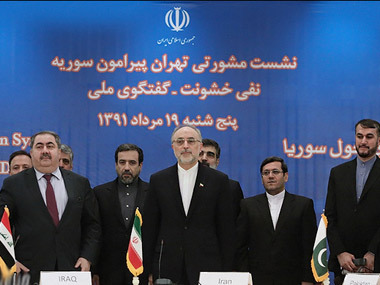
Background on the Teheran Meeting: F.Allafi/Mazen Eyon, writing for SANA, the Syrian Arab News Agency provides more background on the Teheran conference. The Iranian Foreign Minister Ali Akbar Salehi explained the purpose of the conference and the need for a sane, international discussion to resolve the crisis peacefully:
"The consultative meeting which was held in Tehran today aimed at reinforcing the efforts which seek to offer support to the Syrian people in order to end this crisis and find a fit ground to hold the dialogue within calm atmospheres."
Salehi emphasized that Iran's policy regarding Syria has supported a peaceful political solution based on dialogue and understanding:
"Iran welcomed and backed the efforts of the UN and the plan of the UN envoy to Syria Kofi Annan with its six-points ... The unilateral steps and the continuation of intervention in Syria's affairs, according to Annan's opinion, prevented his plan from continuation to tackle the situation ..."
The Iranian Foreign Minister also addressed the armed terrorist groups leading the attack against the Syrian government and Teheran's effort to meet with both sides of the conflict:
"The participants condemned this act and called on the world states which can play a role in this domain to do so and exert their efforts to release the visitors abducted in Syria... Tehran held contacts with the two sides... the government accepted, and appointed Minister Ali Haidar who showed willingness to come to Iran and hold dialogue with the opposition in case it agreed."
Finally, FM Salehi added, "Some states claim they are neutral, but they interfere in the Syrian affairs."
In his second interview with Press TV, Tarpley describes the Teheran conference:
"I think the big turning point actually occurred yesterday. The Tehran consultative conference on Syria, it seems to me, is a landmark event in our times. 30 countries coming together on the basis, I would say, of national dependence and national dignity.
"Not much more than that but that’s already a lot in today’s world, and certainly organized by the Iranian foreign ministry with the presence of Russia, China, India, Indonesia, Pakistan, Kazakhstan, Venezuela, Sudan, a very important selection of countries across the world.
"It obviously shows that Syria is not isolated in a way that Hillary Clinton says. This is really the first time that we’ve had a kind of task-oriented, anti-imperialist conference.
"It’s very interesting here in the United States, the media has not a word about this. It’s a complete blackout. I’ve looked at the Washington Post, the Wall Street Journal, the television stations, there’s nothing about this conference.
"I think the US State Department is freaked out because this is a huge defeat for Hillary Clinton. What is Hillary Clinton’s diplomacy worth if 30 countries including about half the world when you get down to it, can come together on a pro-Syrian, pro-independence platform?
"It seems to me that the imperialists are probably getting desperate. This is of course the classic time when they resort either to some kind of Gulf of Tonkin incidence, something military, or the classic false flag that we’ve seen them play so many times."
There is much more to consider in the details provided in these interesting interviews with Dr. Webster Griffin Tarpley.
- Les Blough, Editor
Axis of Logic
Tarpley: GA resolution on Syria height of hypocrisy; Putin heart and soul of international opposition
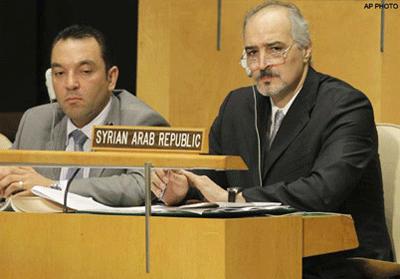
Photo: Syrian UN ambassador Bashar Ja’afari, right, during the UN General Assembly at the UN headquarters in New York, Aug. 3, 2012.
6 August, 2012 - PressTV has conducted an interview with author and historian, Webster Griffin Tarpley, to further discuss the issue. The following is a rough transcription of same.
Press TV: Dr. Tarpley, first of all what do you make of the situation in Syria, how worse can it get?
Tarpley: Well, I guess it can get significantly worse and certainly the events at the UN general assembly now have not helped matters. I would point out that this resolution was actually written by the Saudis, written by Saudi Arabia, unbelievable piece of hypocrisy.
I don’t know how they can do this with a straight face - an absolute monarchy, a relic of feudal barbarism, one of the most backward regimes in the world is going to give lessons to Syria - a much more advanced country.
I think this is absolutely absurd. This was also made possible by the president of the United Nations general assembly who is from Qatar. He represents the royal family there, the Thanis.
The other thing of course is the way that the resolution is written as Russian Ambassador Churkin said, it’s completely one-sided. The resolution reads as if there is no armed opposition; the armed opposition simply does not exist; there are no death squads, no terrorists; it’s just peaceful unarmed protesters - quite fantastic. This makes everything worse.
But before the US gloats too much over this result, let’s just look at some of the internals of that vote if we could. 133 countries voted for it, lots of banana republics can be induced to vote for just about anything but you had twelve countries against it, you had 31 abstaining, including India and Pakistan, large important states and then you had 17 countries that just didn’t show up; they ducked the vote; it was too wrenching for them.
We can assume that they’re not too happy with this resolution. So what you’ve got out of the 193 member states is about one third against it; two thirds for it and the ones that are against it are against it I think with much more conviction.
That would again be Russia, China, Iran, Venezuela - these are important influential states - North Korea, Syria, Belarus, Cuba, Bolivia, Nicaragua, Burma and Zimbabwe. So that is certainly not a coalition to be sneezed at and I don’t think the US can gloat too much if you think about the population of the countries that were unable to support the resolution since you’ve got China and India there and Pakistan and some other big ones.
You get up to I think about 40 percent of the world’s population is against this resolution. So that’s not really one-sided. Syria is not isolated.
Press TV: Indeed, we have several key players in this Syria scenario just to mention Turkey, US and its allies but I’d like to know what role does the Iraqi Kurdistan play in here. We have the Turkish foreign minister recently going there?
Tarpley: Well, we’ve looked at Turkey over the past week as a country that’s losing a sense of reality, that is the leadership group around Erdogan and Davatgulu have lost contact with the strategic premises that have made Turkey a successful country. These were laid down by Ataturk after the First World War. You can’t be an empire, you better be a national state; don’t go meddling in the internal affairs of other countries.
So Turkey is poised I’m afraid to pay a terrible price and we have to look at Saudi Arabia, here in the United States we’re going through the 150th anniversary of the civil war that took place here, right around Washington among other places and what we’ve found was that in the second year of the civil war it got much more radicalized and I think that’s what’s happening in the Middle East.
In particular the House of Saud taking this prominent role now as the champions of democracy, are they not risking a very substantial blowback? We’ve also got the local paper in Aspen, Colorado wondering what is the fate of one of their most famous residents, Prince Bandar of Saudi Arabia who owns a condo in Aspen, who hasn’t been seen for the last week or two. There are reports that he succumbed to an attack on his headquarters.
When we look at the ferment in Saudi Arabia around Qatif, when we look at the agitations continuing in Bahrain, we might say that there is a very good potential that these Gulf monarchs that have been so eager to meddle and interfere in Syria and other countries, they may soon find themselves very busy at home defending the existence of their dynasties, which I think are likely to come under attack as this crisis is driven to a more and more radical form.
Press TV: We’ve seen that Russia has been a key player in this scenario. How much do you think Russia will get physically involved in this case?
Tarpley: This is hard to say. The last report we had was 11 warships dispatched to the Eastern Mediterranean and the Tartus region. There was another report in the last day or two of three more Russian warships with 360 marines on board sent to Tartus that was then officially denied but one does wonder the important thing.
I think with the Russian presence is that it’s incalculable, it cannot be predicted. President Putin is a strong leader; he is really the heart and soul of this entire international opposition. The west, the NATO powers would like to attack Syria right away but they have a feeling that Putin will find a way to retaliate.
They don’t know how, they don’t know where, when - I don’t think anybody knows but it might be a retaliation that would be very uncomfortable, very painful for the Western powers and I think that’s what’s holding this situation together, otherwise we’d be going into a regional war already.
Tarpley: 30 Nations Meet in Tehran for Alternative to Hillary Clinton’s Attack on Syria
12 August, 2012 - PressTV has conducted an interview with Dr. Webster Griffin Tarpley, author and historian, to further discuss the issue. The following transcript is taken from Voltaire Network where it is described as "a rough transcription of the interview."
Press TV: France is the first country to officially commit its military to the Syria situation. Is this a parallel to the role France played in Libya?
Tarpley: President Hollande has been a target of a very vigorous campaign by the reactionaries and colonialists in France, people around Sarkozy and including Sarkozy himself, demanding that Hollande take the lead as the aggressor in Syria. I think it’s a kind of a desperation tactic to keep something going when it’s not going.
Today we’ve had Hillary Clinton visiting Turkey. In her meeting with Foreign Minister Davutoglu, they talked about a no-fly zone that the United States and Turkey, perhaps with other countries, would somehow try to impose a no-fly zone over Syria which, of course, would mean a war.
Brennan, the anti-terror Czar of the Obama White House had talked about a no-fly zone earlier this week at a meeting of the Council on Foreign Relations. It’s not clear whether that’s just talk, whether that’s bluffing. Given the track record of these people, we would have to take it very serious, indeed.
Press TV: On another front, the US secretary of State Hillary Clinton has come out saying Washington and Ankara are working on a detailed military and intelligence operation hopefully to bring a regime change in Syria. Do you think it’s going to work?
Tarpley: No, I think this is a somewhat desperate plan now.
I think the big turning point actually occurred yesterday. The Tehran consultative conference on Syria, it seems to me, is a landmark event in our times. 30 countries coming together on the basis, I would say, of national dependence and national dignity.
Not much more than that but that’s already a lot in today’s world, and certainly organized by the Iranian foreign ministry with the presence of Russia, China, India, Indonesia, Pakistan, Kazakhstan, Venezuela, Sudan, a very important selection of countries across the world.
It obviously shows that Syria is not isolated in a way that Hillary Clinton says. This is really the first time that we’ve had a kind of task-oriented, anti-imperialist conference.
It’s very interesting here in the United States, the media has not a word about this. It’s a complete blackout. I’ve looked at the Washington Post, the Wall Street Journal, the television stations, there’s nothing about this conference.
I think the US State Department is freaked out because this is a huge defeat for Hillary Clinton. What is Hillary Clinton’s diplomacy worth if 30 countries including about half the world when you get down to it, can come together on a pro-Syrian, pro-independence platform?
It seems to me that the imperialists are probably getting desperate. This is of course the classic time when they resort either to some kind of Gulf of Tonkin incidence, something military, or the classic false flag that we’ve seen them play so many times.
Press TV: Of course, Libya did not have this support in the situation at the time. However, how can one explain the US double standards on Syria compared with its role in Bahrain and Yemen? Why is the Western public opinion silent on the atrocities committed against the civilians by the so-called Free Syrian Army, in your opinion?
Tarpley: I don’t think there’s total silence here in the West. I think there’s an awareness and it’s a growing awareness. Obviously, the first part of your question, this is hypocrisy.
What I think we’re getting towards now is a situation where you have to frankly admit there are two blocks of states. There’s an imperialist block with the US, the British, NATO, the Israelis and so forth; but then there’s an anti-imperialist block which is very large and quite formidable when you’ve got Russia, China, India, Pakistan, Indonesia. That’s already a great deal.
Let me also focus on the Pakistani Foreign Minister, Mrs. Khar, who I think made a landmark statement of her own: it’s time now to reject, very categorically, any idea of foreign intervention into Syria.
This leaves the US in a terrible predicament. We have to see how they’re going to get out and it might be some ugly surprises.
If you appreciated this article, please consider making a donation to Axis of Logic.
We do not use commercial advertising or corporate funding. We depend solely upon you,
the reader, to continue providing quality news and opinion on world affairs.Donate here





 Print This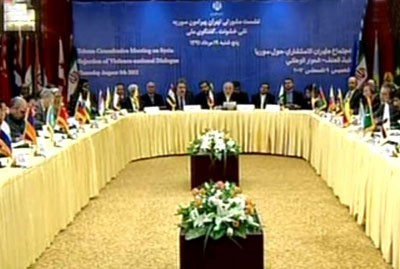
 Print This