Spain protesters clash with riot police in Madrid
Print This
By Paloma Corredor
VOXXI
Friday, Sep 28, 2012
A demonstrator sprays “Police kills” during a march to the Spanish Parliament against the austerity measures announced by the Spanish government in Madrid, Spain, Tuesday, Sept. 25, 2012. The government was hit hard by the country’s financial crisis on multiple fronts Tuesday as Spain protesters enraged with austerity cutbacks and tax hikes clashed with police near Parliament, a separatist-minded region set elections seen as an independence referendum and the nation’s high borrowing costs rose again. (AP Photo/Daniel Ochoa De Olza)
Read more: http://www.voxxi.com/spain-protesters-police-madrid/#ixzz27lWPoM7J
On Tuesday, September 25, Spain protesters marched on the Spanish parliament in Madridcalling
for an end to austerity measures and demanding that Spain’s central
Conservative government resign. The initially peaceful demonstration
however turned violent when some indignados or protesters tried
to tear down barricades and began to throw rocks at police. They
responded firing rubber bullets and beating protesters back with
truncheons.
According to latest reports, a total of 64 people were left injured, including 27 police officers, and a total of 35 arrests were made.
Spain protesters, called the demonstration “25-S, Surround the Congress.” They began with a massive march, announced days earlier by the platform ¡En Pie! (Stand Up) to protest against budget cuts
and demand that the conservative Partido Popular government of Prime
Minister Mariano Rajoy resign. In the anticipation of conflict by
protesters a total of 1300 officers were drafted in to police the march.
The rift between people and government
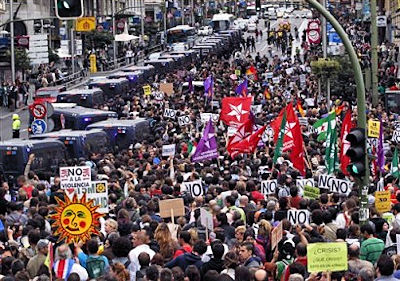
Spain protesters march to the parliament against austerity measures announced by the Spanish government, in Madrid, Tuesday, Sept. 25, 2012. (AP Photo/Andres Kudacki)
Read more: http://www.voxxi.com/spain-protesters-police-madrid/#ixzz27lWUHN28
The government’s delegate in Madrid, Cristina Cifuentes congratulated
the National Police “because they showed professionalism during
difficult times.” The Department of the Interior, in turn blamed the
incidents on “extreme violent demonstrators.”
While thousands of people (about 6,000 Spain protesters according to Cifuentes) took the center of Madrid for the second time in two months, parliament continued with its planned plenary session inside the Congress building as if nothing was happening outside. Spain’s President Mariano Rajoy was out of town—in New York to attend the 67th UN General Assembly. He was not however entirely shielded from events in Madrid. Argentinian Premier Cristina Fernández took the opportunity to publicly denounce “police brutality” in his presence.
Spain protesters here to stay
Spain protesters were hit by rubber balls shot out by Spanish Police during riots after demonstrators marched to the Spanish Parliament against the austerity measures announced by the Spanish government in Madrid, Spain, Tuesday, Sept. 25, 2012. The government was hit hard by the country’s financial crisis on multiple fronts Tuesday as Spain protesters enraged with austerity cutbacks and tax hikes clashed with police near Parliament, a separatist-minded region set elections seen as an independence referendum and the nation’s high borrowing costs rose again. (AP Photo/Daniel Ochoa De Olza)
Read more: http://www.voxxi.com/spain-protesters-police-madrid/#ixzz27lWgT75m
Demonstrations in front of Congress are prohibited in Spain when
parliamentary activity is taking place, so a large police security
operation is to be expected. It’s also true to say that a small number
of violent radicals are almost bound to take part and fuel an atmosphere
of violence.
Far from displaying a minimum of understanding, Partido Popular
members are attempting to “criminalize” the protestors. Opposition
political parties PSOE and IU have described the controls of the
protests as “repressive”, “disproportionate” and even “excessive”. The
protests look like they are here to stay. Organizers have called for a return after 24 hours to one of Madrid’s main squares, just yards from Congress.
Hunger and austerity?
The violence on Tuesday comes ahead of a new round of austerity measures that will be announced on Thursday. The measures are being demanded by the European Commission and linked to a potential bailout that Madrid will probably request soon.
In the meantime, public discontent keeps growing after four years of economic recession and unemployment at nearly 25 percent.
The government continues to cut jobs, salaries, pensions and benefits.
The result? For now there is no sign of an economic recovery.
This Monday, The New York Times featured a photo essay entitled In Spain, austerity and hunger,
including 15 shocking images by Spanish photographer Samuel Aranda,
winner of the World Press Photo 2011. The images include people
searching for food in trash bins and families dealing with evictions.
Are things really that bad in Spain?
Anyone would say “yes”, watching the news or reading reports by the
national Catholic charity Caritas saying that it had fed more than one
million hungry Spaniards in 2011.
The picture though is not uniform. Walk around Madrid on any day of the week and you´ll see that shops, bars and restaurants are full.
You can hear people talking about the recession everywhere but it seems
that many Spaniards still have enough euros in their pocket to enjoy a pincho de tortilla and a good glass of Rioja.
Yes, there are many homeless people around. If you sit down on a
terrace, you can easily be approached by five of six beggars in one
hour. And it’s true, more and more people are searching for food outside
supermarkets. But I have seen many more homeless people in New York or
Los Angeles, where downtown is taken over by indigents every evening.
Things are bad, but… not that bad. The black economy and the support of families are contributing heavily to a true disaster being averted. Almost
50 percent of young people are unemployed. But this is Spain. Most of
these young people are still living with their parents at 30. They will
in turn become their parent’s carers when they grow old. After all, we
are a Latin culture, governed by the rule of “Donde comen dos, comen tres” (Where two eat, there’s enough for three).
Call it Spanish solidarity. Well, for now it’s working.
Watch the video of Spain’s protesters clashing with riot police in Madrid
If you appreciated this article, please consider making a donation to Axis of Logic.
We do not use commercial advertising or corporate funding. We depend solely upon you,
the reader, to continue providing quality news and opinion on world affairs.Donate here





 Print This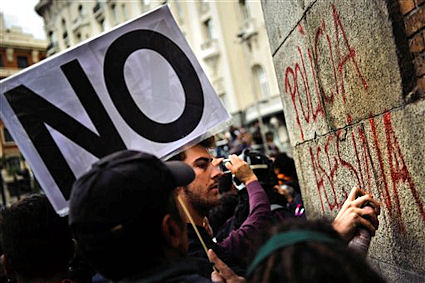

 Print This